Evangelicals Need to Sit in a Room and Say Nothing for a Long Time

chair-prayer

I solve most of the world’s problems right before I go to bed. It’s true. Ask my wife. I have so many amazing ideas, and she gets to hear all of them right before she falls asleep.

I recently solved the central problem with my evangelical tribe.

You know us, we’re the people who claim to have the “good news” and then we basically spend a lot of time worrying about being damned to hell, praying enough, proving ourselves worthy of God, proving we hold “sound” doctrines, defending those sound doctrines from atheists and “liberals,” fearing the fiery destruction of the world, and jumping into the political fray as if the death of America is the same thing as the death of God.

Evangelicals are anxious. We are anxious people who need to sit in a room and say nothing for a long time.

We fill concert venues with blaring worship music and shout, “Come Lord, Come! Come! COME!!!!”

We study, study, study the Bible.

We serve and minister and volunteer.

And then? The crash. So many of us crash and burn with our anxious, hard-working faith. I gave myself to all of this. I’m an evangelical who studied, served, worked, and defended, and all I got was a lousy crisis of faith. Almost every evangelical I know has had a crisis of faith in their 20’s or 30’s. Those who haven’t had a crisis of faith yet are the ones who could really use it the most.

Sure, we trust that Jesus has saved us by faith and grace, not by our own merits. But then we expend SO MUCH energy working and worrying in order to prove that profession is true. We struggle with holy living. We wonder if the defenses for the Bible will be enough to shore up faltering faith. And most importantly, we lose our ever-loving minds because God feels so distant and silent.

So we study harder, we worship with even more passion than the trademarked PASSION events, and we plead and beg with God: “Please show up. Please tell me that you’re real. Please tell me that the years of guilt, shame, repression, and fear were worth something.” Something has to give.

Some snap out of that phase, and realize that the game is over. God isn’t real. How could he be? What God would want people to live with such fear, misery, and uncertainty?

Others harbor those doubts, fears, and illusions, but they stick with the practice of their religion. Jesus matters so much to them. They want the story to be true. They want to believe that God is somehow involved in the world, but they simply can’t figure out how to find that God. They settle for mystery, but end up living without any search for or experience of God.

There’s another option that takes the beliefs and, don’t miss this word, practices of historic Christianity seriously. In fact, the problem that plagues evangelicals today may best be described as a selective amnesia. We have fought tooth and nail to uphold the scriptures and doctrines that the early church passed on to us, but we couldn’t give a flying fig (that’s an evangelical swear word) about the practices of the early church.

There is a stream of Christianity that takes the foundational teachings of our faith seriously—so seriously that they are viewed as givens—without devoting our entire lives to defending them from skeptics. This is the contemplative stream that pre-dates the canon of scripture. This stream has been practiced in quiet and solitude, as well as in cities and small towns. It has driven some to serve actively and it has driven others deeper into the desert. Ironically, those who traveled the furthest into the desert were eagerly sought out by many from the cities. These desert contemplatives exercised tremendous influence and their words remain powerful, relevant, and formative until this day.

The contemplative stream of Christianity tells us to sit in a room by ourselves and to be quiet for a long time. It challenges evangelicals to consider how much we’ve become like the ecstatic prophets of Baal who shout and dance and make a tremendous scene before an unseen god while Elijah watches with quiet confidence.

Evangelicals, we have a lot of good things going for us, but underneath all of our media empires that promise to defend us from the big bad world, our universities that continue edging toward sheltered fundamentalism, our large churches packed with programs and offices (not with prayer chapels), and our deeply flawed hero-worship and business-influenced leadership culture, there is a deep need for the loving search for God. By and large, we are not known as people who love.

I know that “love” is my deepest struggle. How do we generate love for God? How do we love people?

If Jesus’ two most important commands are to love God and to love my neighbors, if Paul said everything he does is “shit” (that’s only a translation of a Greek swear word, so we’re cool) without love, and if the apostle John used love as the only measure that matters, then our disconnect from love has to be addressed.

So far as I can tell, I have found love so difficult because I have been cut off from the source of love. This brings us back to our quiet room where evangelicals need to sit and say nothing for a long time.

The contemplative stream echoes the Psalms that tell us to wait on the Lord, to wait in silence.

For being people who love the Bible, cherish the Bible, defend the Bible, and who attack people who don’t love, cherish, or defend the Bible as much as us, evangelicals do a pretty terrible job of actually believing what the Bible says about God’s love.

I know this first hand because the foundational teachings of contemplative prayer are two things that are both very true in the Bible and very hard for evangelicals to believe:

  1. God is here.
  2. God loves you.

Evangelicals could spend years digging up scripture verses to disprove the very two things that we have longed to know all of our lives. This is why we need to sit in a room all by ourselves and say nothing for a long time.

We need to make a space to become aware of God and of God’s love. This isn’t necessarily a space for epiphanies or visions or amazing spiritual encounters. In fact, the contemplatives warn us that desiring spiritual encounters or amazing visions could become quite dangerous, as they can be self-serving and manipulative toward God. We begin to crave validation and experience over choosing to rest in the truths that God is here and God loves us.

This is a far cry from the anxious, hard-working evangelical subculture. Evangelicals don’t have language for a dark night of the soul. We can only think of ways to shine “light” into a dark night of the soul. When we are given the option of silence before God, we are quick to quote scripture and to begin another freestyle, “Lord we just…” prayer.

We desperately need silence. We need to learn what it means to abide. We need to learn what it feels like to finally be still before God for a long time.

This is the path we walk by faith. This will take all of the faith that we can muster.

I have taken a long, winding path into contemplative practices. They were the only things I could hold onto when my evangelical faith crashed and burned. I spent years worrying that they didn’t work, that God wasn’t real, or that I had somehow alienated myself from God. I freaked out because nothing was happening. I have since learned that this is by and large the point.

People who abide and live by faith don’t need God to constantly poke them in order to prove that he’s real. It took years of learning to search for God before realizing that I’d already been found. I couldn’t make God any more present. I couldn’t plead with God to be with me more than he already is. I couldn’t say anything to make God love me more. I couldn’t add any spiritual practices that would change the way God loves me.

I am loved and you are loved right now. This is the deep, abiding mystery of our faith. This is a truth that can revolutionize our lives.

This love of God is so deep and unfathomably wonderful that the only appropriate response is to sit in a room and say nothing for a long, long time until we accept that God is here and God loves us.


Read More about Contemplative Prayer…

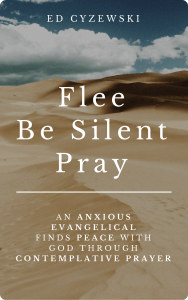
Based on my own resistance to and experiences with contemplative prayer, I’ve written an introduction to this historic Christian practice. The book is titled:

Flee, Be Silent, Pray:
Ancient Prayers for Anxious Christians

On sale for $8.49 (Kindle)

Amazon | Herald Press | CBD
Artboard 1FBP Blog Footer post release

People Are Expendable: My Root Struggle with Church

home-flowers

Growing up with divorced parents prompted me to become a reconciler who desires nothing more than making sure everyone gets along. Underneath this way of functioning day to day, I’ve absorbed an underlying fear of the fragility of relationships. I know that things can fall apart dramatically and horribly, and even the most basic things like your family and your home could be taken away from you, either by your family themselves or by a judge.

My two sons enjoy peace and stability where the foundational issues of their parents, their home, or their future are as solid and steady as can be. I write that without judgment of my own history, but there’s no mistaking that the things I worried about and feared as a child are completely different from anything my kids have faced so far. They have a stability that comes from knowing these relationships are steady, permanent, and secure. When I developed nervous ticks in elementary school and continue to struggle with talking fast when my social anxiety kicks in, it’s hard to communicate all of this succinctly to people who say things like, “What’s wrong with your eyes?” or “What? WHAT? I have no idea what you’re saying.”

“Oh, I just spent the first 15 years of my life fearing that a judge would take away everything that I love.”

When it comes to the stability of family, our closest relationships, and our homes, their security, or lack thereof, can underpin so many of our struggles and fears. These are also some of the core issues behind why so many people struggle to commit to a church or feel like they can never return again after a church let them. Issues of control and rejection are a big part of why I still can’t attend a Catholic mass with any measure of freedom or openness.

Put bluntly: in many churches, the people are expendable.

The reasons why people become expendable vary, but the common traits between the churches where I have felt secure and able to belong vs. the ones where I have not have tapped into this deeper need to know that I am not expendable. Those who struggle to belong in churches often sense that they are in some way expendable.

Just as I feared saying the wrong thing in front of my parents, a judge, a lawyer, or a psychologist, churches can foster atmospheres of fear, suspicion, and defensiveness where everything can change after supporting the wrong doctrine or admitting to a particularly taboo action.

Extreme situations aside (such as those involving criminal activity), I wonder if our core problems in the church boil down to how welcoming we are prepared to be. Or more to the point, under what circumstances will we kick someone out of a church or make him/her/they feel unwelcome?

I have seen friends who attend fairly conservative churches with strict doctrinal statements, and these friends struggle mightily because “belonging” means they need to sign documents, take classes, and jump through various hoops in order to be a part of the group. In other words, the message is that being part of the community or even the “family” is contingent on putting a signature on a list of doctrines. If you can’t sign the doctrinal statement, then you aren’t fully a part of things.

The doctrines are essential for churches, but the people are not.

However, these aren’t problems isolated to conservative churches. Anytime a group of people gathers together to form an organization, there is an inevitable struggle to define insiders and outsiders. Those who say the wrong things in a liberal congregation can just as easily be labeled and dismissed.

As our family prepares to move to a new city, we’re going through the rather agonizing process of researching churches in the area. The stakes feel especially high since we have kids who have a very particular, and overall positive, experience of church that is noisy, joyful, and full of freedom to be themselves.

The question I keep returning to about each church is how expendable we would be if we entered into their little subcultures.

Will they value particular doctrines over us when they learn what we believe?

Will they value a quiet service over seeing my son jump around with joy in front of the band?

Will they require signatures on documents and covenants and statements over sharing in our joys and struggles?

Will they demand commitment and service before they even think of inviting us to their homes for a meal?

These tensions may appear to be false dichotomies. Perhaps reading this you think to yourself, “Our church values people AND doctrines!” That could be the case, but what happens when the rubber really meets the road? I admit that I have struggled with this myself. Where would I draw the line personally with someone? Of course there are situations where boundaries are necessary. However, what does it look like to hold out compassion and mercy for people outside of the boundaries set by our faith communities?

I have seen good people in both liberal and conservative denominations fracture when someone comes along who doesn’t fit the mold.

We all long to fit in, to become a part of the group, and to be accepted as who we are. If we make enough investments in relationships, there may even be grace for messing up or believing “the wrong thing.” I suppose the question becomes where that grace could run out. Can grace and goodwill be exhausted or negated?

I have dedicated the spirituality of my 30’s to rediscovering the God of the Bible who doesn’t turn us away or discard us but welcomes those who turn back to him. We aren’t expendable in the eyes of our loving creator. For some reason, it hasn’t been that hard to believe that he would die for us in the past before we screwed anything up. However, once we start to actually fail, mess up, disappoint people, struggle with doubts, or start to shift our beliefs, it’s easy to believe you’re expendable.

If you’ve been immersed in a church culture with clear lines you can’t cross in order to belong, it’s hard to believe that God would be any different from that. The more I immerse myself in the Psalms each day, the more I confront a God who meets us with compassion, blots out our sins, and shares unceasing steadfast love and mercy with us. I’m also convinced that believing in a God who views people as expendable will create churches where people are expendable.

A missionary friend once shared with me that we must find our homes in God, and I can’t get that image out of my mind because God wasn’t safe or a sure bet for so many years. If I was expendable to God when I couldn’t get my act together, how could I truly find my home in God? Wasn’t this the same kind of insecurity that I endured in my childhood?

Once again, the Psalms describe God as a shelter, a rock, a strong tower, and a fortress. As I reach and grasp for God, asking for help and security, I fail to look down at my foundation. When I reach out to take hold of God, I fail to realize that I’m already being held.

I often think that God acted to save me before I had a chance to mess up, but it’s also true that God saved us before we could prove ourselves worthy—worthy enough for God to keep us around.

The home I have longed for is found in God, even if I still need a home and a place where I belong here on earth.

We aren’t expendable in the eyes of God, and at the end of the day we long for a church home that reflects this. Perhaps the greatest challenge some days is to rest in the love and acceptance of God without letting that reality hinge on what those in our communities believe, do, or say.

The Hidden Danger of Business for Creative Workers

creative-work.jpg

“I just want to create things. I’ll let someone else handle the business and marketing side of things.” I hear this all of the time. I thought the same thing for a very, very long time.

That mindset may have been the most damaging mistake for my creative work. It laid a foundation for a myriad of other mistakes, resulting in hours and hours of work for books that suffered from my ignorance. Had I actually understood the business of publishing, how the industry has evolved, and where I fit into it (the hardest piece to sort out), I could have invested significantly more time in projects that would have been both creatively fulfilling and financially sustainable.

I’m not alone with my mistakes when it comes to the business side of creative work. I’ve seen friends literally lose control of their books because an inexperienced agent made a bad publishing deal with a new publisher who went out of business right after the book released. I’ve seen colleagues get more of less dropped by their publishers before or during their book releases, with publicists offer very vague, limited support.

Other professional writers and bloggers have suffered from SEO changes that hurt their websites or social media shifts, such as changes to Facebook’s author pages, that sent their click-throughs and ad revenue diving.

There are so many things that I wish I had done differently 5-6 years ago that could have helped myself immensely today. That isn’t to say that I wish I had given myself over completely to the business side of the publishing and writing industries. Rather, I wish I at least knew what I was missing and had been more intentional about the direction of my creative career.

Creative workers can mistakenly think that ignorance of business is a virtue that makes their work pure. 

Ignorance of the business end of creative work is by no means a virtue. It may actually hold your work back, deprive you of opportunities, and even prevent you from being generous with your work. For instance, some publishers make it very difficult to share a high quality eBook with potential readers and reviewers. You would think publishers understand the value of putting books in the hands of reviewers who can help improve your ranking on Amazon by putting your book over the 50-review threshold. However, there are many, many cases of employees at publishers shipping PDF’s of the book’s print file to reviewers, which appear as a mangled garble of words and punctuation in most eReaders.

The more you know about business and marketing going into creative work, the better off you’ll be in choosing the direction that is most sustainable and consistent with your values. I have taken one self-directed crash course after another in the publishing business and marketing. I’ve made enough mistakes over the years that I’ve been very motivated to sign up for industry publications and blogs such as Digital Book World, Jane Friedman’s blog, Writers Digest, Joanna Penn’s podcast, and many more. I’ve read books about the craft of writing, the business of writing, and how independent authors make it work. I’ve read about the marketing strategies and tactics that are available.

None of this has taken away from my creative vision. I’m not changing my plans dramatically. Rather, I’m learning where my creative work can overlap with the strategies that work best today.

Here’s the ironic part of this shift: the more I understand the publishing business and where I fit into it, the more I’ve been able to invest in the kind of work that I love. Back when I was completely ignorant of the publishing industry, I wasted so much time on social media, chasing influential people, and more or less wringing my hands about the things that didn’t work out.

With a better picture in my mind of what works and what doesn’t work, I’ve invested in tools that make my work time more efficient so I can focus on my creative projects and the freelancing that will help pay the bills.

Understanding the business side of my creative work means I can choose what to ignore and compensate for the gaps that creates. For my independent books I spend very little time courting endorsements or reviews on top blogs. Rather, I focus on sharing guest posts and give out the books liberally to all who will read and review them. It runs against some of the industry advice, but it feels like a good path for my work. It’s a choice that I’ve made with full awareness of my options.

These are the decisions that no one else could make for me. I couldn’t just “trust” the experts to tell me what to do. The experts can tell you what has worked for them and for other people, but they can’t tell you how to chart your creative career.

Most importantly, if you don’t set your own course with the backing of research and self-knowledge, you could end up running from half-baked ideas to half-hearted projects over and over again. It’s far better to spend time focusing on what you need to do and then jumping in with both feet and playing the long game. It’s a risk and you’ll certainly need to make adjustments along the way. However, it’s far better to give yourself to a particular plan in order to know with a fair amount of certainty that it doesn’t work than to dabble in three different directions without a clue about what would actually work if you give yourself fully to one of them. 

There’s a danger for creative workers when it comes to the business side of their work, but the danger in most cases is ignorance of business, rather than selling out. I only have my own network to go on, but I think the number of sell outs to business are far fewer than those who flounder because of ignorance of the business side of their work.

Authenticity and integrity do not demand ignorance of business.

If you value integrity and your creative vision, there’s no harm in learning about the business side of your creative work. Dig in and sort out which advice rings true and which doesn’t. Take a look at how you fit into your industry and how your creative work can either reach more people with this knowledge.

If any particular practice in your creative industry strikes you as troubling or unsustainable, no one will blame you for avoiding it. It’s better to see the opportunities and obstacles with clarity than to avoid them both in ignorance.


I’m Not Used to the Cycle of Death and Resurrection Yet

garden pic

Today I’m digging out 40 bulbs of garlic from our garden, a grape vine, and a blackberry bush. The latter two were birthday gifts for my wife 4 years ago.

We’ve been renting this home that we’re preparing to leave, and our landlord changed his mind about the raised bed garden and surrounding plants that I put in. He wants it all removed and reseeded with grass.

I took the phone call about the garden in a crowded café last Saturday, and I nearly broke down in tears at my table. I can’t tell you what that garden has meant for me, what it has done for my life and for my family, and what it symbolizes to me. I want to try to put it all into words someday, but for now I’m just feeling the ache of that loss.

If we want to move on to the next season of our life together as a family, we need to literally dig up the old stuff and leave this place as if we had never been here.

We’ve moved quite a bit since marrying back in 2002 and moving to Philadelphia. In 2005 we moved to Vermont. In 2009 we moved to Connecticut. In 2011 we moved to Ohio. In 2016 we will move to western Kentucky.

We’ve dug up so many things, packed so many boxes, and left so many people behind from each place. Each time I’ve clung to a promise from God that we were doing this living by faith thing, moving on to a place that we knew we needed to go. We trusted that new life could spring up in each new place we settled.

And so today we’re digging up the life we planted at our home in Ohio so that we can move on to the next thing. I’ve had plenty of chances to get used to this process of planting, uprooting, and moving on, the cycle of death that must precede resurrection and new life.

Among the Bible verses that I wish didn’t exist, there’s this one:

“Very truly I tell you, unless a kernel of wheat falls to the ground and dies, it remains only a single seed. But if it dies, it produces many seeds.” John 12:24 NIV

There’s this cycle of life, death, and resurrection that spins on and on in our lives, and each time something comes to an end, I can’t help holding my breath and worrying about the next thing that follows. Will life come out of this loss? What will come next?

Today I’m looking backward at the past provision of God and all of the times that I didn’t think we would make it. As we stepped out in obedience into the great unknown, leaving behind what we knew for certain, we didn’t always find what we were looking for or wanted, but we learned that God was holding us. Isn’t that funny how we want God to hand over what we want, but then we find that God has only wanted us all along? I have pouted and fumed that God’s hands were empty when I reached out to him. Why didn’t God give me what I wanted when I wanted it?

Little did I know that God’s empty hands are there to hold us and to draw us near. When I asked God for the desires of my heart, he showed me that I’m the desire of his heart.


Keep Showing Up and Finishing Stuff

picjumbo.com_IMG_3242

I didn’t hit rock bottom when I started out as a writer. Sure, I kept failing and struggling for a few years, but that wasn’t the worst part. No, the rock bottom came when I had experienced a little success, had some potential for even more success in the future, and then everything fell to pieces.

I met with a friend a few years ago when I didn’t know what else to do. As we talked through my fragile little career as a writer, I ended up with this resolution: Well, it’s not like anyone can stop me from writing, and it’s still what I know I need to do. So I’ll just keep writing.

In the weeks and months and years that followed that conversation, I kept writing books, pitching proposals, posting on my blog, and publishing independently. I kept sending newsletters. I kept attending conferences and connecting with my writing friends and colleagues.

I don’t know what it looked like on the outside, but I suspect that some people thought I was super focused and on target. From MY side of things, I felt like a wandering hot mess who couldn’t take my work to the next level—whatever that meant. I’m sure my definition of success changed weekly.

I didn’t do too many things right over the past ten years, but here are two things that I know worked: I showed up and I finished stuff.

I showed up to my desk each day to work on my projects and the work my clients needed. I showed up at conferences despite my track record of failures, and I kept connecting with colleagues and friends in Facebook groups despite my insecurities.

I won’t say that I’ve arrived or achieved success or reached any kind of milestone. Rather, I’m working on giving up these measurements and labels. This is the cliché of all Christian writing clichés. I’ve rolled my eyes when other writers shared it with me. But today, this is the truest and most helpful thing I have learned: My only goal in writing is to be faithful.

For me, being faithful means I show up and I finish stuff.

During a panel on independent publishing at the Festival of Faith and Writing I saw this same thread come up with each panelist, especially with Andi Cumbo-Floyd, Kris Camealy, and Shawn Smucker (see also this). Shawn shared, “Finishing stuff is important.” As those words sunk in, I realized that was at the heart of my resolution a few years back as I discussed my future with my friend. They could each write their own versions of this post, and I suspect that the message of each post would be roughly the same: show up and finish stuff.

No one can stop you from showing up, writing, and finishing stuff. Sure, people won’t read it, editors will reject it, and eager Facebook posts about your new project will slip away unnoticed into the ether. You’ll show up at events and wander around in search of conversations while everyone else seems to know everyone else. You’ll get really close to a big break, and then it will fall apart, never to materialize again—or so it seems.

I’ve been through all of this: the loneliness, the feeling out of place, the failure, the years of not being read, and the gnawing fear that I don’t belong anywhere and that perhaps there’s no hope for me to do anything meaningful or worthwhile.

I kept showing up to write because I couldn’t figure out what to do with myself. I kept showing up at writing events because it was the only place that made sense for me. I don’t know what it means to be successful any more, and there are times when I want to be more successful and times when I genuinely fear success. I know enough people who have suffered through the downside of success to believe that “success” at any level won’t solve all of my problems. Some days “success” just feels like exchanging one set of headaches and risks for another set of headaches and risks.

I don’t know what the best path forward is for myself most days or what the next step should be after enjoying a little bit of success here and there. I think that’s why these words ring true: “Show up and finish stuff.” It applies to any season and situation. Whether you’re just starting out or you’re on the brink of a major break, showing up and finishing stuff isn’t about measurements or goals or accolades. It’s about faithfulness and sticking with the things that God places before us.

To a certain degree we all start out with the same insecurities, struggles, and failures. No one gains experience without a ton of ground work and failure. Every successful writer I know has a very similar story of laboring over their work for years in obscurity. They suffered heartbreaks and failures. They were rejected and ignored. Of course all of these things hurt. They were devastating. Believe me, I could talk your ears off with all of my own stories of heartbreak and disappointment and devastation. How many hours do you have?

They all kept showing up and finishing stuff. And sure, they did other things. They learned and experimented and took risks and networked. That doesn’t mean they didn’t try out some different ways to make connections with readers. However, they did the work and kept showing up because they knew that faithfully doing the work and following through was their only calling card.

I honestly have equal respect for the person who has written several unpublished books and the person with multiple bestsellers. I think both people get it. They know what it’s like to faithfully show up, do the work, and finish. If that isn’t enough right now, I’m not sure what will make things that much better.

May we find the fulfillment and peace we crave in the simplicity of faithfulness. May we never believe the lie that online accolades and paper contracts are the measuring sticks of faithfully sharing the gifts we have been given from God.

Do You Want to be Made Well? Probably Not

20160318-barnimages-igor-trepeshchenok-03-768x514

“Do you want to be made well?”
 – John 5:6

That’s the question Jesus asked a blind and paralyzed man. The man was so focused on his own plans and solutions to his hopeless problems that he never even answered Jesus’ question. Perhaps that non-answer was answer enough.

It’s a good thing that Jesus wasn’t picky about his answer. I can relate to this man. Who hasn’t been so fixated on the solutions that work for everyone else? Who hasn’t looked at his own faltering plans and doubled down, trying to make them work?

There’s an even deeper issue at play, at least for me:

Honestly, I don’t want to be made well. Too often I choose to limp along or to stick with my comfortable half measures that make life tolerable. Actually moving into a place where I could thrive and experience renewal takes sacrifices, discipline, and, most importantly, hope.

Do I believe that God can make me well?

Do I believe that God offers something better than what I already have?

Do I believe that reaching out to God will change anything?

Who wants to make time for God if there isn’t a guarantee that prayer will “work” or that God can offer something better than what I already have?

Here is what I’m learning: I settle for far too little, far too quickly, far too often.

The first step you take is often the hardest because you don’t have hope or experience to fall back on. Beginning with prayer is the great unknown. Where is this going? Who knows?

I have learned that Jesus promises “Seek and you shall find,” but he doesn’t offer a lot of details about what exactly we’ll find. We’re seeking the treasure of the Kingdom, but we only have this guarantee: “You’ll know it when you find it.”

Who knows when you’ll find it.

Do you want to be made well?

Yes and no.

I want to be made well, but only if it’s easy and doesn’t cost much. I want to be made well if I can understand and, ideally, control the process. I want to be made well only if I’ve seen the solution work for other people so that I can imitate them.

The hardest thing about spirituality for me, and I suspect many Protestants, is grasping the amount of effort and will power it takes to daily surrender to the love and power of God. The life-change and healing we seek is 100% from God, but it takes everything we’ve got just to surrender and to trust completely. It takes so much effort to bring ourselves to the place where only God can work to heal us.

Healing will never come from our own plans, methods, and “medications.” We can choose to limp along with sleeping pills, wine, recreational drugs, consumerism, or sexual indulgences. We can choose to run from the pain of the past, the anxiety of the present, and the terror of the future. There’s no escape that we can engineer on our own. There’s no way to medicate this pain long enough. There’s no healing that we can engineer on our own that replaces the healing power of God’s loving presence.

As a new struggle, source of pain, or wound emerges in my life, I ask God yet again, “This too, Lord? Must I bring this to you, completely out in the open with a blind faith that you can heal this?”

Surrender is a life-long and daily struggle.

There’s no guarantee about what follows after the surrender, what the healing will be, or how long it will take. There’s no guarantee for anything other than the hope I can gather from past experiences and the experiences of others (including the stories of scripture).

Each time I bring my wounds and limps to the Lord, I find that it’s only through this bracing vulnerability and faith that I can find healing. It’s only through doggedly fighting to make space in my mind and in my day for God that I can expect to be made well.

Do I want to be made well?

Do I want to make time to be made well?

Do I want to make time to hear the voice of God?

Do I want to make space in my life for God’s presence?

Or do I want to keep limping along, hiding my pain and medicating it with the imperfect medications on hand?

You can be made well. I can be made well. I suspect that we can’t even imagine what God has in store for us. That may be the greatest challenge we face when it comes to answering Jesus’ question. Only Jesus himself knows how badly we need to be healed, and that’s why he isn’t picky about how we answer his question.

Whether we struggle with vulnerability or surrender, God’s mercy is more than enough to meet our great needs and weaknesses, even when we can’t manage to say one simple word: “Help.”


Read More about Contemplative Prayer…

After years of anxious, hard-working spirituality, I found peace with God by practicing contemplative prayer. I’ve written an introduction to this historic Christian practice titled:

Flee, Be Silent, Pray:
Ancient Prayers for Anxious Christians

On sale for $9.99 (Kindle)

Amazon | Herald Press | CBD

FBSP blog footer

Make the End Times Great Again with: Tribulation of Love

The Tribulation of Love

FOR IMMEDIATE RELEASE

The latest title from Ed Cyzewski, co-author of the NOT bestselling The Good News of Revelation

TRIBULATION OF LOVE
The Beginning of the End Is the End of Her Love’s Beginning

Fiercely independent, wise beyond her years, and strong beyond the boundaries imposed by patriarchy, Rachel’s decision to remain with her Amish community hangs in the balance when a mysterious stranger arrives in her small, rural, bucolic, quaint, buggy-friendly, and ravishingly-named community of Intercourse, PA. Jacob promises everything that she has longed for: freedom, power, and a really, really nice front-loading washing machine.

As Jacob sweeps Rachel up into a whirlwind courtship that gallops rapidly from hand holding to heavily petting her knee, Rachel becomes alarmed by Jacob’s statements:

“We’re going to make the world great again…”

“It’s just a tiny barcode on your hand…”

“Just wait until my friend rises from the ocean for our wedding…”

“What are your thoughts on global plagues?”

Rachel begins to fear that her courtship with Jacob is doomed to perish in the eternal flames of a fiery lake of unrequited passion. She’s also a little sad that the world is about to end.

Should Rachel leave her community behind for the love of Jacob, even if he is evil-incarnate?

Is Jacob the Anti-Christ?

Will Rachel wish we’d all been ready?

Is there any time to change your mind?

Can Jacob make the tribulation great again?

Will anyone be surprised by the choices the characters make?

Why do otherwise rational people listen to pastors who write books like Four Blood Moons?

Do you realize that today is April 1st???


You’ll not answer those questions in Ed Cyzewski’s fake new Amish end times romance:

Tribulation of Love: The Beginning of the End Is the End of Her Love’s Beginning


Find links to all of my prank book releases here. 


If you want to find out what Revelation is actually about, check out these books:

The Good News of Revelation

Revelation for Everyone

Reading Revelation Responsibly

Revelation for Dummies

I Resisted Winter and Missed the Renewal of Spring

The Contemplative Writer Twitter header.jpg

The kale we planted in the garden last spring grew into thick stalks all summer and kept our table supplied with greens. By fall the kale stalks were curling and falling all over themselves. Their leaves, which had been full, crisp, and green throughout summer started wilting, turned shades of brown and yellow, and finally succumbed to the constant attacks of tiny pests. By the time the cold winds of November swept the final leaves off the trees, our kale plants were little more than battered stalks with tiny bits of green poking out here and there. Yes, they were just barely alive, but they were far from healthy.

I don’t know why I waited so long to pull out the old kale. Maybe I was hoping that it would survive the winter and sprout new life in the Spring. I left it hanging limp and lifeless all winter. By the time the snow melted, the kale had all but rotted away.

As soon as the weather grew warm, I finally gave in and yanked the old kale stalks out of the garden. I poured new compost into the beds and raked it smooth. A few weeks later I scattered a new crop of kale and lettuce seeds into the orderly garden beds.

The new kale is going to take some time before it’s ready to eat, but I couldn’t hold onto last year’s planting. It had to go in order to make room for what’s next.

How long have I tried clinging to last year’s planting and held up the new things that must take their place?

I have been longing for the new thing, but have continued to cling to what is old.

I have become withered and overgrown, bitter and stagnant, but then I wonder why the new life hasn’t taken root and grown yet.

This week I had a chance to finally pull some old roots up as I make space for a new venture. The “Revert to Author” notice arrived for my first book that I wrote about theology. At the time I was one of many writers trying to sort out Christian theology and whether my faith could survive without the promise of certainty. Some are still wrestling with that question, some have moved on with their faith, and some needed to leave their faith behind. I have moved on with my faith, realizing that I didn’t need an airtight theology in order to have a relationship with a God whose top concern is love.

As I set aside my identity as a writer about theology and culture, I felt both a relief and a fear of what’s next. The fear of “what’s next” is why we often cling to what’s old and dying. We can’t imagine that something better is possible.

I made the mistake of thinking: Better to stick with the broken thing we understand than the new blessing we can’t fathom.

The same day that I signed my agreement to revert the rights of my theology book back to myself, I also continued to work on plans to launch a new website: www.thecontemplativewriter.com. This is a project that has been in the works for a long time, but I just didn’t see how to move forward with it. I kept plodding along with what I knew about theology, uncertain about what would grow if I pulled everything up and started all over.

I finally started planting new things a few years ago when I took a break from blogging about theology and then released Pray, Write, Grow: Cultivating Prayer and Writing Together. Since then, each step toward prayer and writing, or writing about prayer, has been affirming and life-giving.

It was a long winter, but I now see that I needed the winter. I needed a winter to kill what was no longer productive or life-giving. I needed winter to force me to uproot the past and to make room for what’s next.

Shifting to writing about prayer feels like the beginning of Spring. There is new life to this direction, and I’m finally realizing how I’ve held myself back by failing to uproot what I planted last season.

How many of us go into winter kicking and screaming, lamenting the loss of summer’s warmth and the brilliant colors of the fall because we lack hope for the future?

Perhaps fighting winter is a good sign at times. Perhaps we rightly see the good that we’ve had. I’m grateful for all that I’ve accomplished and learned from that last season. In fact, the things I’m planting today are benefitting from what I planted before.

For this new season, I need to keep writing on this website with longer form posts about prayer, writing, and Christianity, but I’m also making a new space for brief, daily posts about contemplative prayer. The site officially launches April 2nd and begins with regular daily posts (not Sundays) on Monday, April 4th.

My new site, The Contemplative Writer, will offer daily posts that provide guidance for daily prayer, Christian spiritual practices, and sources for meditation and contemplation. You can sign up to receive posts via email, the weekly email with highlights and a custom Examen, or follow through the RSS feed. In the coming month I hope to add more spiritual direction topics and a podcast version of the newsletter.

This website is what I’ve needed in my own life. It’s my hope that my own imperfect journey toward prayer and the wisdom of others will prove beneficial for you as well.

Visit The Contemplative Writer today.


Does Christian Spirituality Boil Down to These Two Questions?


planner-time-for-prayer

Christian spirituality often boils down to two questions: Do I have time? Will this work?

You could say these are chicken and egg questions. If prayer works, you’ll find the time for it. If you don’t find the time for prayer, it won’t work. If prayer doesn’t seem to work, you won’t find the time for it.

Find the time for prayer, and it will work… eventually.

This is why it has helped to compare the ways that the reflection of prayer resembles the reflection that goes into writing. The two use many of the same practices and mindsets. If I struggle at one, there’s a good chance I’m struggling at the other. My failures and breakthroughs in writing have helped me understand my failures and breakthroughs in prayer.

Writing is a lot like prayer since everyone thinks they can write, just as everyone thinks they should be able to pray. However, both require learning some basic disciplines, mindsets, and practices in order to make them more likely and more fruitful. True, anyone can and should pray. Anyone can and should write. However, just sitting down to write can be extremely frustrating. The same goes for just sitting down to pray.

Disciplines, structure, and the wisdom of those who have gone before us provide a framework that helps us stand. We learn within the security of these structures and disciplines. What we learn from others we imitate clumsily at first. Over time we find our own way forward.

In the case of writing, I’ve faced these questions about whether I have the time and whether writing will “work.” I’ve found that I had to spend years making time for writing, prioritizing it, learning from experts, imitating the masters, and failing a lot. The progress was slow and incremental.

We can find time for just about anything if we make it a priority. I have learned that prioritizing things like prayer, exercise, and writing means I have to really plan ahead during the day for things like:

  • When will I do the dishes?
  • When will I fold the laundry and put it away?
  • When will I sleep and when will I wake up?
  • How will I keep myself from wasting time on social media?
  • How will I focus on my work?
  • Some days go better than others with all of these tasks!

If I want to make the most of my writing time, I need to invest in things like:

  • Reading constructive books.
  • Free writing when I have a moment.
  • Jotting down ideas in a notebook or phone.
  • Practicing and stretching myself with new projects.

My growth as a writer is a lot like prayer in that I need to learn the disciplines of prayer, learn from people who have greater experience in prayer, and practice using them. Just trying prayer out a few times won’t give you a clear sense of whether it will work. It’s a long term discipline that you develop over time.

Will prayer work? Only if I make the time for it.

Can I find time for prayer? I can, but I’ll be more likely to do so once I see that it works.

If you’re uncertain, discouraged, or leaning heavily toward doubt right now, I trust that prayer is hard to attempt. Where do you begin if prayer has been a source of frustration?

I’ve learned that I need to begin with making time to practice and learning what I can.

We’re left with faith, believing that God is present already and that the greatest barrier in prayer isn’t coming from God’s end of things but rather training ourselves to become aware of God. We can step forward into prayer believing that those who seek will find. Mind you, we don’t know what exactly we’ll find when we seek. We can’t control the timeline of our seeking.

We can only control our schedules and what we believe about God: that God is present, that God is seeking us, and that the simple desire to pray is enough to begin making time for prayer.


Read more about the basics of contemplative prayer and Christian spirituality in my latest book:

Flee, Be Silent, Pray: An Anxious Evangelical Finds Peace with God through Contemplative Prayer

On sale for $2.99

Amazon Kindle | Amazon print | Kobo | B&N


When the Truth Doesn’t Help and God Is Hard to Find

unsplash_524000a90aaad_1

My pastor once asked during a sermon: “Who would you turn to when your life hits rock bottom, the theological know-it-all or the person who embodies the love and compassion of Jesus?”

Some may say that one need not choose between the two, suggesting that an unrelenting, uncompromising dedication to the truth is the most loving thing you can do. My pastor was aiming at something entirely different.

If you get the truth that Jesus and his contemporaries were communicating, you’ll start to embody his love and compassion. In fact, transformation becomes far more important than indoctrination.

I won’t say I’ve hit rock bottom, but our family is in a challenging, isolating season. It has felt like ALL HANDS ON DECK for months now, and we have no guarantee that it’s going to end soon. In the midst of it, someone said to me, “Remember, we have a great God.”

I’m not sure that “remembering” theological statements in this season has been that helpful. I have been far more in need of God’s presence and empathy rather than intellectual guarantees. It’s a similar principle to the story of Job: when difficulty strikes, theologizing should never come before empathy and presence.

I’m not shutting down the “thinking” part of my faith, tossing out my theology books, or leaving my Bible unread. The big picture of my life doesn’t boil matters down to an either/or proposition between theology and love/empathy. Perhaps I’m reacting against a proposition-based, theologically-driven form of the Christian faith that mightily feared not having an answer for a particular situation.

When life becomes difficult, this fragile form of the faith grasps for answers and throws around truth as if the people in a difficult situation could pose a threat to the stability of Christianity. What if someone’s trouble demands an answer that a proposition-based faith can’t deliver?

More than propositions, Jesus came to give us God’s presence. The assumption is that seeking first his Kingdom and his righteousness will ensure that things work out in the end. If anything, Jesus disrupted the answers of theological systems without necessarily tossing out theology all-together.

Jesus pointed us to the place where we can find God’s presence and experience union with God. I have grown suspicious of anyone who wants to debate that point or inserts caveats.

As life feels uncertain, and challenges pile up, I have longed for God’s presence more than ever. The people I’ve turned to for prayer aren’t the ones with all of the answers. I’m taking my weakness and fear to the people who will pray with compassion and love. These are the people who know the Father’s heart and can intercede on my behalf as fellow beloved children of God. These are the people who happen to have a sound theology, so far as I can tell, but that is only  because they have drawn near to the loving presence of God.


Read more about the basics of contemplative prayer and Christian spirituality in my latest book: 

Flee, Be Silent, Pray: Ancient Prayers for Anxious Christians

On sale for $8.49 (Kindle)

Amazon | Herald Press | CBD
Artboard 1FBP Blog Footer post release