What Do We Depend on If Jesus Isn’t Our Bread of Life?

If we reflect on what it could mean for Jesus to be the “bread of life,” it may help to try an exercise of opposites. 

What does it mean if Jesus isn’t my bread of life? 

Do I rely on other things as my bread? If so, then what are those things? 

Perhaps something as vague as “control over life circumstances” or “my own wisdom” could be the “bread” that I rely on to sustain my life. We could say things like entertainment, distraction, power, position, or productivity at work. Perhaps politics have become the “bread” of life for some Christians. 

If bread is something we rely on to sustain us in some way (mentally, spiritually, etc.), then our choice of bread is going to impact what we do, how we feel, and how sustainable life may seem. Bread is the essential thing that we can’t imagine skipping on a day to day basis. 

If the bread is removed, then everything else grinds to a halt. Without the energy and life provided by the bread, nothing else seems possible. 

Whether we think of Jesus as the bread we need to sustain us day in, day out, or a vine that provides continuous life from the soil, the message is one of dependence. If we hope to have the kind of life that Jesus came to give us and promised us, then we need to make space each day to receive him in the same way we make time to eat bread. 

There is something very simple about eating bread. Even a child as small as a one-year-old can figure it out. Perhaps I’m reading too much into things, but our spiritual practices can also follow along with this simplicity. 

Silent centering prayer is about as simple as it gets for a spiritual practice. Just remain still, let go of your thoughts, and center on a word or phrase that helps draw your attention back to God. That isn’t to say that centering prayer is “easy.” 

It’s not necessarily easy to pray at a time with so many distractions and disruptions. But it can be simple. And if we practice something simple long enough, then we can hope that it will eventually become easy. 

The same can be said for basic meditations on scripture that teach us to read slowly, to pause for reflection, to wonder, to ask questions about the passage, and to imagine ourselves even in the story. Simply imagining ourselves in the crowd with Jesus may seem even childlike in its simplicity, which is the point of it. 

Bread and grape vines are simple. Jesus meant for our spiritual life to depend on such simple things that are already within our reach. 

We can receive Jesus each day as our “bread” of life, even if we aren’t quite sure how exactly he sustains us and gives us “life.” By making space for him daily, we can begin to share in the life-changing mystery that Jesus offers us. 


What Remains of Our Faith When All Else Crumbles

Over the past eight months, and really the past two years, I’ve been through a difficult situation with several Christians that has pushed me to my limits. The wrongs have been subtle at times, but the accumulated impact has hurt me and plenty of others.

At this point, I won’t share the details of my experience at this time, but I need to mention it because it shut down any plans I had for writing in 2023. When an author, who is also a long-time blogger, feels unable to write, that’s worth explaining.

I’ve invested a lot of time into developing a daily contemplative prayer practice, as well as other spiritual practices like the Examen or centering prayer. While going through the worst of this situation, it has been my daily prayer practice that has, in part, sustained me. 

When a situation is so difficult that it’s hard to find words, it’s extremely comforting to have a daily practice that doesn’t rely on words. The Examen offers an opportunity to draw my attention elsewhere, while centering prayer is a silent practice of openness to God.

These practices offer stability when everything else starts crumbling down as fellow Christians dramatically let us down. I know I’m not alone here.

I’ve read about plenty of deconversions and deconstruction over scandals involving negligent clergy, congregations, denominations, seminaries, charities, and who knows what other groups of Christians. Such experiences can bring a crisis of faith to those harmed by them.

At this point in my life, I’m no longer surprised by Christians behaving badly. Although, it’s deeply distressing to see the pain and wounds caused by these situations, I can hardly blame people for tapping out.

If they’ve been wounded by such experiences, then avoiding Christianity may feel like the safest thing they can do!

The beauty of contemplative practice for me has been the emphasis on the practice itself, the quiet seeking of God in solitude. Yes, some may teach practices and offer guidance in the particulars, but everything is ideally taught with humility and open hands, welcoming diverse experiences and outcomes.

There isn’t too much room, at least that I’ve seen, to insert a personal agenda into a practice that encourages quiet, personal intimacy with God.

Silent contemplative prayer is hardly the reaction we’d expect from folks preaching about the end times or imagined government persecution of Christians in America.

When I see Christians acting contrary to what we believe and practice to the detriment of others, I can return to the centering thought of God’s love for all. I can’t control how others act. I can’t even stop myself from feeling crushing disappointment at times. Yet, I can choose to be still and physically silent even when my racing mind is giving my prayer word or the Jesus Prayer a run for their money.

So much of what I would have considered “Christianity” is quite fragile. Some of the things we come to rely on and associate with our faith can be disrupted by someone’s or a group’s poor choices.

There is a good chance that our institutions, leaders, and congregations will let us down in some way.

The simplicity of Christian prayer, especially silent prayer before a loving God, offers stability that no one can take away from us. There surely are plenty of things to think over, even to deconstruct, but when all depends on the loving presence of God in the midst of silence, our weary minds can find rest even when the foundations appear to be crumbling beneath us, and we run out of words to say.

We Know Less Than We Think, So Why Not Emphasize Love?

How often have I changed my mind about a religious belief I once considered essential?

I doubt that I could count that high. My shift from a regimented theology with an all-controlling God to a free-will-based world with a loving yet powerful God has been enough to make my head spin.

Don’t even get me started on leaving behind the rapture or how reading Jewish Apocalyptic literature changed how I read the book of Revelation.

It’s not that I’ve entirely changed religions here. I’ve always been a “Christian.” Yet, the type of Christian I am and the things I believe and prioritize have shifted enough that it feels like a completely different religion.

I shouldn’t be surprised by this. Trying to figure out a mysterious God sure gets tricky, and only my pride keeps me optimistically thinking, “OK, now I’ve got this figured out!”

I imagine that Jesus isn’t surprised either, and it feels like he tried to warn us that getting into the finer details of God would be a giant FAIL.

There were a few moments in seminary when I read dense theology books and wondered why Jesus told so many simple yet mysterious parables. Something didn’t feel quite right, even though I went along with the program.

When Jesus gave his disciples commands, he kept the list almost insultingly short. It’s as if he implied, “I know you’re in over your heads. Let’s keep this short and simple.”

Love God and love your neighbor as yourself.

With all that I have sought to learn and couldn’t, with all that I have changed my mind over, and with all that I thought I had figured out and didn’t, two straightforward commands have never changed.

Those two simple commands supposedly unlock the path toward every other act of obedience. In other words, it’s impossible to love your neighbor and break another commandment. If you have loved, you have been obedient.

So much has changed in what I believe and practice, but if I’m going to take Jesus seriously, it sure seems like these are marginal matters that hardly touch on what’s most important to him. Loving God and loving my neighbor stand firm in place regardless of what I do with the other parts of the Bible.  

If it’s guaranteed that I’m going to get quite a lot wrong about God and how I interpret the Bible. Even though I think I’m “less wrong” today than I was in the past, that hardly justifies placing the pursuit of answers over the pursuit of love.

If love is the greatest command, then I have a much simpler and more accurate way of measuring whether I’m living in the way of Jesus. Letting two simple commands guide my life can be humbling, and perhaps that’s why it’s sometimes so hard to get out of my own way and love.

There’s a good chance I have much more in common with those who believe differently and yet love generously. Maybe I should start acting like that’s true.


Books by Ed Cyzewski

What Does It Look Like to Pray More Effectively?

I think we all want to figure out how to pray more effectively, but what exactly are we wishing for? We want our prayers to connect us with God, and we want to see positive outcomes when we pray for peace, strength, courage, safety, or healing.

Yet, does praying effectively mean seeing a direct correlation between praying for specific outcomes and then seeing God deliver them?

I spent a lot of time worrying that my prayers weren’t effective. I feared that God wasn’t real or that my faith was flawed because I didn’t see enough outcomes from my prayers.

Looking back, I got swept up in my expectations and desires for control or even for some kind of sign based on my prayers. I wanted to be legitimized or verified.

Curiously, Jesus often rebuked those who asked him for a sign. The people who couldn’t trust in his word or rest in God’s unseen presence were the ones who demanded verification proving Jesus was God.

When I wanted to prove that my prayers are effective, I made a similar mistake. The mystery of God had to be uncovered in order to give myself a sense of security.

Although I still try to “improve” my prayer practices and become more disciplined in my daily prayer routines, I don’t get wrapped up in the outcomes of my prayer. There isn’t really a way to measure the effectiveness of my prayers.

Perhaps the only measure of prayer’s effectiveness is whether I’m trusting in God or not.

Thomas Keating famously said that you can only fail at prayer if you get up and leave the room.

You are praying effectively as long as you are reaching out to a loving and present God.

You are praying effectively as long as you are resting in God and trusting in God.

You are praying effectively if you either lay down your burdens to the Lord or clear your mind so that God’s love is all that remains in your awareness.

It’s easy to turn prayer or Christian living into balance sheets or stock markets where growth and declines happen regularly. We want to be “growing” as Christians, but such progress isn’t easy to nail down.

It’s more helpful to think about whether you’re participating in prayer or not. Even if you don’t see clear outcomes or progress from your prayers, that isn’t a mark of failure or alienation from God.

Consider whether you have unrealistic expectations or whether you need some instruction in prayer, but prayer isn’t a simple matter of input and output with predictable results. We can beat ourselves up if our prayers don’t bring the same results we see attained by others.

I’ve had to balance extremes in my life.

I know I need to keep engaging in prayer, learning more about prayer, and growing in my practices that are always in need of refinement.

I also know that I can’t measure my progress in prayer or label certain prayers as “effective” based on my own criteria. Who can say with certainty what’s effective while praying to a present but mysterious God?

I hope to keep learning more about prayer, stretching my faith as I trust more completely in God, and practicing prayer in ways that help me experience God in new ways.

I will continue to make petitions for myself and for others, and I will wait on God in silent faith.

Yet, I also will avoid beating myself up over the “results” of my prayers. There are moments in the Bible when God responds with yes to a prayer request and times when God responds with no. Both prayers could be described as “effective” in the sense that they were shared intimately with God.

We won’t always know how to measure the effectiveness of prayer according to our own terms. Yet, if you can address God as your Father, a loving parent, then you are certainly well on your way according to the guidelines shared by Jesus.

Books by Ed Cyzewski on prayer and Christian spirituality.

Photo by Amaury Gutierrez on Unsplash

Why Is Stopping to Pray Agony Sometimes?

If Wayfair sold a sitting chair that comes with a seat belt or, better yet, a five-point belt system like a toddler seat, I’d drop it right into my shopping cart with hardly a second thought.

Perhaps my common sense would kick in and overrule such an impulsive move, but some mornings, it’s so hard to sit in my chair to pray that a belt system sure seems like it would help. It takes an act of will to keep myself glued down, mind clear, and intentions directed toward God.

Why is prayer so agonizing sometimes?

There is something to be said of developing habits and discipline. I know that prayer isn’t anywhere near as difficult as it used to be.

There is also something to be said for mental health or other conditions of the mind. I know that some people have a much harder time focusing and single-tasking than others, and there is no shame or judgment for them.

Speaking only for myself, I can’t overlook the place of activity as a preferred state of being. Zipping from one thing to another while keeping a tally of what’s been done and what needs to be done all while nurturing a lingering feeling of “overwhelm” makes a seatbelted sitting chair sound awfully practical when it’s time to pray.

What motivates us to keep in motion? First of all, I don’t know if I can even recognize the negative side of being in motion. Oftentimes I’m moving from one good or neutral thing to another. It’s not like my day is piled high with vices or aimless distractions–although we all know that our phones can suck up plenty of time.

Second, I likely overvalue the benefit of the items on the running list that weighs down my mind but makes my feet light. I’m not even sure what exactly I hope to gain by getting so much done, but somehow these things gain an oversized importance.

Finally, I wonder if I can’t quite imagine the good that could come from silent prayer, sitting still in God’s presence, or interceding for others. At this point in my prayer practice, it’s not hard to make myself sit down at a regular time to pray (things haven’t always been that way!), but it remains quite hard to settle my mind sometimes.

The agony of sitting still during prayer means that I’m often too focused on getting one more thing (and then one more thing after that) done. I have overvalued the benefit of my own activity and undervalued the benefit of being present for God in a quiet moment.

There isn’t an easy fix for such agonizing moments during prayer. Perhaps the best solution I’ve found is knowing that I can endure the desire to bounce out of my seat, to remember such restlessness is often for a season, and that moments of greater peace and attentiveness to prayer are possible.

The solution I crave deep in my soul, the thing that keeps me on edge and ready to leap to my feet, isn’t going to come from surrender to my restless impulses.

Restoration will come on the other side of the agony of stillness (which really isn’t agony at all) where my mind grows in daily, even momentary awareness of God.

Attention to the presence of Jesus can shape our minds and direct our actions rather than letting the roller coaster of each day take control. Even today, Jesus can speak, “Peace, be still,” to our ever moving, ever shifting bodies.

It’s OK to Call Dangerously Absurd Situations Dangerous and Absurd

One Original Cloistered Genius

In the 1960’s the majority of people in America were preparing themselves for a far-reaching nuclear catastrophe.

Many of the people who prayed to Jesus the Prince of Peace on Sunday were quite alright with the idea of blowing up entire cities of godless Communists.

Even though the Pope had written about the urgency of peace on earth, plenty of Catholics remained disconnected from such thinking.

Monks were even building fall out shelters for themselves while debating finer points of obscure Medieval theology or selling their fancy bread and cheese for a handsome profit.

All of this infuriated Cistercian monk and bestselling author Thomas Merton who plodded away on his typewriter in the isolation of his hermitage in the hills of Kentucky.

As he wrote articles publicly about the madness of his times and the negligence of his church toward people who had been created in God’s image, Merton faced a stinging backlash from the superiors in his monastic order. They believed that a monk should remain silent, weep, and pray.

This only deepened Merton’s frustration, as he watched monks labor for hours each day on profit making ventures rather than “weeping or praying.” In fact, he directly linked the loss of any monastic prophetic function with the neglect of prayer and weeping. He wrote in one letter:

In a word, it is all right for the monk to break his ass putting out packages of cheese and making a pile of money for the old monastery, but as to doing anything that is really fruitful for the Church, that is another matter altogether. What is the contemplative life if one doesn’t listen to God in it?

The Hidden Ground of Love, 79

He dug the knife a bit deeper about all of the “weeping” monks did at his monastery in a journal entry:

I had been hoping to republish a few articles on nuclear war that had been permitted by Dom Gabriel—thinking that it was enough that he had permitted them once. Not so. The new General, Dom Ignace Gillet, dug into the files, held a meeting of Definitors, and declared that there was to be no republishing of these articles. Thus I am still not permitted to say what Pope John said in Pacem in Terris. Reason: “That is not the job of a monk, it is for the Bishops.” Certainly it has a basis in monastic tradition. “The job of the monk is to weep, not to teach.” But with our cheese business and all the other “weeping” functions we have undertaken, it seems strange that a monk should be forbidden to stand up for the truth, particularly when the truth (in this case) is disastrously neglected.

The Intimate Merton, 215

Although Merton tried to overcome the barriers to his publications about peacemaking and justice at a moment of great peril for humanity, his superiors won in the short term. Blocked from public publishing, he regularly found solace in his journal entries and in letters to friends that pointedly and humorously described the absurd and dangerous state of the world and his monastic order’s inadequate response.

There was no other way to describe his moment in time than a failure of Christians, and monks in particular, to grasp the enormous challenges facing the world.

In both journal entries and personal letters, Merton’s humor is sharp and cutting. His sarcasm thick and heavy. He knew that he was only fleshing out what the Pope had already written, but his station as a monk, bound to obey his superiors, meant they had the final say about which of his works on the dangers of nuclear war or the injustice of racism could leave the walls of his abbey.

As an honest man convinced that he was right but also realistic enough to mockingly call himself the “one original cloistered genius,” Thomas Merton felt a burden of helpless despair to use his notoriety for the good of humanity. It appears nearly his entire order had no concern about the well-being of the many people who could suffer from nuclear war.

Having experienced a profound vision of God’s love for humanity during a trip to Louisville, Merton longed to write with clarity and sanity about the dangers of his moment in history.

Thankfully, many of those works, even the ones that were originally blocked, have finally been published. Yet, I take particular comfort in the unflinching realism of Merton’s letters and journal entries detailing his conflict and frustration over his blocked attempts to meet the madness of his times with a bit of God-inspired sanity.

It often feels like the threats to humanity have only multiplied since the time of Merton.

Today we are awash in misinformation, political partisanship driven by fabricated culture wars, vaccine misinformation during a pandemic, climate change’s threats to our planet’s viability, and attacks on voting access. It can be maddening to see the state of our world.

There are real dangers, and these dangers are only multiplied due to bad faith political actors. Even worse, too many people flat out deny these dangers, and plenty of Christians either ally themselves with those denying

We are living in a moment of mass gaslighting and an avalanche of misinformation that is threatening to tear our society apart, to marginalize minorities, and to warm our planet beyond a dangerous point of no return.

How can we stay sane during a moment that is so filled with absurdity and danger? Should we panic? Should we cry? Should we scream? Should we disconnect from it all to care for ourselves?

Thomas Merton stared down many dangerous and absurd threats in his own time, and he used a blunt realism matched with a sharp wit to endure. He sought to do what he could, he spelled out the absurdity he encountered, and he kept praying and trying to make a difference for the common good of God’s beloved creation.

It’s impossible to say what kind of impact had been achieved by Merton’s letters or limited articles that reached the public. However, we do know that peace activists and social justice leaders regularly sought his insight and support. The few times peace activists met Merton’s disapproval, they immediately sought to repair the relationship.

In my new eBook short The One Original Cloistered Genius: Enduring Adversity and Absurdity through the Savage Humor of Thomas Merton, which is also available as a paperback, I have collected many of Thomas Merton’s humorous journal entries. These brief passaged show how deeply he loved his monastic community and also how badly it let him down when it could have done so much more for the common good at a moment of international crisis.

There isn’t a simple application in a collection like this. If anything, Merton’s sarcastic and humorous letters offer us solidarity and encouragement to face the absurdity and danger of our times.

It’s helpful to know that a man recognized as a “spiritual master” in his own time mocked his own pride and leveled devastating criticisms at his superiors and monastic orders when so much was on the line.

In retrospect, it’s quite clear that Merton was right. Blasting untold numbers of densely populated cities to dust with nuclear weapons was a really bad idea and still remains a really bad idea.

I can only hope that more people will realize that issues like stopping climate change or having wider access to voting are good for humanity, good for the poor, and good for the people who are marginalized the most.

Perhaps reading Merton’s struggles in a previous generation will give us the courage and hope to persevere as we face the absurd dangers of our time. And the starting point for facing such a moment is to simply acknowledge that it’s absolutely absurd that we have even reached this moment of crisis in the first place.

On sale now: The One Original Cloistered Genius: Enduring Adversity and Absurdity through the Savage Humor of Thomas Merton

Order the eBook for $1.99 or the paperback for $7.99.

Can You Recognize the Signs of a Spiritual Breakdown?

We have a 2002 Subaru Outback that burns through oil. Maybe it leaks oil. Maybe it does both. No one really knows. A mechanic told me the engine from that year was really, really bad.

To make things worse, the dip stick is extremely unreliable, so I’m always just guessing how much oil to add.

All of that is to say, when we used to drive that car daily, I had to keep a really close eye on the oil—among several other things.

It’s my understanding that cars generally have an “oil” light that comes on when it gets low. In our case, we were on a road trip with that Subaru, cruising up a hill on an Interstate, when the light came on and then we instantly heard an alarming crunch in the front of the car.

That was it for our engine.

Besides a useful dip stick and an engine that kept oil inside of it, I also could have really used a warning light BEFORE running out of oil completely.

It turned out that we had driven through a lot of mountains in western Maryland and West Virginia, and we had burned through all of the oil I put in at the start of the trip.

While we could replace that engine with a used one, I often think of the warning signs I see in my life before I burn out or hit rock bottom mentally or spiritually.

Do I have a functioning “warning” light for the times when I’m in emotional, mental, or spiritual trouble and in need of a pause for restoration?

As I’ve explored what spiritual health looks like for me, I have learned that I am at my best when I do at least 3 things every day:

Journal

Pray

Read scripture

These aren’t major revelations or secrets, right? That’s a pretty standard list of daily practices for a Christian. I could list things like exercising daily, getting 7-8 hours of sleep, reading spiritual books and attending church, but those three in my list above form the foundation.

If those three practices aren’t a regular part of my day, I can almost certainly expect to start feeling distant from God, out of sorts, or just kind of lost. Each practice plays a vital role in keeping my head in a good place and helping me to remain aware of God’s presence.

Since it’s so important, I have a schedule each day, and I fit my spiritual routine into it.

Here’s the thing, schedules change, life gets crazy, and the routine sometimes falls to pieces.

We had some pretty disruptive changes to our schedule over the past month, and my routine suffered.

Over the years, I’ve learned to watch for some warning signs that all may not be well. Here is what I look for:

Is My Journal Empty?

When I open my journal, I can know things are difficult or stressful if I don’t have any entries for the past day… or week.

During one really tough stretch, I would show up for church, open my journal to jot down some ideas during the sermon, and start right below my notes from the previous Sunday. That’s a whole week without reflection!

I use my journal for a wide range of ideas, reflections, prayers, meeting notes, and whatever else. It’s a place to get thoughts out of my  head, and if my journal is empty, that means my head is likely full of stuff I haven’t fully processed. That is usually not good for my mental health.

Journaling also makes it much easier to pray since a head full of thoughts can lead to a busy mind that will struggle to pray.

Have I Moved My Bookmark?

I use The Divine Hours to read, reflect, and pray through scripture daily. Each day offers a series of readings based on the day of the week and the time of day. It’s a very handy way to read a variety of scripture on a consistent basis.

But when my schedule falls to pieces or life gets chaotic, I may catch myself flipping past a few days in order to find that day’s reading. If I haven’t been keeping up with scripture reading, my bookmark will be off by a few days.

Having grown up in a Christian subculture that attached a lot of guilt and obligation to Bible reading, I’ve really had to rethink WHY I read the Bible. I prioritize devotional reading or using scripture to guide my prayers.

When I open up the morning scripture reading, I take a prayerful posture and ask God to guide me. I’m not looking for answers, prooftexts, or a duty I can check off in my list of spiritual things.

If I’m not guided by the words of scripture and the Spirit’s inspiration through those words, then who knows what will influence me. There are plenty of alternatives!

I shouldn’t be surprised that my head often ends up in an unhealthy place if my daily scripture reading slides.

Do I Have Enough Time to Pray Daily?

There isn’t an easy way to visibly track how often I pray, but generally I aim to land in the 20-30 minutes range for dedicated prayer. Of course there are plenty of opportunities to be prayerful and mindful of God throughout my day, but I benefit the most from focused, distraction free prayer time if possible.

But dedicated prayer time isn’t guaranteed each day. A kid may wake up early, a work project has a tight deadline, I miss an alarm, or who knows what else can spring up.

I do my best to stay honest about prayer. Am I getting at least 20 minutes? It’s not a magic number that guarantees some kind of spiritual epiphany. It’s just a way to keep myself from getting lazy or cutting corners.

Over the years, I’ve found that if I can set aside 20 minutes for prayer, it’s usually a breeze to hit 30 minutes. Of course, stretching my prayer time that long can start to take away time from my morning exercise routine!

What Are Your Warning Signs?

I’m certain that my three essential daily practices aren’t the only ones or that they aren’t unique to me.

I’d love to know which daily practices you rely on to be both mentally and spiritually healthy. If the comments are closed (they close after 2 weeks to prevent spam), you can always drop me a line on my contact page or share this post on social media along with your own list of essential practices.

Training Ourselves to Be Present for the Sacred Already Around Us

What if we spent our time seeking the sacred, being present for the holy?

We wouldn’t have to travel anywhere. We wouldn’t have to overhaul our routines. We would only have to add activities that bring space for thought and awareness of the present moment.

Where is the sacred found? Some may travel to a sacred space to find the sacred, but such spaces help us detach from distractions rather than bringing us closer to God. Jesus spoke of the indwelling Spirit and the Kingdom of God being within or among us.

We could say that the sacred is found among us in the present moment.

If we want to find the sacred, then what prevents us from seeking it? What blocks our path toward what what is deeper and more valuable?

This is the pearl of great price, the most valuable thing we could imagine. We spend our lives making cost/benefit analysis for our choices and practices. What do we gain, what do we lose, and is that trade off worthwhile?

My sense is that the sacred presence of God and the resulting presence of God’s Kingdom is found when we are able to be focused and stable in the present moment.

We may repent of the past and cast dreams and visions into the future, but we can only rely on God’s grace to cover what we have done and rest in God’s care for what’s coming tomorrow. We can’t change the past, and we can’t control the future. Our faith addresses these two areas where we exert no control.

Yet, the sacred now is where God’s dynamic energy is present, and preserving our attention to this moment will pay off in personal, spiritual, and relational ways. My faith in the present rests in God’s presence that I can easily miss.

Any of my fears about God abandoning me or my own sin making me unworthy have given way to the assurances of Jesus that he is present, he knows his own people, and nothing can separate us from the love of God.

The disconnect I often find in my own life from God’s sacred presence is my attention. Training myself to be present, to be still, and to be receptive to God’s presence changes my approach to spiritual practices.

If the sacred is already present, I’m not trying to summon God, to prove myself worthy, or to do the right thing in order to make God show up. ​My practice becomes a process of training myself to chase distractions from my mind and to be present for God in the moment.

This training to be present in the moment involves everything from the chores I do, the moments I wait in line at the store, and the ways I spend my free time.

Taking a run, painting a picture, or building something out of wood becomes part of the practice of prayer as I train my mind to be still, to release thoughts, and to be present for whatever God may have for me in the present moment.

My creative projects by themselves can draw glory to God, but they also become a formative experience that trains me in the ways of being present in the moment. The more I am present in the moment, rather than dreading the future or lamenting the past, the more I can enter into prayer with a clear mind that is receptive to the sacred that is already there.

Can You Really Pray for an Hour Each Day?

The great spiritual writer and priest Henrí Nouwen once visited Mother Teresa and asked her what he should do to live out his vocation as a priest, she replied:

“Spend one hour a day in adoration of your Lord and never do anything you know is wrong, and you will be alright.”

My first reaction was something like, “Oh, that sounds super simple. Got it.”

Then, I started looking at my calendar. “AN HOUR??? REALLY?”

And then I started thinking about the low points in my days, the times when anger burns, and the moments when apathy and sloth make it very easy to resist what could help me the most.

With a few moments of reflection, the words of Mother Theresa started sounding like a reach for me.

While we could argue about the merits of her advice and the fact that she gave it to a priest rather than a married guy with a job and three kids, let’s assume for a moment that she’s right on the money about what we all need each day. Besides, it’s easy to assume that only “religious professionals” have the time for spiritual practices.

If adoration and obedience will help most of us fulfill our vocations, then we just need to figure out how to make them both happen. And even if we want to debate with Mother Teresa, I don’t think more adoration and obedience would hurt anyone—especially since adoration could take so many different forms.

So, let’s consider for a moment what it could look like to set aside an hour of adoration for the Lord each day and not doing anything we know that’s wrong.

Where Do We Begin? Obedience?

I’ll be honest that when I first tested out this path for spiritual direction, I spent a lot of time focusing on my actions and thoughts. I tried to do what I knew to be right.

There are moments when we need a bit of willpower and some white knuckling to obey God’s commands. A few incidents with neighbors come to mind as moments when I had to intentionally act to forgive some who had done something wrong. I had to choose to let go of my anger in order to forgive as Jesus told me to forgive.

Forgiveness isn’t usually easy, but it is what a merciful and forgiving God asks of us. Yet, should obedience to God’s commands always come down to willpower and white knuckles?

I think that question helps us see how Mother Theresa’s two suggestions intersect rather than stand alone. In fact, that separated approach to obedience and adoration was a big mistake on my part.

An hour of adoration of a merciful and forgiving God will remind me of God’s great mercy for me. I’ll also allow God to shape and change me so that I conform to the work of the Holy Spirit in my life rather than making myself act correctly.

If I need some spiritual direction that will lead me away from willful sins, then I may benefit most from looking toward the God who can show me the path forward.

Adoration has a lot to do with obedience.

Can I Spend an Hour in Adoration of the Lord?

The thing I’ve learned about myself and spiritual practices is that I can’t let the ideal undermine the reality of life. I can’t let the perfect replace the possible.

Some days the kids wake up extra early or stay up super late. Some days the alarm isn’t set properly or we fall back asleep by mistake. Some days the unexpected happens or an interruption pulls us away from our worthy pursuits.

If we aren’t tucked away in a monastery, we have to accept that we probably don’t have as much control over our schedules as we would like. And even monks have sometimes complained about not having enough time to pray!

I have found that I do best with making space for adoration of the Lord in silence and in praying scripture by aiming for a rough schedule every day. It’s not perfect, but I generally know how I’m going to start each day. That helps a lot.

I also try to make some space in the middle and at the end of each day so that I can remain aware of God. It would be amazing if I could just make an hour available each day at the drop of a hat, but there are so many competing priorities and distractions each day. The best solution I can find at now is to make space for prayer and adoration before the day really gets going and to then find space for it as I do other things or as I take breaks throughout the day.

I don’t know if I’ve gotten close to an uninterrupted hour of adoration in a day, but I have found that it’s possible to at least spread this time out throughout a day.

As imperfect as that approach feels some days, I have noticed without fail that my ability to live in obedience to God always follows my ability to make space for silent adoration. If my adoration falters, then my obedience most likely follows that path shortly.

This is the mystery of the Christian life, both choosing to live in obedience to God while also placing ourselves in the care of the Holy Spirit to shape us and to guide. As my mind is reshaped by God’s work, my “work” of obedience becomes a joint venture in union with the Holy Spirit.

These days I try to spend a lot more time asking if I’m making time for adoration rather than if I’m living in obedience. If I am making time for adoration, the obedience often takes care of itself.

Photo by Agê Barros on Unsplash

Prayer Is Boring. But We Need Boredom… And Prayer


Considering that digital formation, often through our phones and social media, either fills our minds with thoughts or prevents us from facing our thoughts in silence, spiritual formation frees us from the constant chatter of our thoughts and trains us to let go of them.

Whether we are meditating on the life-giving words of Scripture or waiting in silence before God, spiritual formation relies on disengaging from the constant flow of chaotic ideas that create a reactive mind that struggles to focus on prayer. In addition, once we have stepped away from this stream of ideas, we also need to let go of the ones that we have fixated on.

The thoughts lodged in our minds prevent us from perceiving ourselves and God’s presence clearly. The more we are engaged in stimulation and ideas, the less space we’ll have to thoughtfully review our days and to let go of what Martin Laird calls “afflictive thoughts.”

These thoughts can fill our minds to the point that we fail to realize God is present, or we remain boxed in by our illusions about ourselves or God. By sitting in silence, releasing our thoughts gently, and creating space for God, we can gain greater clarity through simple contemplative practices. Laird writes:

“Contemplative practice gradually dispels the illusion of separation from God. Through the medicine of grace, the eye of our heart is healed by the gradual removal of the lumber of mental clutter, ‘the plank in our eye’ that obscures the radiance of the heart. This radiance is a ray of God’s own light.”*

This letting go of thoughts is not a spectacular or brand-new, cutting-edge spiritual practice. This isn’t the sort of thing spiritual gurus do onstage to the applause of the crowd. It is an ancient spiritual practice of letting go of our thoughts and illusions that can blind us to the brilliance of God—even if the practice often feels quite unspectacular on most days.

Howard Thurman shares how the unspectacular waiting in silence, releasing each thought as it comes, is the kind of space that God can work with in our lives:

“It is in the waiting, brooding, lingering, tarrying timeless moments that the essence of the religious experience becomes most fruitful. It is here that I learn to listen, to swing wide the very doors of my being, to clean out the corners and the crevices of my life—so that when His Presence invades, I am free to enjoy His coming to Himself in me.”**

If smartphones and social media ensure that we never have to wait in boredom, that we can always find a source of stimulation, and that we never have to be alone with our thoughts, we are training ourselves to fail in spiritual formation. In fact, our devices are stealing an important element of a typical prayer experience.

Put bluntly, prayer is often quite simple and mundane, and even boring. It may include incredible encounters with God or moments of powerful transformation, but the day-in, day-out discipline of prayer is rarely exciting or even rewarding. Prayer even thrives in the boredom of its simple routines and practices.


Learn More about Spiritual Formation vs. Digital Formation

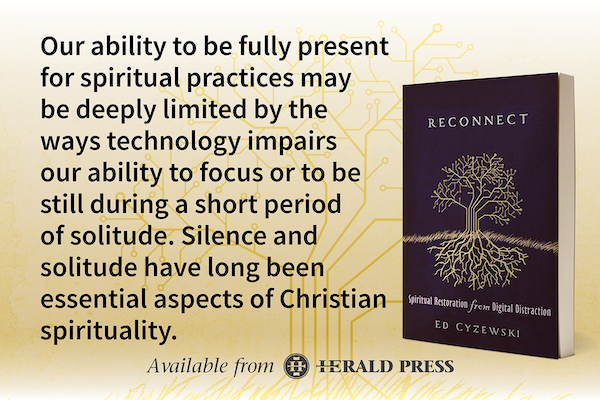
Read a sample from Reconnect about “Reactive Mind”

Learn more about Reconnect: Spiritual Restoration from Digital Distraction

Order Reconnect Today

Download the FREE 4-Session Reconnect Discussion Guide

Reconnect


*Martin Laird, An Ocean of Light: Contemplation, Transformation, and Liberation (New York: Oxford University Press, 2019), 58.

**Thurman, Essential Writings, 45.