If I Created God in My Own Image, He’d Let Me Slap You

slap Christians over doctrine

God is merciful, and I am not.

That is one of the most important conclusions I’ve reached after years of theological wrangling and Bible study. In fact, it’s the mercy of Jesus that often caused the greatest amount of friction between himself and the religious leaders of his time.

I don’t think you can deny the mercy of God in the story of scripture, but the challenge often becomes how to apply that mercy today. I mean, God does get around to judging people at the end of time and all, right?

But whatever form that judgment takes, it’s also abundantly clear that Jesus would really quite rather we spend our time showing mercy to others. He framed his ministry as the work of a doctor healing the sick. He even prevented religious authorities from stoning a woman after she committed adultery—an act that they could have easily backed up with chapter and verse.

God patiently sent one prophet after another to tell the wayward Israelites: “I desire mercy, not sacrifice.”

In other words, learn to be merciful and you will be obedient. Don’t use your obedience as an excuse to abandon mercy.

As I try to sort out what God’s kind of mercy looks like today, I’ve often heard those who self-identify as more “biblical” or “gospel-centered” accuse me of reinventing God in my own image. By seeking to be merciful, I’m going soft on people because it’s what I want rather than what God and scripture teaches. If God had his way with me, I’d go around shoving the faces of sinners into the chapter and verse for everything.

This accusation is both annoying and frustratingly inaccurate. How dare they mistake me for a merciful person!

I’m just about the most stodgy, rule-following, judgmental person there is. I would love to point the finger at other people than deal with my own issues. Really. It’s super easy to find other people to criticize and judge. It makes me feel amazing because all of these other jokers set the bar so low that I can’t help but look like a religious super hero.

And if I could get God to see things my way, he’d also let me slap more people. Nothing harmful or abusive. Just a little, “HEY! GET IT TOGETHER!” They do this thing on television and the movies all of the time, and I think I would be really good at it in real life. If God let me slap more people like that, I think I would exercise restraint and there’d be a ton more people who would “get it together” faster.

At the very least, all of my slapping would ensure that people wouldn’t go around making ridiculous assertions that people who speak of mercy are remaking God in their own image. I assure you, the vast majority of us are not. I’d love to be more judgmental, to set up stronger boundaries, and to ensure I exist in an echo chamber of ideas that never leave me challenged or uncomfortable—what some may call a “remnant.”

I could be wrong. Maybe the slapping approach isn’t the best way forward. I’m willing to admit that.

While I can admit my slapping plan may have flaws, I wonder if those who accuse the merciful of reinventing God in their own image could ask themselves the same question: “Are we also inventing God in our own image?” That’s not a comfortable place to be.  Maybe getting slapped doesn’t sound so bad now, amirite?

As I read the story of scripture, I don’t see people who struggled to judge others. If anything, God’s people struggled time and time again to be merciful. The people who received mercy direct from Jesus failed time and time again, calling down fire from heaven, writing off the blind as sinners, and trying to protect their turf when casting out demons. Mercy was anything but natural for them.

What if those most prone to judgment are just as likely, if not more likely at times, to be inventing God in their own image?


Why Hurting Honestly Will Save Them

earth and sky

Author Guy Delcambre writes about grief in his new memoir with this powerful reflection: “If you never fully hurt, you never fully heal.” Delcambre lost his wife suddenly in the course of five days, and was left to raise three daughters on his own. He’s sharing a guest post today based on his book about that experience: Earth and Sky.


“Do you get sad still?”

She sat quiet, half leaned into my ribs, lost in four-year-old thoughts, which roam and meander in a world too big. Her sisters cried through stories recalling time with their mom. She cried, too, nearly every night in the year after their mother’s unexpected death. But me, I exerted much of my energies moving beyond her death and growing strong again as fast as I could. This was my duty as their remaining parent: to pick up all the broken pieces and rebuild life. I am a 33-year-old widower, father to three little girls all under the age of eight. I am clueless as to what to do. That was over four years ago.

In the four years since my first wife’s death, I have learned much more about parenting than ever before. More so, I’ve learned myself in ways truer. On mountainous trails teaching them hiking basics and good enough fishing spots where patience delivered their first catch, I discovered how to recognize my daughters’ wanting hearts. My daughters taught me the art of the quick, perfect ponytail. For hours, I practiced on them as they modeled how to gather all the hair together in just the right spot. We celebrated with joyous dance when I finally got the hair band twisted tight enough to hold the ponytail in place. They, too, wanted the future and the warmth of hope that I often told them about, but they needed the past to get there. The past hurt. It reminded me of failure, of God not there where I needed him. Returning to the past scratched counter intuitively across my heart. When I left, I never wanted to return.

Back on the couch, my youngest tucked into my side, contemplating the world her dad knows free of apparent sadness, she taught me one of the most formative lessons to shape my parenting.

“Yes, sweetie, I get sad at times.”

“Well, you hide it really good, Dad.”

As a result of me always being okay and in the busyness of me liberating myself from the hurt of her death, my daughters grew more isolated in their own bewildering grief. Those simple little words of my littlest daughter found me moving ahead alone, leading no one, just in time.

To hurt honestly is to hurt wholly, to admit wrong and to welcome the future through the past. This is what my daughters were missing. Rather than me leading them, they only heard me talk about a foreign place of hope disconnected from the reality of death they knew all too well. Grief piled atop their grief. I was leaving them as well.

“Blessed are those who mourn, for they shall be comforted.” At first glance, blessing coupled with mourning is a bad matched marriage. No one sinking in grief recognizes any sort of benefit in his or her tears, other than the momentary release that serves as a reminder that life has indeed twisted askew. However, the more I mourned, the more frequent the release of emotion proved to be blessing. Mourning guided me through grief. Sharing my hurts and fears and frustrations with my daughters served as guide for them.

Grief is a life-long journey that when committed to can bloom the deepest blessing in the darkest of life. The third Thursday of every November is Children’s Grief Awareness day, an opportunity to raise awareness and affirm healthy grief for children who have experience loss in their little lives. Death can be such a scary life event – in a moment a loved one can disappear into forever without understanding and so much as a proper good bye. Take time to consider those little ones who may be struggling through the lost of a loved one. If not your own, those little ones could be your child’s classmate, neighbor or friend. Revealing your own held fears and hurts about death could very well be their way out.

(*Matt 5:4 ESV)


Pick up a copy of Earth and Sky on sale today.


About Today’s Guest Blogger

Guy Delcambre Headshot1Guy Martin Delcambre is an author and public speaker based in Dallas, Texas, who writes about faith in thin moments, strength found in weakness, and God’s grace immeasurable. Guy was once a pastor, a church planter, and a widower, in that order. From the darkest night in life— the death of a spouse— to learning to live life as a single father to three young daughters, Guy has traveled the greatest distance of the heart to find home in God’s faithful goodness.

He lives with his wife, Marissa, and three daughters, Elizabeth, Emily, and Chloe.

Follow Guy on Twitter @GuyDelcambre.
Visit Guy’s Blog here.


Publishing a Book Is Not NEAT

book publishing is hard

In case you were wondering, publishing a book is not “neat” in any sense of the word.

Writing a book is messy.

Writing a book is demanding.

Writing a book is heartbreaking.

Writing a book demands sacrifices of yourself and everyone close to you.

Writing a book will drain you, punch you in the gut, and then kick you while you’re down.

When you finally hold that book in your hands after years of fighting, chopping, and spilling your heart onto the page, it will be surreal. It will be amazing. You’ll also think something like, “Well, it’s about damn time.” And then you’ll go take a nap or collapse onto the couch to sob a little… and then take a nap.

I outlined my publishing journey in my book Write without Crushing Your Soul, and the most common response I hear from readers is despair. When I walk new authors through the book marketing process, many of them just want to crawl into the fetal position.

And I haven’t even mentioned the absolute worst part of book publishing. And no, it’s not a bad review.

The worst part about publishing is the staggering indifference of most readers to your work.

Marketing a carefully crafted book is draining and demanding, but few may read it no matter how hard you try to spread the word. Remember, J.K. Rowling published a book under a pen name, and it hardly sold any copies. This is someone who has penned enduring bestsellers that have defined an entire generation of young readers, and she couldn’t even rack up a few thousand readers when using a different name.

Do you have any idea how daunting that is?

All of this is profoundly NOT NEAT.

* * *

I do a lot of author coaching both formally and informally, recommend they read Write without Crushing Your Soul, and encourage them to write with questions about the next step. If they can’t even finish the book, then they’re clearly not determined enough to publish a book—they probably just think publishing is “neat” until you read about the demands and challenges of the process.

The people who will succeed in book publishing cannot go into it because they think it’s neat. They need a stronger driving force to carry them through all of the politics, discouragement, and exhaustion.

Writing a book has to be an unstoppable mission or a haunting presence that you can’t shake. You have to find yourself scribbling down ideas, dreaming of book covers, and imagining what your readers want.

I would go so far as saying that it’s like the words bottled up in the prophet Jeremiah that were a fire in his bones. If he didn’t let them out, they would have consumed him.

Authors must be driven write. There’s something inside of us that we simply can’t switch off. And perhaps we’ll still say that publishing a book would be neat, but deep down it must be more than. It must be a driving passion.

* * *

When I talk to friends about book publishing and I learn that one of them is considering it, I often say something like this, “I’ll help you, but I also want to spare you from pain. This is going to hurt.”

The pain of publishing is one of the most common reflections I’ve heard from fellow writers. It… just… hurts. That isn’t to say that it’s bad to have that pain. You just need to really want that finished book project if you’re going to endure that kind of pain.

The most worthy goals in life often call us to the greatest pain.

In the Christian faith we talk about the cost of discipleship, laying our lives down for the cause of Christ. If you feel a calling or desire to write, there will be a sacrifice and it will hurt, but there are certainly rewards if you can fight past the pain.

In fact, I would even say that we can even resist some of the pain in publishing. We can choose to ignore which influencers or friends have ignored our book. We can stop comparing our success to other authors.

Instead, we can look at the people whose lives have been changed by our work.

We can be grateful that we finally breathed these words of fire onto the page and they didn’t consume us.

We can be grateful that we’ve created something that could outlive us.

We can be grateful that we’ve persevered and accomplished something that only a small group of people are willing to endure.

Book publishing is not for everyone. In fact, even with the ease of self-publishing, there are lots of people who should focus on other creative outlets, such as podcasting, creating short videos, or blogging. A book can effectively communicate ideas to a lot of people, but it’s not the only way to reach a large group of people with ideas or stories.

Writing and publishing several books has been the most meaningful work I’ve done. If I had a few days, weeks, or months left to live, I’d keep publishing. It’s the best kind of challenge I can imagine. It results in something I’m proud of.

As much as I love it, I can assure you that publishing a book is not “neat.”

You can read more of my thoughts on publishing and protecting your soul in my book…

Write without Crushing Your Soul: Sustainable Publishing and Freelancing 

What Saved Your Faith? Highlights from the Synchroblog

synchroblog

Last week I asked “What Saved Your Faith?” as part of the release celebration for A Christian Survival Guide. I was overwhelmed with the honest, beautiful stories of faith that felt on the brink and was saved. There are so many different ways that your faith can be saved, and I’m grateful that so many participated and shared with the Twitter hashtag #savedmyfaith.

I’m going to take the next week off from blogging in order to catch up on some things I had to put on the back burner, but I first wanted to share a round up of the posts along with some of my favorite quotes:


Alise D. Chaffins

“In the middle of the night, our church was that stairwell; our hymns, an improvised jumble of notes and rhythms that spoke of longing, of peace, of joy. We shared our hearts with one another in a way that was sacred. In the midst of the questions surrounding my faith during my college years, I found holiness in the music of a dirty hallway.”


Lisa Burgess

“When freedom is as evident as it’s ever been and God’s presence breaks through the thin places again and again, yet I still struggle with occasional (though less frequent, praise God!) worries about my kids or fears about new adventures, God reminds me through songs to keep focusing on him, keep showing up to love, and keeping praising through everything.”


Andi Cumbo-Floyd

“Grief and loss and the iffy decisions that I made in that dark hour led me far, led me to push hard against the edges of my faith to see what would break away and what would stand.  And all that while, when I battered away at the false promises of ease and lifelong marriage, as the accusations about divorce and celibacy lobbed from without and within, that love held my core tight and firm, reminding me in groans I could neither utter or hear that I was profoundly and deeply loved by One who is love.”


Jennifer Luitweiler

“As the new and clueless mother of infants who cried and demanded things in a language I didn’t know, my faith was stretched like a breaking rubber band. I remember stretching out on the carpet of my bedroom while one or two wailed, praying for peace, and knowledge and creativity, and energy. I remember rising from that carpet, tears on my face and carpet impressions, too, walking with a supernatural calm to ease their discomfort, to fulfill their needs, to be the mom I had to be, wanted to be.”


Kelly J. Youngblood

“While the timing of past events has become very fuzzy to me, there is one moment I do remember, although I do not remember when or where it occurred.  I was at a point where I thought I would have to make a decision to give it all up.  Faith, church, Jesus.  And as I contemplated what to do, I realized it could go either way.  I didn’t know anymore who Jesus was or what he was supposed to mean to me.  It was as if I was facing two paths to walk down, and I had to choose one.”


Sequoia Ways

“Ultimately I don’t believe it is my faith in God that keeps me going, it is his commitment to love me and be at work within me that endures in good times and in bad. He saves the faith he planted in me whenever it is threatened by times of darkness, disaster or drought. ”


Jason Whittington

“I’ve been on the edge of giving up. Weary of rituals. Weary of people equating my questions with a lack of faith. Weary of people using the first chapter of 1 Corinthians to persuade me to stop digging deeper. Weary of people telling me to “just believe.” Weary of people in general.

Then there are people that God uses in tremendous ways.

Every person that listens to my story and my struggles and says, “me too.”

Every person that listens to me recount the ups and downs of my day to day existence with even a hint of love and empathy in their eyes.”


Christian on the Frontline“These “heretics” have quite literally saved my faith and my relationship with Christ. They blew wide open the questions and dared to go down roads many deemed too dangerous. Anytime I find someone branded a heretic by a Christian, it encourages me to go read their work. ”


Cara Meredith

Because when The Gray emerges, when it overwhelms and frightens and clouds our stories, it also sometimes forces us to huddle under cozy blankets and stare out cloudy windows and just be. We become lost in a tangle of unknowing and we question God, hurling insults at him and raising questions towards him, one after another after another, like the ball pitching machine in the batting cages. Whoosh! Whoosh! Whoosh! Our hands lob and they sling and they fire fastballs towards the Great One, wondering if this’ll be the last time he’ll lend ear to our third-degree queries. For somehow, in this insult-throwing, not-knowing, time-of-questioning period of gray, I’ve felt the most certitude.”


Traces of Faith

“Sometimes I was the only one at the altar, but it made no difference. Through my tears, God taught me deeper lessons about faith. And sharing our story with loved ones. I walked away from this time knowing one’s salvation truly rests in Christ alone.”


Melinda Inman

“It took me a full decade to grasp what God was doing. He was stripping me of my legalism, arrogance, and self-reliance. He was transforming me to rely on him, so he could show me that his promises are really true and I could learn to love him. It wasn’t about me and my capabilities, but about Christ and his cross.”


Cindy Brandt

“You see, I want all of the beauty. I want the irreverent, gritty honesty out there AND the deeply mystical prayers in here. I want the pragmatic, scientific solutions for the world’s problems out there AND the earnest faith for the impossible in here. I want the big, huge tent that welcomes everyone out there AND the narrow road of life giving sacrifice in here. I want to glean the wisdom of the world AND own Jesus’ beautiful vision. I want to be a Christian, but not THAT kind of Christian.”


Leigh Kramer

“I’ve long turned to books for answers and solidarity. In spite of this new section, I wasn’t hoping for much when I asked Andy for recommendations. He didn’t hesitate before placing A New Kind of Christian in my hands. It had been published almost a year earlier and when he described its impact on him, I immediately sensed it would have the same effect on me.”


Charity Singleton

“Not only is God not made of dust, He is capable of making me from dust, and you. He creates something—everything—from practically nothing. He takes ruined things and makes them whole and valuable again. But he remembers, always, that I am not more. I am just dust.”


Kris Camealy

“Learning to pray prayers formed from my own words, out of the contents of my own heart transformed my faith. Listening to the honest prayers of my fellow congregants served as an invitation into something richer than I ever imagined–real conversational prayer with Jesus.”


Jennifer Tinker Clark

“When I am struggling in my faith I am particularly glad for corporate worship and liturgy in particular. Even if I can’t pray, the community of faith carries me through their prayers. Churches who do liturgical worship are accused sometimes of “just going through the motions.” I have to tell you though, when infertility plunged me to my lowest point, those “motions” were all I had. Reciting liturgy that I have memorized, that I know by heart allowed me to pray when I would not have otherwise been able to pray.”


Interviews

Jennifer Clark Tinker at Life & Liberty

“The book had me laughing out loud and reading passages to bystanders, while also giving me wisdom to continue to ponder in my heart.”

Listen to the Interview


Trip Kimball

Read the Interview here.


A Few Reviews…

Joan Nienhuis

“If you are being challenged in an area of Christian belief, take a look at this book. There just may be a biblical perspective you have not considered that will help you survive with your faith intact. Above all, rely on the Holy Spirit to sustain you and keep you focused on Jesus.”


Jason Freyer

“Every year, almost like clockwork, our students who are in 11th grade suffer some sort of crisis of faith. It’s something that we’re looking at pretty hard, trying to research and discover where this phenomenon comes from. But in the meantime, as I was reading Ed’s Christian Survival Guide, I knew that I would be purchasing several more copies, and handing them out to students when these crises of faith arise. I would highly recommend youth pastors of all walks of life buy a batch of these books to have on hand to give to your students. You’ll be glad you did.”


Anna Joy Tucker

A Christian Survival Guide lays things out in a methodical and logical way, but it also leaves some wiggle room.  Rather than having an air of authority and arrival or one of pure confusion and questioning, Ed’s tone is one of the best I’ve seen in terms of opening a conversation.  He shares his own experiences and thoughts, he provides Biblical backing when he can, he offers perspectives from lots of different Christian traditions, and he is soft and gentle on things that could get confusing.  In short, he makes me think.”


* * *

I appreciate everyone who posted a review, picked up a copy of the book, shared about it on social media, and helped spread the word. This has been a labor of love for me over the past four years, so it means the world to me that you’ve helped tell others about it.

I’ll be back to the blog in a week or so.

Gratefully,

Ed

When Prayer Is a Still Small Voice for Big Loud Problems: A Post for Preston Yancey

beuchnerquote1

A few weeks ago the upcoming memoir Tables in the Wilderness by Preston Yancey arrived on my doorstep. I started to casually read it. He’s a twenty-something writer who likes to cook and hang out with icons. I didn’t quite know what to expect. While I haven’t finished it yet, I’ve been completely delighted by his story and his masterful writing, and I highly recommend preordering it today.

Preston is also a passionate blogger who has kindly shared his blog, hosting me for a guest post adapting A Christian Survival Guide’s chapter about prayer.


Did you know that Jesus spent significant amounts of time praying? He regularly took trips into the wilderness and up mountains to pray for extended periods of time. It’s not exactly a hidden aspect of his ministry. It’s just one that I didn’t think about too much until recently.

Have you ever wondered why Jesus prayed so often?

Wasn’t Jesus already pretty tight with God since he was a member of the Trinity? The fact that he took time to pray is a Trinitarian brain bender. Wasn’t he still God?

If Jesus made prayer an integral part of his life, what makes us think we can do any better without it? If anything, Jesus sent us a very important message about the practice and importance of prayer. Our survival as followers of Jesus depends on it. If our Lord modeled prayer for us, then we’d better figure out a place for it in our lives.

Many Christians I know today, myself included, struggle with a condition I call “prayer guilt.” We all like to pray. We all see the value of prayer. We even pray most days. However, we always feel like we never pray enough. If we have prayed, we didn’t pray long enough or failed to stay focused while praying. I’ll even tell myself, “Sure I prayed, but the prayers weren’t very good.” It would be nice to at least have a vision or speak in a tongue or two before checking prayer off my “to do” list.

I’ve spent far too many days living with an underlying sense that I should be praying more or doing more for God. I can always think of someone who must be meditating longer, reciting prayers that are more ancient, or lighting taller, brighter candles. Whether or not I’m correct, that guilt leaves me feeling inadequate and unable to approach God with the kind of confidence that Jesus talks about.

Read the rest at Preston’s blog.

What Saved My Faith: A Synchroblog about Christian Survival and a Big Book Discount


synchroblog

I wrote last week about my doubts that arose when I didn’t receive any obvious manifestations of the Holy Spirit and God felt distant whenever I tried to pray. Much to my dismay, there wasn’t a quick fix to my faltering faith. I’m writing a follow up post as part of a synchroblog this week: What Saved My Faith? Synchroblog details are at the end of today’s post: 


When God felt distant throughout my early 20’s, I felt like my faith was completely breaking down. The only way to save my faith was to ask the question that I thought would mean losing it:

“Why has God abandoned me?”

What did my lack of charismatic experiences mean about my faith or about God?


I couldn’t figure out a way to make prayer work until I acknowledged that I’d hit a dead end. I had to admit that I was struggling to connect with God. In fact, one word sums my experience up:

SILENCE.


While I wouldn’t describe myself as particularly charismatic at the time,  I was used to spiritual experiences. I’d had many moments where the words of scripture seemed to jump off the page, and I sensed either an intense joy or sorrow. I’d felt conviction to make major life changes. I’d felt God’s presence while praying int he past.

However, one day it all just fell apart. I can’t say what exactly happened. It’s not like you plan for prayer to stop working or for insecurity to become the norm. Prayer, which had just flowed before, was riddled with uncertainty, doubt, and fear.

The Bible describes a present God who is able to meet people when they pray. That was not my experience.

I quickly became an anxious Christian. I wanted my spirituality to work, and if it didn’t work the way I expected it to work, then I feared that I’d been abandoned by God.

It’s not that I didn’t believe in God. I’d experienced too much. Rather, I just feared abandonment. All of the promises of scripture couldn’t squelch the burning anxiety that God had abandoned me.

“Where are you God? Why won’t you come near?” I asked each day.

I knew so many people who heard God speak, who experienced God, and who sensed God’s direction in their lives.

Why not me?


I had to start believing something without personal proof: What if God was near even if I couldn’t sense God’s presence? What if I had to remain faithful without any assurance that God saw me?

I had to learn how to wait on God.

I’ve been surrounded by Christians who talked about victory and breakthroughs, but I didn’t have any concept of a dark night of the soul. One thing pulled me out of my downward spiral into darkness: I relied on the prayers of others. 

First, I asked for prayer.

I asked for a lot of prayer, in fact. Each time I received assurances. I gave God every opportunity to tell me what I was doing wrong through the people praying for me. It turned out that I wasn’t living in sin or on the brink of being cast into the flames of hell or anything else.

In fact, my father-in-law sensed that God had imparted the Holy Spirit to me. If God wasn’t angry with me, I decided to take a different approach to prayer.

I prayed the prayers of others.

When you can’t find your own words to pray, the words of the Psalms and the historic church can serve as a real life saver. In fact, as I struggled with doubts and uncertainty during my dark night of the soul (or whatever one calls these things, I’m a Protestant, remember), I relied heavily on the daily prayers from the Divine Hours (buy the books or pray online).

The Divine Hours exposed me to all kinds of prayers: petitions, laments, praise, etc. I saw that doubt, dark nights of the soul, fear, and uncertainty came up quite a bit while praying. The majority of the readings were short passages of scripture, and I saw that waiting on the Lord comes up quite a bit in the Bible and especially in collected prayers in the Hours.

Psalm 5:3
In the morning, Lord, you hear my voice; in the morning I lay my requests before you and wait expectantly.

Psalm 27:14
Wait for the Lord; be strong and take heart and wait for the Lord.

Psalm 130:5-6
I wait for the Lord, my whole being waits, and in his word I put my hope.
I wait for the Lord more than watchmen wait for the morning, more than watchmen wait for the morning.

The Psalms are full of waiting, in fact.

So I started to wait. I started to rely on the prayers of others. Slowly, gradually, I learned to wait and trust God on my own.

The more I relied on the prayers of others, the more I say that my prayers were full of pushy petitions and demanding deadlines. I was asking God to show up in the time, place, and manner I specified. Perhaps my season of silence was God’s way of shutting down the ways I’d been trying to exert my control over prayer. Who knows.

I started waiting and praying the prayers of others, and I eventually began to sense God’s presence and voice again. In silence and in the recitation of scripture, I found a new path to God that didn’t rely on crafting clever prayers. In fact, prayer became peaceful and restful, inviting God to come and simply paying attention to however the Spirit would move.

I don’t think I could have figured out how to pray on my own. I had to experience the prayers of others and copy the prayers of scripture and fellow Christians. That felt like cheating. It made me feel like a failure, as if I wasn’t smart enough to sort this out on my own.

Rather than failing, I was actually learning what faith looks like. I was learning to stop relying on my won wisdom and to seek the wisdom that can only come from God alone.  By relying on the prayers of others, I finally learned what it means to pray in faith, waiting and trusting in the presence and direction of God.

The things that feel like threats to our faith are often just the necessary failure of flawed faith that must break down and shatter before real faith can take their place. 


This post is part of a synchroblog for the release of A Christian Survival Guide: A Lifeline to Faith and Growth  that’s answering the following question:

What saved your faith? 

Write a post this week answering that question and then scroll down to learn how to join the synchroblog.


A Christian Survival Guide is also being offered at a steep discount this week.

On Monday, August 18th, it will be offered as a free eBook at select sites:

Amazon and B&N

Tuesday-Friday, August 19-22, it will be offered for $2.99. (See also the Publisher)

Print Copies: Get $3 off on Amazon this week.

Survival Guide Order Button


How to Join the Synchroblog:

1. Write a post for your blog during the week of August 18-23.

2. Begin or end your post with something like, “I’m joining the synchroblog for the release of A Christian Survival Guide: A Lifeline to Faith and Growth by answering the prompt: ‘What saved my faith?'”

3. End with a link to today’s post.  (This is the short link: “http://wp.me/p36rtR-k5”). Add the link up information to your post, the synchroblog image, and end your post with a prompt like this: “What saved your faith? Write your own post answering that question and then visit www.edcyzewski.com to learn how you can join the synchroblog or to read additional posts to celebrate the release of Ed’s book A Christian Survival Guide, which is discounted on Amazon this week. “

4. Link to your post in the comment section on Ed’s blog post and tweet with the hashtag “#SavedMyFaith”. 

5. Read other posts by checking the comments or the #SavedMyFaith hashtag on Twitter. Then comment, tweet, or share the best posts you find!

3 Reasons Why You’ll Hate My New Book

lewisquote

I try to avoid reading reviews of my books.

OK, I admit, if it’s 5 stars or a glowing review in Publisher’s Weekly, I’ll probably read the review. Possibly even 10-15-80 times.

But the other day I saw the first one star review show up for A Christian Survival Guide. I didn’t read it. I was just passing along the link to the book’s page and didn’t scroll down to see anything else. However, I can pretty easily imagine why quite a few Christians will really hate this book.


1. Our Christian culture has confused certainty with stability.

There’s nothing wrong with being certain about what you believe. However, there’s a big problem when we expect everyone to follow our own templates for faith. We all pass through seasons of doubt, uncertainty, or personal struggle, and the results of those seasons will differ from person to person.

There’s no single template for followers of Jesus. And actually, if there was, the template for following Jesus would be doubt and confusion. Jesus’ followers had three years to get things straight about Jesus and what kind of Messiah he was, and they still weren’t fully clear about Jesus until the very end of his ministry.

My pastor has a saying that goes like this, “In Christianity, you either become a mystic or you become an atheist.” That’s an intentional overstatement, but he gets to the heart of things: Bible study and theological systems can’t handle everything life throws at us. We all have to sort through things in our own way, and oftentimes that means prioritizing the presence of God over theological certainty.


2. This Book Is Too Liberal and Too Conservative

When someone asks if I’m conservative or liberal in my theology, I usually say, “It depends who you ask.” I’m probably too conservative for the liberals and  too liberal for the conservatives. It’s not that I’m trying to land in the theological middle on every issue. Rather, I try to keep various perspectives in conversation with each other without always taking a side in each instance.

That will probably drive some people crazy. Remember, this is a book for people who are processing their faith and trying to sort out answers. If there’s a majority position that causes a lot of problems for Christians, I take some pretty major swings at it. If you love the idea of an end times rapture and hell being a place of eternal conscious torment, you’re going to really hate this book, because I present the biblical arguments against both of these positions.

That isn’t to say that one can’t believe in the rapture or hell as ECT in order to survive as a Christian. Rather, I’m helping people ask hard questions about these kinds of issues.


3. I Will Tip Some Sacred Cows

While I can’t cover every topic that may cause someone’s faith to falter, I’m also pretty frank in pointing out the kinds of issues that have become distractions from the core issues of Christian living. I write in the Introduction to the Survival Guide:

“When I speak of Christian survival, I’m talking about the real problems and doubts that can hinder your relationship with Jesus and your fellowship with others. In America we are bombarded with all kinds of campaigns, organizations, and agendas that are supposed to be important to us as Christians.

We’re told by politicians on both sides that we need to support legislation that will preserve the “moral character” of America. We learn that our country is either in danger of being taken over by maniacal socialists/fascists (which is an impossible mix by the way) who will turn America into Canada or that fundamentalists will turn our open-minded republic into the Holy Land Experience. Others warn us that men need to watch ultimate fighting or they’ll start baking cupcakes and give up their careers to stay home with the kids, and that women need to raise kids and bake cupcakes lest they spend their free time watching ultimate fighting.

We are bombarded by campaigns to build museums that tout certain agendas or prove certain views of the Bible. Some lament that America is on the brink of becoming a land crawling with atheists and therefore we need to buy a certain book, attend another conference, or believe some checklist of absolutes. Others fear that America is on the brink of being overrun with religious zealots who want to take control of the minute details of our lives.

I trust that the people behind such campaigns mean well and that they love Jesus, but these “important” issues are not essential for our faith as Christians. I’m far more concerned about getting the basics of Christianity right: learning how to pray regularly, how to commune with the Holy Spirit, how to love our neighbors, and how to read the Bible so that we can live in relationship with Christ and do God’s will on earth. If the basics are following Jesus, loving God, and loving others, shouldn’t we make our top priority the removal all of potential obstacles that could keep us from God?”


So you may hate this book. It’s a distinct possibility. Some people have already confirmed how much they disliked this book. However, I suspect that as annoying as this book will be for one group, it will be a lifeline for others. In fact, I’ve heard just that thing from many early readers who felt like I’d been spying on them and addressing the very questions that have been troubling them. It’s really impossible to answer everyone’s questions in one book.

That’s how faith works: it’s always shifting and moving. At least, that’s how it works for me. I’ve passed through different seasons. I’ve watched my faith change and grow and struggle and then shift. This is a book for a season of questions, seeking, and exploring. It’s my hope and prayer that you’ll find my book a helpful guide if you’re in that kind of season right now.


Check out A Christian Survival Guide today! You’ll… um… love it? 

A Christian Survival Guide


What Saved Your Faith?

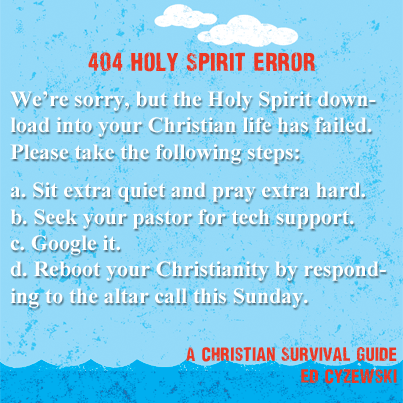
Holy Spirit Download Error

“Why does God bless some people and not others?”

That was one of the questions that almost ended my faith.

When I learned that miracles can happen today and that many had actually been healed, I had a brand new crisis of faith to consider. I met Christians who spoke in tongues, shared words of knowledge that were eerily accurate, and even healed people from various ailments. I saw a friend receive deep spiritual healing during a revival. I saw another receive a life-giving blessing.

Throughout all of this Holy Ghosting, I stood by, flat-footed and uninvolved. God hadn’t “poured out” his Spirit on me. I was just a regular old Christian with a Bible, notebook, and highlighter, learning more truth but not experiencing the kind of life the New Testament described.

Why not me?

Although there are many hucksters and abusers of spiritual gifts such as tongues and healing, I’d witnessed and learned about enough genuine encounters to know there was something to it. I wanted in. And when things didn’t start happening when I prayed for them, my faith took a nosedive.

What did my lack of charismatic experiences mean about my faith or about God?

I feared that I wasn’t a true Christian or that God had somehow found me unworthy. It wasn’t so much that I doubted God’s existence. Rather, I feared the end of my faith if I stepped out in faith, asked God for something, and then nothing happened. If I stepped out in faith and found only silence, I didn’t know what to do next. Should I just keep praying and waiting?

American Christianity has done a terrible job preparing me for patiently waiting on God or preparing me to deal with a spiritual “dark night” of the soul. We have language for quick fixes, processes, how-to manuals, and words like victory and break-through.

We hear a lot about break-throughs, but we don’t talk so much about breakdowns.

We hear about God delivering someone in the nick of time, but we don’t hear much about God being “late.”

I feared that the problem was inside of me and that God couldn’t or wouldn’t fix it. I feared that God was playing games with me, waiting for me to say the right words or to make the right sacrifice. If couldn’t figure out the code words, I couldn’t have the blessing.

In a sense, the hardest thing was simply letting myself ask that question. It seemed like the wrong kind of question for a good little Christian to ask. I feared the question and avoided it for years. I lived in fear and uncertainty.

The only thing that relieved the tension in my life was the moment I finally leveled up with a trusted mentor: “I don’t understand why God won’t bless me with the Holy Spirit?”

The day I asked that question, putting into words the seemingly irreverent if not downright heretical questions in my mind, I could finally do the one thing I wouldn’t let myself do: Search for answers.

We run from all kinds of questions, issues, and doubts. That running undermines our faith and alienates us from God far more than simply asking the questions we fear the most. In fact, there is freedom in simply asking what you’re not supposed to ask.

Starting Monday, August 18th, I’m going to blog about this question and some others that I wasn’t supposed to ask. These were some of the questions that guided my journey while writing my new book A Christian Survival Guide.

I’m inviting you to join me by writing your own post for a synchroblog. Here’s the prompt:

What saved your faith?


We face so many reasons to stop believing, so much discouragement, and face palm ourselves daily with the antics of certain Christians.

Why do you keep believing? What made the difference for you?

I’m inviting you to write about it and to link up for the week of August 18th. I’ll include some basic synchroblog information to include at the end of your post so readers can join in or read additional posts.

If you’re wondering how I resolved my question about the Holy Spirit and healing, I’ll write about that on Monday the 18th of August to kick off the synchroblog.


synchroblog


How to Join the Synchroblog:

1. Write a post for your blog during the week of August 18-23 about what saved your faith.

2. Begin your post with something like: “I’m joining the synchroblog for the release of A Christian Survival Guide: A Lifeline to Faith and Growth by answering this prompt: ‘What saved your faith?'”

3. End with a link to my post for Monday, August 18th (This is the link that is NOT live yet: http://wp.me/p36rtR-k5). Add the link up information to your post, the synchroblog image, and end your post with a prompt like this: “What saved your faith? Write a blog post answering that question and then visit www.edcyzewski.com to learn how you can join the synchroblog or to read additional posts to celebrate the release of Ed’s book A Christian Survival Guide, which is discounted on Amazon. ”

4. Link to your post in the comment section on Ed’s post and share it on Twitter with the hashtag “#SavedMyFaith”. 

5. Read other posts by checking the comments or the #SavedMyFaith hashtag on Twitter. Then comment, tweet, or share the best posts you find! I’ll make a round up on Monday, August 25th.


What If a Newspaper Reviewed the Book of Revelation?

ephesus-expose

Oh, hey, did you hear that another Left Behind movie is coming out in October? It’s sure to make the book of Revelation extra, super scary. Check out this official description:

“The most important event in the history of mankind is happening right now. In the blink of an eye, the biblical Rapture strikes the world. Millions of people disappear without a trace. All that remains are their clothes and belongings, and in an instant, terror and chaos spread around the world. The vanishings cause unmanned vehicles to crash and burn. Planes fall from the sky. Emergency forces everywhere are devastated. Gridlock, riots and looting overrun the cities. There is no one to help or provide answers. In a moment, the entire planet is plunged into darkness.”

Death! Destruction! Chaos! Terror! End Times Judgment!

AWESOME!

Man, Revelation sounds terrifying… that is, if such events linked to an actual rapture were actually going to happen.

I’ve already shared quite a bit about the book of Revelation in my book The Good News of Revelation. That book digs into the background of Revelation, particularly its audience.

The short version is that John wrote a book in a series of symbols in order to answer a very important question: Why are God’s people killed and oppressed by the Romans if Jesus is Lord?

As evidenced from the movie promotion, the Left Behind version of Revelation can turn God into a violent and angry monster hell bent on destroying the world—or at least the people who weren’t raptured. When I worked on A Christian Survival Guide I found that such violent depictions of God can become a huge barrier to faith.

How do we reconcile Jesus, who said, “My peace I leave with you” and a God who is about to send fire pouring down on the earth?

Well, there are lots of ways we could go about this. We could even look at the Bible, but sometimes a little bit of humor can help cut the tension.

Why not write up a fake book review of Revelation to snap us out of Left Behind terror?


Book Review from the Ephesus Exposé

“Sophomore Effort from Fisherman Casts Wide Net in Revelation by John of Patmos”


Dragons, beasts rising from the sea, and angel guides add elements of danger and mystery to the latest release from John of Patmos, even if they sometimes fall flat as familiar, pedantic tropes from Jewish “apocalypticisms” and the wildly speculative book of Daniel. John is clearly reacting to the stinging critiques of his previous eponymous release that used painfully simple Koine Greek and dragged over-wrought symbols and signs through each scene. If his microcosm of a “gospel” was too reductive, obvious, and heavy handed, his apocalypse veers toward the obscure and obstreperous with its grandiose literary aspirations and pantheon of religious symbols.

For all that is familiar and overused in Revelation, it’s a coruscating and provocative read that offers a new-age twist from John’s break-off Jewish sect of Nazarenes that reenacts a series of familiar, though sometimes tiring, biblical clichés such as the serpent vs. the woman and the plagues that precede the exodus. His opening epistolary warnings to a series of churches lends an air of urgency that drives home the many symbols of heavenly and earthly warfare that follow. No doubt his readers may puzzle over the identity of the Antichrist, but once again, John’s failure to develop this character only serves to expose his limitations as an author. For all of his faux sophistication, John of Patmos remains hooked on his humble origins and has yet to produce a work of literature that will endure beyond its two-week release period. Fascinating though John’s innovations may be, this humble laborer’s work still smells fishy.

– Flavius Josephus

Read more ridiculous parodies in A Christian Survival Guide—because everyone struggling to save their faith needs a good laugh, right?

Why I Avoided Christians Who Lost Their Faith

When faith is uncertain and clouded

This week I’m sharing a story from my Christian Survival Guide book about the time I avoided a man who was a former Christian:

From the post…

I had a lot of reasons to hate Clark.

We were polar opposites in every way. I’m a driven, self-starter who would rather die than break the rules. He was the atypical slacker who did the bare minimum to get by, letting others, namely me, do the heavy lifting for him. He’d chat up anyone near his office, and when company proved hard to find, he’d wander the building in search of anyone willing to kill a half hour with him.

When I didn’t cover for his deficiencies, Clark snapped that I’d better do my job.

I stormed away, swearing just loud enough for a co-worker to hear me.

Clark brought out the worst in me, and I let it happen rather than seeking to understand him or at least have a frank conversation about our differences. Over the years, we maintained an uneasy truce with our parallel careers within a small business of no more than ten employees.

At a company event, we happened to end up sitting next to each other. Seeking any kind of conversation topic, I asked him about his family who lived a few hours away. He mentioned that they were Christians, and he couldn’t stand the people at their church.

No surprise there. I was sure they felt the same way about him.

Clark went on to share that he had, in fact, been a Bible study leader and church elder before leaving the faith. I can’t tell you what we talked about after that. I just remember being shocked and then suddenly quite afraid.

Clark had a significant amount of Bible knowledge. He’d been taught everything that I knew. For some reason it stopped working for him.

Why? Why did he leave the faith? Honestly, I didn’t want to know.

Seeing Clark as a fallen Christian suddenly opened my eyes to my own hypocrisy. I had failed him greatly by hating him for his work habits. And when I learned that he had left the faith, I only wanted to write him off all the more. I didn’t want to wrestle with any of the questions or issues that wrecked his faith.

Fearing the fate of my fragile faith, I distanced myself from doubters like Clark.

Isn’t that something we’re all tempted to do when we meet someone who has left the faith?

Read the rest at A Deeper Story.