To even write about the current crisis in America seems to require saying something that proves or identifies the crisis for those not yet convinced we are in a crisis.
That simple act of proving reality to skeptics is when the wheels start falling off for me.
We are so saturated in propaganda, infotainment, and reactionary rage bait on social media that we seemingly have to begin any discussion about our current crisis with proof of the crisis. That is maddening, and I presume that at least some people desperately want things to be this way to keep us divided, distracted, disdainful, and despairing.
I’m sure there are more words that start with “d” that would help describe the current moment.
In the hope of moving toward something better, I’m going to skip spelling out the details of our current crisis and move on to beginning some sort of response.
We have a fire hose of bad news each day. It seems our country is run by people who diligently try to figure out the worst thing they could do, devote all of their energy to doing it, and, when called to account, claim to be doing the best thing.
If we don’t have the lowest of the low running our country right now, it’s only because they aren’t intelligent enough to find a way to go any lower than they already are.
How should we respond to this onslaught of daily crises, violence, inhumanity, and injustice?
I have a thought that stems from an observation someone made of the current political class running our country. This class is selfish, self-serving, and grotesquely individualistic. They are gathering as much power and wealth for themselves and their allies while they can, and everything they do aims to serve themselves.
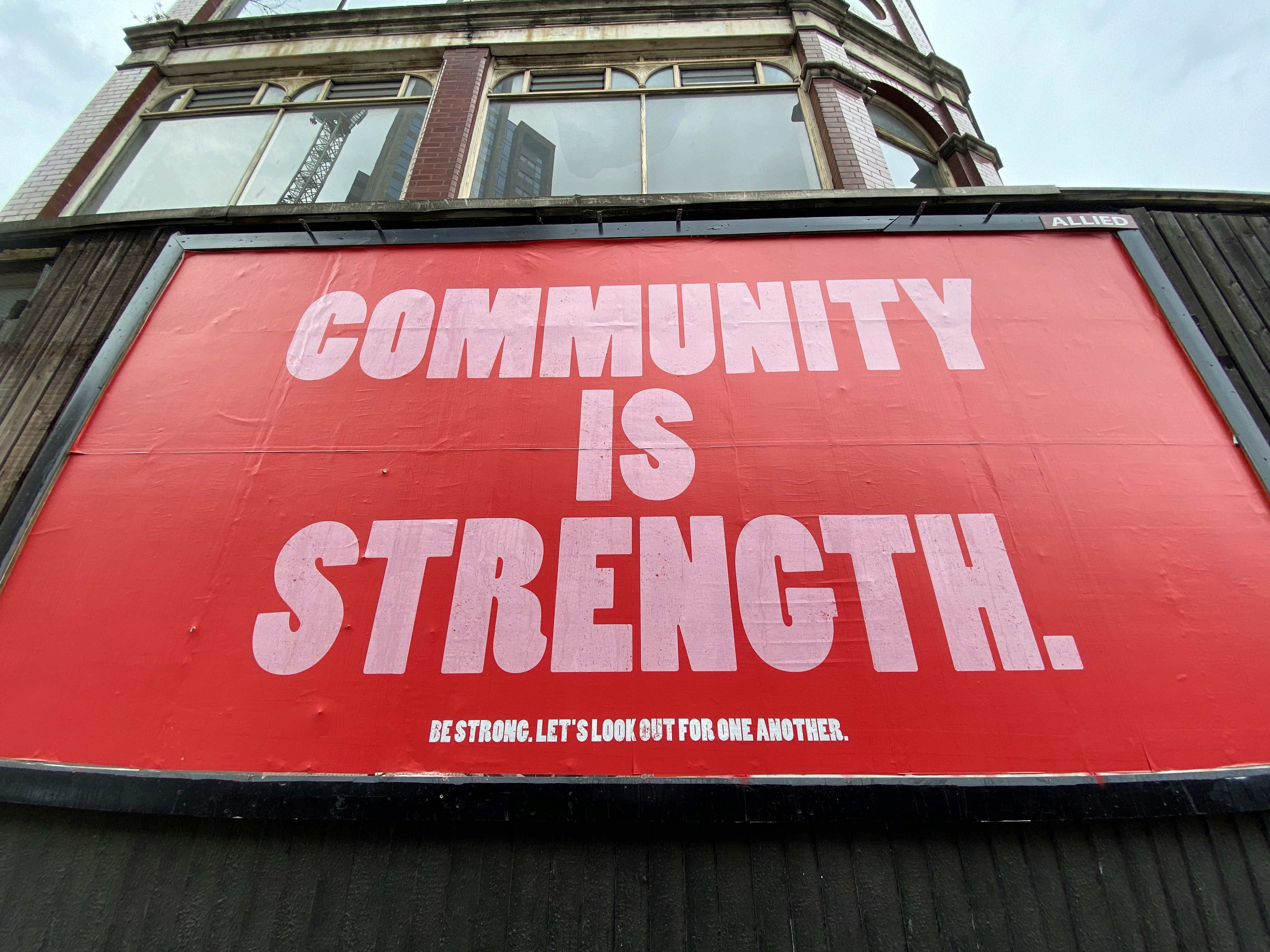
Our response is to ask how we can become more interdependent on each other, how we can love our neighbors, and how we can build stronger bonds in our communities. I don’t think that most of us have the capacity for large projects. I’m thinking about things like donating food, volunteering where we can, sharing resources with others, and building understanding when possible.
I continue to invest time into artistic projects like oil pastels and woodworking because these are skills I can use to help others, to give people gifts they enjoy, or to pass on creative skills to others.
Of course, there’s the daily practice of prayer as well, working hard to let go of the anger and despair that so easily takes hold and creating a clear space for God to speak into my life. Although I remain devastated by the horrible failure of Christians in America to hold such an evil man in power to the basic standards of moral decency, we can find renewal to love our neighbors if we remember how deeply we are loved by God.
I’m not offering a perfect path forward to help us make it through this terribly perilous moment in our country, but we have to start somewhere. The place I’m starting is recognizing the temptation to become overwhelmed by the flood of anger and negativity in this moment and then embracing practices that move me toward a healthier, more sustainable place.
If we can end today by saying no to despair and yes to love and community, we will have hope to continue when the sun comes up tomorrow.
I’m the author of Flee, Be Silent, Pray: Ancient Prayers for Anxious Christians, Reconnect: Spiritual Restoration from Digital Distraction, and other books. I write about prayer and spiritual restoration at http://www.edcyzewski.com.
I completed the following Sermon for St. John’s Episcopal Church in Murray, KY on the Friday before Federal ICE agents publicly executed Alex Jeffrey Pretti while they had him pinned to the ground. However, my sermon references similar cases of violence committed by federal agents and the propaganda of the current administration, and so I did not revise the content to mention him specifically. In addition, I recorded the sermon on Friday evening for my church in case a winter storm caused a power outage in our town.
Sermon for January 24, 2026
Matthew 4:12-23
Some of the most transformative moments in my life were the times when someone treated me better than I deserved. I knew I had failed others, but their mercy and forgiveness quickly pulled me out of my shame.
I once worked at a nonprofit with an extremely challenging director who wanted our marketing firm to send out a series of press releases to the local papers. Before doing that, our director had to give them all the thumbs up.
I was the main point of contact with the marketing firm. Yet, they weren’t replying to my emails or moving fast enough for our director’s liking.
When our director nagged me once again about the press releases, I snapped and sent him an email that was extremely critical of our marketing firm’s responsiveness. That was a teeny, tiny, HUGE mistake. He immediately forwarded my message to the marketing firm, copied me on the message, and added that we needed to work this out.
As you can imagine, I felt like an idiot—a common theme in my 20’s. I was unprofessional and threw them under the bus because of our director. I wrote a very sincere apology, and the lead copywriter immediately replied that it was water under the bridge now. We could move on.
He would have been justified to tear into me. I deserved it. But he very kindly replied immediately and moved on. In the midst of my shame over my failure, his forgiveness was a ray of light that helped me move forward.
We read today in the Gospel about Jesus being a light to people who were living in a land of darkness. I think we all want light and hope to come, but the light and hope that comes in today’s Gospel may give us pause.
While it’s true that people who lived in the ruins of the exile and suffered under Greek and Roman rule had God’s light among them, how much were things about to change? Were their lives about to become significantly better? Were they hoping for something different from what Jesus offered?
And while I’m sure the disciples Jesus called would all say that they wanted God’s light and salvation to come, they also had to make significant sacrifices. They would have to face dangers among violent leaders that made a storm on the sea appear quite tame.
And what did the people who saw this light of God’s hope think? I’m sure they were happy to experience healing and listen to Jesus, but wasn’t all of the healing just a band aid on far more serious wounds that had accumulated over time? And the message from Jesus to repent was directed at them. Why didn’t he tell the Romans to repent first?
As they experienced injustice and suffered the indignity of yet another military occupation in a long history of them, what in the world did they make of Jesus? He seemed promising, but he also was likely confusing, frustrating, and even appeared a bit dangerous. He spoke of God’s kingdom without actually challenging the Romans.
Change was coming, but was it enough?
And let’s not forget that Jesus called men who were largely unlearned, rough fishermen. These weren’t sophisticated, well-spoken, theologically astute, politically savvy men who could wow a crowd. Even after 3 years with Jesus, the book of Acts notes that their lack of education was hardly a secret. What was Jesus thinking by calling this group of misfits to support his ministry while his cousin John, a legit prophet, languished in prison?
Most people in America today have not suffered anything close to what the people of Israel endured throughout their history of military calamities, oppressive rulers, brutal exile, and the daily deprivations of military occupation. If they had any hope left for God to deliver them, it was likely quite faint by the time Jesus showed up on the scene.
The people of Israel, especially in the northern region around Galilee, had suffered a great deal over past and present generations.
And let’s admit that we can understand why they would have found Jesus perplexing. He healed people of their personal sicknesses, but did he address the sickness of their nation? He spoke of God’s Kingdom, but he left John in prison while scraping the bottom of the barrel in their society for his help.
If we let ourselves ask the hard questions that this passage demands, we can see the extreme tension of this moment. Light has come up against darkness, God’s Kingdom has appeared at a time of Roman domination, and Jesus has told the Jewish people to repent as God’s Kingdom draws near.
Jesus started a movement that could only work if his followers left behind the resources of this world and trusted in God. The more they relied on their own plans and resources, the more likely they would turn to greed, political power, or violence for solutions.
We recently celebrated the life and legacy of Martin Luther King Jr. and the Civil Rights movement. While a moving quote on social media may make us feel inspired for a second before the next video clip steals our attention, let’s not forget that King and his Civil Rights colleagues were staring down some of the most concentrated, unfiltered forms of evil that ever walked on earth.
The opponents of Civil Rights included men who thought nothing of torturing and killing a person of color who wanted to vote, who bombed churches where children sat in Sunday school classes, and who resorted to any form of injustice or violence that guaranteed their continued domination in society.
Facing this sort of evil without first unloading our burdens and imperfections through repentance is like bringing a pool noodle to a knife fight. Even if the flaws in our hearts seem as nothing compared to the evil we see around us in our world, we need to be transformed by God’s forgiveness and love to live in and contribute to the kind of world God imagines.
Jesus showed us that the kingdom drawing near means the sick are healed, the hungry are fed, our wealth is shared with those in need, and we treat our neighbors with the mercy and love that God extends to us.
We’ve seen in recent days how the unchecked forces of greed, power, and violence can converge in ways that dehumanize others, divide us, oppress our neighbors, and even leave civilians beaten or shot in their neighborhoods.
We have seen the exact opposite of repentance where the victims of violence were blamed for the immoral actions of others. That is evil.
We can’t hope to face these forces of evil and injustice in our world if we aren’t first transformed by the mercy and love of God in our hearts. King and the members of the Civil Rights movement didn’t just share moving quotes to inspire us to be nice to others. They were being transformed by the love of God in order to meet the violence and injustice of their time.
God’s transforming love begins working in our lives when we repent and receive forgiveness. That’s why repentance is especially relevant today.
Speaking for myself here: From the systems of our society that benefit myself while harming others to the ways I have failed others personally, there’s a lot I can bring to God in a spirit of repentance.
Yet, Jesus didn’t want us to stay in a state of repentant sorrow. He called everyone to repent first, but then he asked them to tell others about God’s mercy and pay that mercy forward.
When we repent and receive forgiveness, especially forgiveness that shows mercy beyond what we think we deserve, we can experience freedom. A weight has been lifted from us, and new possibilities emerge in the light of God’s mercy and love.
Repentance is only a first step that sends us on a new path forward beyond our failures and imperfections. It’s the first crack of light in the darkness. And as we call out to our most merciful God, we find mercy and forgiveness.
God knows we need to carry that mercy, generosity, compassion, and love into our world. We can participate in God’s mercy we have received as we face those seeking fulfillment through power, violence, and injustice.
We can participate in the real Kingdom that rules by taking notice of the overlooked, healing the weak, welcoming those in need, and giving power away. Who in our circles of influence can we notice, serve, or welcome?
In recent weeks I have felt fear, anger, shame, and despair. The last thing I have thought about is repenting of my own sins and failings. Yet, that is exactly where Jesus began at a time of far worse injustices and violence.
We come to God to receive mercy, healing, and forgiveness because these are the very forces we can use to restore a world that is drowning in greed, power, and violence.
Click on “Vimeo / Diocese of Kentucky Video Sermons”
Look for Epiphany 3 A Ed Cyzewski and click on it.
Click on the “Play” arrow at the bottom left of the picture
Ed Cyzewski
I’m the author of Flee, Be Silent, Pray: Ancient Prayers for Anxious Christians, Reconnect: Spiritual Restoration from Digital Distraction, and other books. I write about prayer and spiritual restoration at http://www.edcyzewski.com.
In light of some recent events and incendiary accusations about the violent schemes of the left in America, I wanted to set the record straight in the hope that there will be less finger pointing and more reflection.
That’s a high bar for our social media crazy world, but I’ve got to try…
In my Bible classes at an evangelical Christian university and an evangelical Christian seminary, I learned how to think critically about my ideas and then present them with evidence. There’s a simple format I learned to use when sharing my thoughts on how to interpret a biblical passage, and you’ll recognize it in many commentaries and sermons.
Start with the least likely explanation.
Present the more likely options in the middle.
End with the most likely option.
Throughout each step, I learned to present evidence for each idea, including support for my claims that a certain interpretation was the least likely and that another interpretation was the most likely. I learned similar skills in my literature classes at my undergrad. I was a double major, and both courses of study helped me to think critically as a Christian.
We sought to share our ideas with the care and attention to detail modeled by C.S. Lewis in his reasoning about the divinity of Jesus: Someone who made the kinds of claims that Jesus made was a liar, lunatic, or savior.
That was how I learned to think and present my ideas as a Christian college student, and it’s very similar to the lessons being taught at Christian and secular universities across the country. In fact, I’m married to a college professor and have many friends who are college professors, so I know this world quite well.
The perspective of these professors, some of whom are Christian and some of whom are not, is strikingly the same: students are free to present a point of view in an essay or presentation, provided they can back it up with some evidence. I have never heard of a professor who dismissed a student’s view out of hand because he/she personally disagreed. In fact, they welcome students who disagree with them and want to see students advance their own ideas and support them. (Like any profession, I’m sure someone can dig up an anecdote of a professor who falls short of this standard.)
These professors do not see their students as threats to their views or have designs on molding them according to a detailed agenda. The agenda is to think about things and then carefully present what you think with supporting evidence or details.
This is a far cry from what you’ll hear about professors and intellectuals from right wing influencers, who view professors as a threat.
When I saw that conservative influencer Charlie Kirk was tragically assassinated at an event, the horror of that heinous act was compounded by unsupported accusations that his killer was someone on the left. I could have told you right from the start that it was highly unlikely that a person on the left killed him. I grew up in the conservative Christian/conservative political world and now consider myself a progressive Christian who tends to vote for Democrats, and I can assure you that “killing” people you disagree with, even if they threaten your safety, is extremely far from the rank and file of people on the left.
Put simply, the vast majority of the people on the left had zero fear of Charlie Kirk as a threat to our beliefs or intellectual values. We saw his “prove me wrong” posturing as a front for fake intellectualism and a way to troll people on the left in order to generate viral video clips when an unprepared student wandered into his recorded trap. If I took Kirk’s approach to a paper on a biblical passage, let alone a sermon, I’d be laughed out of the room.
“The Sermon on the Mount is about real poverty being blessed, not just spiritual poverty. PROVE ME WRONG!”
That’s not what folks would call “winsome” Christian debate or critical thinking. C. S. Lewis may call that sort of reasoning, “damn nonesense.” It’s just posturing with a dose of provocation trying to get a rise out of someone so Kirk can record a reaction from the “unhinged left.” Almost no one on the left feared his arguments. Why would anyone want someone with such a poor style of argument dead?
I will tell you why I and many others did fear with someone like Kirk. He managed to drive a lot of wedges between people with his culture war rhetoric, his tendency to fabricate stories (such as public school teachers letting their kids identify themselves as a cat), and his use of stochastic terrorism.
Stochastic terrorism has been all over the place since Trump hit the political scene in 2015 or so. The basic premise is that a stochastic terrorist creates the environment for violence and even directs violence in certain directions, but they never directly participate or give precise directions on what to do.
Kirk utilized stochastic terrorism on a regular basis through his watch list of professors. While stoking fear and distrust of professors on his massive platform, Kirk then provided a list of the professors he deemed the most threatening.
Although he could claim ignorance of what happened next, the results were highly predictable, as his followers terrorized these professors with threats and harassment. Kirk could have called them off or told them to leave the professors alone. I don’t see any record of him doing so.
Even if people on the left “feared” Kirk’s stochastic terrorism tactics, no one wanted him dead. In fact, killing Kirk would only further enrage his followers toward the left and appear to prove him right about the threat from the left. Heck, the Democratic brand is that we’re too busy fighting each other to do much of anything else!
The overwhelming sentiment on the left is that no one wanted to see any harm come to Kirk. As a Christian, I would say that he was created in God’s image and was a husband, father, and son who should be alive today. I was horrified at his death. It’s the last thing I would have wanted for him, and his murder has only made all of us less safe.
I didn’t fear the arguments of right wing thinkers, especially religious posers like Kirk. I don’t know anyone who did. I’m sure some folks have gotten pissed off in the heat of a moment and said some things they later regretted, but the vast majority of folks on the left know that violence against people like Kirk is a waste of time and a dangerous escalation.
People who fear the arguments of others rely on violence and intimidation to silence their opponents. When I see the weak argument style of Kirk’s perspective and his stochastic terror tactics against university professors, it’s hard to miss what’s really going on here. I assure you, intellectuals on the left avoided Kirk because he was annoying, not because his arguments were rock solid. Besides, professors have too much grading to do.
Kirk and his brand of influencers desperately need to fabricate a violent, insecure leftist movement that wanted him dead. He used this fear of the left to drive wedges between groups and to project a sense of desperate urgency in a fight for America. The reality is that the left wanted to be left alone and to watch Kirk slowly fade into irrelevance as his followers figured out his game, exposed his nonesense, and challenged him and his fringe ideas.
To those who disagree with my analysis, I suppose I could have just said, Prove me wrong.
A few years ago, I passed through an extremely difficult season of conflict that involved reporting pastoral misconduct at our church. My own part involved trying to help our priest regain trust after we uncovered several instances of dishonesty. I wasn’t prepared for how quickly everything unraveled as we uncovered additional dishonesty, and things got really bad, really fast.
I have a lot of distance from that season of my life and have the benefits of time and healing to help me look back with a more analytical eye.
The writer in me can’t help thinking that I don’t want to have gone through all of that just to get through it. I hope that I can share a few things that will help others as well.
Some of the lessons are simple, if not a bit blunt. For instance, a dishonest, manipulative person in a position of authority gets ONE chance to come clean. After that one chance, do everything you can within the rules of your church to expose the dishonesty and take immediate action.
Others are a bit harder to explain, and the best I can come up with is this idea of each person having a starting point for handling church conflict.
Let’s begin by hoping for the best that each person has a similar way of processing church conflict and reported misconduct.
Starting Point A is where you learn about the misconduct.
Point B is where you consider all of the reasons why it could be happening.
Point C is where you arrive at a conclusion, whether through witnessing additional misconduct or hearing enough evidence from enough people who all corroborate each other.
Point D is where you are ready to take action based on your conclusion.
Now, here is the wild card in arriving at all of these points. Your personal relationships and trust level for each person involved will determine how fast you move from one point to another.
As a person in leadership at our church, I was one of a handful of people who started off at Point A where I learned about the priest’s dishonesty. I processed explanations, gathered evidence, and witnessed more incidents at Point B, arrived at my own conclusions at Point C, and then took action at Point D where we started having meetings to address the dishonesty.
What I didn’t fully grasp is that each person in leadership and then later in the church had to go through the same process I had just gone through. They had to learn about the dishonesty, process the explanations, accumulate evidence, and then come to conclusions as well.
Those who trusted me and knew me personally still had to go through that process, but their time going through it was much shorter than those who knew the priest well and trusted him. It took a lot longer for them to process the possible explanations and come to conclusions.
When I had been at Point D for a long time, ready to take action, it was hard to see some of my closest friends still at Point B, trying to figure out possible explanations for what had happened. Didn’t they believe me?
They did, but they needed to go through the same process I had just gone through. Mind you, they went through it faster because they knew me and trusted me. Yet, they still needed time to accumulate evidence. And once they witnessed more dishonest behavior, they were immediately ready to take action as well.
Looking back, even the people who didn’t believe me and initially concluded that I was a troublemaker came around to conclusions similar to my own. They just needed more time to witness the dishonest behavior. In retrospect, I have a lot more grace and understanding for them.
Of course, church conflict and pastoral misconduct can be quite complicated and painful, so my little diagram of points A to D won’t always apply perfectly. But it does help to see how we tend to process difficult situations and how personal relationships and trust determine how fast we process a difficult situation.
Even if I understood all of that, it probably would have still hurt a lot to go through it all, but I’m certain it would have hurt a good deal less.
Ed Cyzewski
I’m the author of Flee, Be Silent, Pray: Ancient Prayers for Anxious Christians, Reconnect: Spiritual Restoration from Digital Distraction, and other books. I write about prayer and spiritual restoration at http://www.edcyzewski.com.
The too long, didn’t read version of this post is: Maybe.
There is no simple equivalent in America to the political scene at the time of Jesus. We have to make interpretive decisions, and the track record of the American church in politics is… well… really BAD.
Compared to the time of Jesus, we don’t (yet) have an absolute tyrant of a ruler who is worshipped as a god or who is actively exploiting our country as part of a colonial military occupation (although the plight of the American south under white supremacy’s authoritarian violence shouldn’t be overlooked).
In a broad sense, our political situation today is very different from the time of Jesus.
Political opposition to Rome at the time of Jesus was easily lumped together with revolution. Violent forms of execution, like crucifixion, took care of the political opposition.
The Roman occupation government aimed to enrich the Roman Empire and its fake god-king. Government wasn’t by the people, for the people. There were no boot-strapping Jewish shepherd boys who could rise through the Roman political ranks and one day get elected to political office to make life better for the poor farmers and fishermen.
We can try really hard to determine some kind of equivalence between the sayings of Jesus and the politics of our times, but there isn’t a simple one-to-one correspondence between the challenges of his time and our own. Even if we tried, we’d likely never stop debating it.
What were politics like for the Jewish people?
At the time of Jesus, the only options available for the average person were compromise with the pagan Roman occupying army, as a tax collector for instance, or disengagement, either by keeping your head down or relocating to the wilderness like the Essenes.
The Pharisees and Sadducees tried to chart a course of engagement and faithfulness that often led them to compromise of one sort or another.
Of course you could always try out disengagement from Rome and pair that with revolution, but that never ended well.
There wasn’t a fruitful way to have a positive influence in politics without deep compromise to a government that believed its ruler was a deity and that its armies could plunder the world for its glory. We shouldn’t be shocked that we can’t find a simple correlation to modern democracy at the time of Jesus!
What great “What if?” question of Jesus and politics
We are left asking how Jesus may have interacted if he lived in a time of representative democracy. Would he have used the tools of politics to advance his Kingdom agenda? Would he have abstained from all worldly tools altogether?
Perhaps we can at least create some common ground among fellow Christians before we get into the more challenging issues. At least, what should be common ground…
For instance, we should be able to confidently assert that God favors no one nation over another. America is not the new Israel. We may aspire to be “a” city on a hill for democracy (even if “aspire” is doing some heavy lifting), but we are not THE city on a hill.
We should also be able to assert that God does not favor one political party or movement over another. The correction to the corruption of merging Christianity with one political party isn’t to merge Christianity with an opposing political party.
That should be the easy part of discussing Christianity and politics. (NARRATOR: It’s not easy actually.)
Political parties advocate for specific policies and approaches to solving real or perceived problems. I’d say it should be hard for us to imagine Jesus adopting a partisan stance or throwing in his full support of one political party or another. Yet, I also can’t imagine Jesus being completely disengaged from the political process if his vote could count toward meaningful change that would end suffering or advance peace.
This is where we need to be careful with our bias and limitations. It’s likely that we all want Jesus to arrive at the same assessments of our times as our own.
It’s very hard to open ourselves up to the Jesus revealed in the Gospels and to let that Jesus challenge us in our present time.
Which political positions align with the values of Jesus?
We could begin by asking what Jesus cared about. Put simply, he spent a lot of time feeding and healing people while teaching about the coming Kingdom of God. Since we should all, hopefully, want the government to avoid preaching for us, let’s focus on the healing and feeding part of Jesus’ ministry.
These miracles weren’t the equivalent of a parade handing out snacks and candy for fun. Jesus was feeding people who were likely very hungry and food insecure to one degree or another.
If Jesus didn’t heal people, they were stuck with suffering. Can we imagine Jesus wanting it to be harder for someone to see a doctor, to deny life-saving medical care to a child, or to see a mother needlessly die because an insurer ruled she has a pre-existing condition?
Healthcare should be part of the pro-life discussion today, but we are left to fill in the considerable gaps from the time of Jesus. There was no equivalent to a modern healthcare system at the time of Jesus. Can you imagine the Romans investing in a network of hospitals serving the people they had conquered?
If anything, we can find a few more clues in the Old Testament where the rulers of Israel and Judah met with judgment from God because they hoarded wealth, underpaid their workers, and exploited the poor. Rather than using the resources of government for the benefit of their people, they used it for themselves.
Of course, it remains extremely challenging to apply the ideas of an ancient theocracy to a modern democracy, but some patterns emerge. When God could have instructed the kings of Israel and Judah to rule as they pleased, to keep taxes as low as possible, and to let private charities help the poor, we find quite the opposite. A righteous ruler is just, attentive to the needs of the people, and takes action to ensure equity and prosperity.
By the same token, we have to do some interpretative work to arrive at a Christian belief in creation care—not hard work, mind. This shouldn’t be a difficult position for Christians to adopt by connecting a few dots.
Clean drinking water, clean air to breathe, and preventing warming trends that cause severe weather events should be VERY easy positions for anyone to support, regardless of their faith. Political leaders and parties can be challenged to work toward caring for the environment without creating a conflict between “affordable energy” and mitigating climate change or keeping water clean.
We can’t make a one-to-one correspondence with the politics of Jesus and our own times, but we can at least see why this is such a challenging task. At the very least, there is an Old Testament precedent for using government to benefit the people, especially those who have the least, and to ensure justice.
When Jesus didn’t have viable political tools as his disposal, he at least took concrete steps to care for the material needs of others through healing and feeding them. If we have the means to ensure others are healthy and well-fed through the tool of a government created for the people and by the people, I can’t imagine passing up such an opportunity.
We shouldn’t need specific commands to discern in good faith what matters to God. We don’t need God to command us, “Thou shalt make sure everyone has clean drinking water.” If one political party is negligent when it comes to pollution or installing new water pipes, aren’t they in conflict with the most basic part of caring for our neighbors?
Do we have to talk about abortion politics? Uh… Yeah.
Arguments over a consistent pro-life ethic have become a stalemate over the years. I don’t know any Democrats who want “more” abortions to happen. They want women to be free from the government regulating their own medical decisions, and late term abortions are incredibly rare and often only to save the life of the mother.
I am sympathetic with Republicans who oppose abortion because I was once in their shoes. Arguments over when life begins ventures into the realm of science where preachers and theologians are out of their depth. If life begins at conception and 10%-20% of pregnancies end in miscarriage (80% happen within the first 10 weeks), then God has created conditions where a lot of babies are being killed.
This all fails to bring up the real fact that abortions have historically gone UP under Republican presidents and DOWN under Democrats regardless of the laws that are on the books. Is abortion politics about ACTUALLY reducing abortions or just getting certain laws passed.
With the complexity of abortion politics aside, “pro-life” encompasses more issues than abortion, and so it is absurd to call Democrats “pro-death” or baby killers. Neither party is flawless when it comes to pro-life issues. I can see where both sides come from, but I tend to be more critical of the Republican positions that I know so well from within.
Which political actions are antithetical to Jesus?
Here we have a much easier time coming up with standards that can help us judge political causes today. Bearing false witness is clearly prohibited, Satan is called the “father of lies,” so anyone who lies repeatedly, say someone who is fact-checked to have lied thousands of times on the record, does not align with the way of Jesus.
Of course “truth-telling” can be a hotly debated topic when propaganda and half-truths are fact checked. Yet, we can avoid the “all politicians lie” trope by examining who is relying on a false version of reality vs. who has occasionally bent the truth in a speech.
Bending the truth should not be tolerated, but it’s not remotely comparable to a politician who refuses to be fact-checked, lest his torrent of lies is exposed for what it is.
We could argue that honesty and character flaws matter more than anything else because it doesn’t matter what a candidate says if he/she is exposed as self-serving and dishonest. A candidate could say he’s pro-life and favors particular religious groups as long as that serves his political fortunes.
Will that person actually follow through? Could that person shift positions if there is a future advantage? He already tried to back away from the Pro-Life movement, in fact.
Vote for such a man at your own risk.
Author of Flee, Be Silent, Pray, Coffeehouse Theology, and other books.
After spending my formative years in the American evangelical tradition, I’ve had to face the lingering effects of what I’d call missionary guilt: never doing enough to make disciples.
Missionaries are often hailed by white evangelicals as the real heroes of the faith who have truly counted the cost, left everything behind, and done whatever it takes to follow Jesus. I would guess that many who didn’t become a missionary at least felt some missionary guilt.
Perhaps some missionaries feel missionary guilt for not being a good enough missionary!
Missionaries tend to command so much respect that I found I could often get an edge in an argument with my fellow evangelicals if I demonstrated that respected missionaries agreed with my point of view. Seeing the ministries of female missionaries also opened my eyes to the inexcusably bad arguments against women in pastoral roles.
This emphasis on missions and sharing the Gospel is tied in part with Jesus’ final words to his disciples. Matthew passed on what has become known as the Great Commission at the end of his Gospel:
And Jesus came and said to them, “All authority in heaven and on earth has been given to me. Go therefore and make disciples of all nations, baptizing them in the name of the Father and of the Son and of the Holy Spirit and teaching them to obey everything that I have commanded you. And remember, I am with you always, to the end of the age.”
Matthew 28:18-20, NRSV
What should we do with that command from Jesus? Does it mean that we should all become missionaries and feel guilt if we don’t?
My issue isn’t whether we should listen to the words of Jesus. We should ALWAYS listen to the words of Jesus. I’m asking whether we should rethink how we have interpreted and applied these particular words of Jesus to this particular moment.
It’s clear that quite a few of Jesus’ earliest followers thought they should go preach the message of Jesus all over the world. Then again, some of Jesus’ followers also stayed put to either teach or to serve others as deacons.
Even during the great missionary expansion of early Christianity, there wasn’t a one-size-fits-all application of making disciples of all nations.
I’ve also heard quite a few preachers and commentators note that the commission from Jesus has two parts to making disciples: baptize them and then teach them. In other words, Jesus didn’t ask us to merely convert people. He asked us to participate in the longer term, deeper work of discipleship that teaches people how to obey what Jesus taught.
This all is part of my larger project to rethink what it looks like to be a Christian after I cut ties with conservative evangelicalism and joined an Episcopal Church.
What does faithfulness look like if I’m not a missionary or if I’m not driven by the evangelical emphasis on evangelizing others?
Surely my religious practice as an Episcopal Christian involves more than attending church each Sunday and voting for Democrats each election. (That’s a joke, folks!)
For me, the crux of things is that I think people are better off if I they have an awareness of God’s love and make room each day for prayer, scripture, and obedience to the teachings of Jesus.
If more people treated each other according to the example set by Jesus, our world would be a better place.
Our lives would be better if we sought meaning and purpose through love and service in humble deference to God’s will and the upside down kingdom Jesus brought to earth.
In that sense, I haven’t changed in my desire to share the good news of God’s Kingdom coming to our world through the loving ministry, death, and Resurrection of Jesus. I want others to find the love and peace that comes from God and the meaning that comes through serving others.
Yet, all of the things I have described are practices and ways of living that call for my own commitment and complete embodiment in my own life. This isn’t a message that is just “preached” to others. It’s a path of discipleship that is learned and modeled through personal commitment to the risen Lord.
There is a place for teaching others to follow the way of Jesus, but it remains a “way of living,” not just a way of thinking.
And that brings me back to the lingering power of “missionary guilt” that is so pervasive among evangelicals and former evangelicals. At least in my own experience, my guilt originated from feeling like I was never doing enough to “tell” others about Jesus.
At this moment in history, the majority of people are aware of Jesus. They could learn all about him if they desired. For most people, and just about everyone I meet in a typical day, there is no need for a preacher to show up and teach them the story of Jesus.
The majority of people today need to see what it looks like to be transformed by the power of the Spirit and a life dedicated to following the way of Jesus. You could say that there is now a different cost for the majority of Christians who are surrounded by people who know about Jesus but may not follow him.
The majority of Christians, especially those in my own North American context, don’t need to go and tell people about Jesus, but they do need to demonstrate what it means to be a disciple of Jesus.
My own theory is that Christians in America have generally underestimated the damage done by Christians behaving badly. We don’t account for the many who have turned away from the church because we were perceived as uncaring toward the poor, racist, political partisans, cruel to immigrants, disparaging sexual identity, covering up sex abuse, blaming victims, imposing strict rules on others, and generally not caring for people more than our own theology and rules.
At a time when more people have either de-converted or said, “No thanks” when hearing about Jesus, the need isn’t for more information about our faith. Our message has been undermined by the conduct people have witnessed.
Whether their conclusions are fair or not, our calling is to go deeper into the way of discipleship, experiencing what it means for God to love us and how we may respond with love. Our hope today at a time of deconversion and disinterest is to show what it could look like to be shaped the presence of Jesus, the risen Lord who conquered death and evil.
Instead of worrying if we’ve done enough or measured up like a missionary “sold out” for Jesus, we can turn our gaze toward Jesus and ask where he may be leading us today.
Where is Jesus going? Where is he inviting us to meet him? Who is with him? How can we help?
Those are the kinds of questions that can help us replace our missionary guilt with discipleship hope. We have hope in the way of Jesus, and we trust that he will never leave or forsake us.
Jesus has called us to follow him, and if we ask him to show us the way forward, he will show us in one way or another. The way may not be the one we expect or would choose, but I’d wager that our commitment to the way will speak more to the de-converted or disinterested than the most forceful message a missionary could preach.
I was far from the most conservative student at my nondenominational evangelical seminary.
Yet, I hit a point where I realized that my faith would crumble if I remained rooted in a conservative theological system that emphasized the boundary markers of knowledge, rigid morality, and a sense of duty or obligation over the life-changing power of Jesus through the Holy Spirit at the center of our faith.
Perhaps the more easy-going and fluid faith traditions on the Christian left could result in a bunch of lukewarm people who reduced their faith to punch card Christianity, but I could see the dangers on the conservative side that had a form of godliness while denying its power. It would have been all too easy to focus on theological concepts and controlling aspects of the faith that would have let me down in spectacular fashion.
I once had a pastor who often quipped about conservative Christians, “You either become a mystic or an atheist.”
It’s a hyperbole that would make plenty of conservative Christians break out in hives. They certainly don’t want to become atheists, but being mystics isn’t any great shakes for them either.
It’s easy to equate conservative Christianity with a drab Bible church presided over by an angry, sweating preacher in a cheap suit screaming about God’s judgment. We can also make the mistake of thinking Christian mystics are miserable religious fanatics sitting in a stone cell in a burlap sack as they lament their guilt and ponder the crucifixion in gory detail.
Neither of those options sounds appealing!
As quick as we are to dispel such stereotypes of conservative Christians and mystics, I have seen enough conservative Christians leave the faith because their theology and practices couldn’t sustain them. A bit of mysticism wouldn’t have hurt.
I’m in a season of life where I’m helping my kids become more aware of God so they can develop their own relationship with God. I am very much aware that I want their faith to be rooted in the mystery and presence of God in their lives that is based on God’s love and grace.
You could say it’s mysticism lite.
Although I am concerned about my kids turning their religious practice into a Sunday morning punch card system, I am perhaps more concerned about them being sucked into the rules and certainty of conservative Christianity that promises a lot of things it can’t deliver if they submit to its controlling systems that generate fear and anxiety.
This anxiety and disappointment hit me hard in my 20’s, and it hit quite a few others hard as well. In the early 2000’s, we were deconstructing, emerging, and endlessly critiquing the religious systems that promised neat and tidy religion in the face of life’s chaos and uncertainty.
I’ll be the first to admit that I wasn’t always deconstructing or critiquing in healthy ways, but they were honest and real based on what I was presented vs. what I experienced.
It’s the temptation of formulaic religion that turns our practices into an equation where doing certain things or believing certain things will lead to specific promised outcomes of peace, hope, joy, security, etc. This overlooks the unpredictable realities of life that defy simple explanations of God ordering everything in our lives to one specific purpose that ultimately brings us prosperity and peace.
Overly simple beliefs cause far more problems than they solve. At first, a seemingly airtight belief system may be extremely appealing, but over time, it can’t hold up in the daily grind of life and the highs and lows that can shake one’s faith loose.
Anyone can practice the simple spirituality of the Christian faith, but it’s not possible to easily explain the complexities of life or the mysteries of God. When we run into mystery, we can’t fill in the gaping voids of life with platitudes we could carve into a hunk of wood or paint onto a coaster.
I am sure there are many paths to atheism, but the one I am most familiar with is from the fragile certainty of airtight Christian conservatism to the seeming exhale of becoming an atheist. Curiously, some are able to become atheists with a sigh of relief that they are free from a life-sucking religious system. Others adopt a kind of fundamentalist/evangelical style atheism that is sure of itself and eager to convert others.
Whatever shape one’s atheism takes, I’ve seen enough of people getting crushed by rules, judgment, fear, and power struggles in the conservative end of American Christianity (most likely white American Christianity), to know we have a problem on our hands.
Our seeming strength of conviction and doctrinal rigidity often attempts to overcompensate for our barren branches that could be nourished by the vine and carry the fruits of the Spirit. Christians have Jesus at the center as our vine that sustains us, but we lose sight of our source of life when we turn our primary attention to maintaining boundaries like doctrinal particulars.
If Jesus is the center and we focus on him, then we will find new life and renewal that we can share with others. If our time is consumed by maintaining the rigid particulars that make up the boundaries of conservative Christianity, we’ll soon become exhausted by its combative, defensive siege mentality where a fragile faith cannot stand without our vigilance.
The vine and the branches is reduced to a theological concept, rather than a life-giving lesson from Jesus.
There are many other paths toward losing one’s faith, but I worry the most about this one because it is not understood by those most likely to go down it.
I imagine someone tuning a guitar by tightening the strings over and over again. No matter high the notes go, the solution is to turn the knobs tighter. It’s true that strings may need to be tightened sometimes, but there are moments when tension must be loosened as well.
At a certain point, people who are turned tighter and tighter with rigid doctrines are going to snap. When they do, the conservatives around them will often say, “They only snapped because they weren’t rigid enough!”
And so, they become more rigid once again, until another person snaps.
Ed Cyzewski
I’m the author of Flee, Be Silent, Pray: Ancient Prayers for Anxious Christians, Reconnect: Spiritual Restoration from Digital Distraction, and other books. I write about prayer and spiritual restoration at http://www.edcyzewski.com.
If we reflect on what it could mean for Jesus to be the “bread of life,” it may help to try an exercise of opposites.
What does it mean if Jesus isn’t my bread of life?
Do I rely on other things as my bread? If so, then what are those things?
Perhaps something as vague as “control over life circumstances” or “my own wisdom” could be the “bread” that I rely on to sustain my life. We could say things like entertainment, distraction, power, position, or productivity at work. Perhaps politics have become the “bread” of life for some Christians.
If bread is something we rely on to sustain us in some way (mentally, spiritually, etc.), then our choice of bread is going to impact what we do, how we feel, and how sustainable life may seem. Bread is the essential thing that we can’t imagine skipping on a day to day basis.
If the bread is removed, then everything else grinds to a halt. Without the energy and life provided by the bread, nothing else seems possible.
Whether we think of Jesus as the bread we need to sustain us day in, day out, or a vine that provides continuous life from the soil, the message is one of dependence. If we hope to have the kind of life that Jesus came to give us and promised us, then we need to make space each day to receive him in the same way we make time to eat bread.
There is something very simple about eating bread. Even a child as small as a one-year-old can figure it out. Perhaps I’m reading too much into things, but our spiritual practices can also follow along with this simplicity.
Silent centering prayer is about as simple as it gets for a spiritual practice. Just remain still, let go of your thoughts, and center on a word or phrase that helps draw your attention back to God. That isn’t to say that centering prayer is “easy.”
It’s not necessarily easy to pray at a time with so many distractions and disruptions. But it can be simple. And if we practice something simple long enough, then we can hope that it will eventually become easy.
The same can be said for basic meditations on scripture that teach us to read slowly, to pause for reflection, to wonder, to ask questions about the passage, and to imagine ourselves even in the story. Simply imagining ourselves in the crowd with Jesus may seem even childlike in its simplicity, which is the point of it.
Bread and grape vines are simple. Jesus meant for our spiritual life to depend on such simple things that are already within our reach.
We can receive Jesus each day as our “bread” of life, even if we aren’t quite sure how exactly he sustains us and gives us “life.” By making space for him daily, we can begin to share in the life-changing mystery that Jesus offers us.
Ed Cyzewski
I’m the author of Flee, Be Silent, Pray: Ancient Prayers for Anxious Christians, Reconnect: Spiritual Restoration from Digital Distraction, and other books. I write about prayer and spiritual restoration at http://www.edcyzewski.com.
How often have I changed my mind about a religious belief I once considered essential?
I doubt that I could count that high. My shift from a regimented theology with an all-controlling God to a free-will-based world with a loving yet powerful God has been enough to make my head spin.
Don’t even get me started on leaving behind the rapture or how reading Jewish Apocalyptic literature changed how I read the book of Revelation.
It’s not that I’ve entirely changed religions here. I’ve always been a “Christian.” Yet, the type of Christian I am and the things I believe and prioritize have shifted enough that it feels like a completely different religion.
I shouldn’t be surprised by this. Trying to figure out a mysterious God sure gets tricky, and only my pride keeps me optimistically thinking, “OK, now I’ve got this figured out!”
I imagine that Jesus isn’t surprised either, and it feels like he tried to warn us that getting into the finer details of God would be a giant FAIL.
There were a few moments in seminary when I read dense theology books and wondered why Jesus told so many simple yet mysterious parables. Something didn’t feel quite right, even though I went along with the program.
When Jesus gave his disciples commands, he kept the list almost insultingly short. It’s as if he implied, “I know you’re in over your heads. Let’s keep this short and simple.”
Love God and love your neighbor as yourself.
With all that I have sought to learn and couldn’t, with all that I have changed my mind over, and with all that I thought I had figured out and didn’t, two straightforward commands have never changed.
Those two simple commands supposedly unlock the path toward every other act of obedience. In other words, it’s impossible to love your neighbor and break another commandment. If you have loved, you have been obedient.
So much has changed in what I believe and practice, but if I’m going to take Jesus seriously, it sure seems like these are marginal matters that hardly touch on what’s most important to him. Loving God and loving my neighbor stand firm in place regardless of what I do with the other parts of the Bible.
If it’s guaranteed that I’m going to get quite a lot wrong about God and how I interpret the Bible. Even though I think I’m “less wrong” today than I was in the past, that hardly justifies placing the pursuit of answers over the pursuit of love.
If love is the greatest command, then I have a much simpler and more accurate way of measuring whether I’m living in the way of Jesus. Letting two simple commands guide my life can be humbling, and perhaps that’s why it’s sometimes so hard to get out of my own way and love.
There’s a good chance I have much more in common with those who believe differently and yet love generously. Maybe I should start acting like that’s true.
Ed Cyzewski
I’m the author of Flee, Be Silent, Pray: Ancient Prayers for Anxious Christians, Reconnect: Spiritual Restoration from Digital Distraction, and other books. I write about prayer and spiritual restoration at http://www.edcyzewski.com.
There’s a deep suspicion of the Federal government in my region of Kentucky, and as someone who came from the northeast, I didn’t understand it at first. Once I learned about the history of the region, some of that suspicion started to make sense.
When the Federal government formed the Tennessee Valley Authority in order to create jobs and affordable electricity in our area, the dammed up Cumberland River resulted in flooding that required the removal of several towns in the region now known as the Land Between the Lakes.
In addition, the Land Between the Lakes region was designated a recreation area, and the few remaining homes were purchased by the government so that residents could resettle.
Although there were some excellent benefits from this project, including extremely cheap electricity in a region that has struggled economically, homeowners in the Land Between the Lakes region alleged that the government undervalued their homes and then paid them less than the home’s value. In addition, several long time communities were unwilling to move from land that had been in their families for generations.
Such incidents hardly account for ALL of the suspicion of the Federal government in our area, but they surely don’t help. From what I can tell, the good of providing jobs and electricity was undermined by some extremely troubling exploitation of people who already didn’t have a lot of resources.
When I hear someone’s strong views about government overreach around here, I’m mindful that there’s some history that I haven’t lived through that could be influencing such perspectives.
I’d also qualify that by saying there’s a history in our region (and to the south) of resenting the government for liberating slaves and assuring the rights of black citizens. Such resentment should be understood, but it’s certainly not a belief that should be honored or accommodated.
Looking a bit more broadly, it’s fair to say that when someone is deeply committed to religious beliefs, political ideology, or a certain school of philosophy, there’s sometimes (if not often) a good bit of pain involved in that person’s story leading up to those strong beliefs.
Looking back at my own history, I am strongly opposed to the politicization of the Christian faith for the ends of any political cause, but those strong beliefs are driven in part by my disillusionment with Christianity being exploited by the religious right in America.
I know I’m hardly unique in that sense. It feels like well over half of the Christians I know in my age range share my disillusionment with politics co-opting the Christian message.
I’ve met plenty of Christians who were disillusioned by organized religion, especially Christian churches with strong pastoral figureheads, and all of them have a story of a leader abusing his (it’s almost always a man) position to the detriment of others.
People end up supporting political leaders, rejecting religious beliefs, swinging from one extreme to another, and engaging in who knows what else because of pain from their past.
Perhaps they can’t draw a straight line right away from their pain to their current convictions, but it sure seems like pain changes us and prompts us to make really big shifts that we’d otherwise resist. At the very least, our pain prompts us to make changes that we feel very strongly about.
I had some extremely negative experiences with Catholic priests who were quite dismissive of me and who were quite authoritarian in their use of power. They more or less said, “I’m the priest who represents the authority of the church, so your beliefs need to fall in line with what I’m saying.”
Such things were said with a smile that belied an assumption that I would surely take their view of things and merely fall in line. They never thought that I’d want to read the Bible and consider ideas outside of their own.
To this day I find the Catholic mass almost suffocating and unbearable. The last place I want to be is under the authority of a priest, even in the course of leading a mass.
I can read Catholic writers because there’s a different dynamic present with an author and a reader. I can go to an Episcopal Church because our priest doesn’t claim a kind of unlimited and unquestionable religious authority that is linked to a Pope. It’s quite clear in my mind, but I’m sure it doesn’t make sense to everyone.
The common link between myself and those who are suspicious of government, religious leaders, organized religious groups, or politicians pandering to religious groups is a history of pain and disappointment.
It’s easy to judge people based on how they act today. I’ll admit that it would be much, much easier to dismiss someone who doesn’t make any sense to me or who holds views that I find wrong or even harmful.
Yet, such a dismissive spirit falls well short of how I’d want someone to handle my own pain from my past.
I also know I haven’t been as kind and gracious to some Catholics or politically driven Christians because of my own past.
We all want to be understood. We want our pain to be acknowledged and seen for what it is, even if it can make us a bit hard to handle at times.
Maybe if we can talk about our shared pain, we can even more toward a common healing where we can drop our defenses just a little bit so we can see how much we hold in common.
Ed Cyzewski
I’m the author of Flee, Be Silent, Pray: Ancient Prayers for Anxious Christians, Reconnect: Spiritual Restoration from Digital Distraction, and other books. I write about prayer and spiritual restoration at http://www.edcyzewski.com.






 Ed Cyzewski: Author // Contemplative