The Lie about How to Live the Life You Love

contemplation-happiness-image

I’m not saying anything novel or shocking when I declare that the contemplative stream of Christianity is a completely different mindset compared to the self-help strategies of the business world and Christian self-help subculture.

I’ve read enough of both contemplation and self-help works, and in my unprofessional opinion, there is one core difference between contemplative Christianity and self-help Christian/self-help business world:

Christian contemplation differs from Christian self-help based on the promise of delivering fulfillment and happiness.

This is the difference between finding happiness, fulfillment, and meaning in what you do each day. It’s the promise that taking certain actions, following a program, or designing a particular business or spiritual program will bring you the fulfillment and joy that you want from life.

There’s a mechanism to the self-help mentality. For self-help Christianity, one must design the right mechanism with the right mix of Bible study, prayer, and service.

For self-help business, one must design the right balance of sleep, family/relationships, exercise, and work, preferably with some kind of automated function or outsourcing for the business that relies on selling high end products.

The more you see the self-help Christian world and the self-help business world in action, the more they appear to be different sides of the same coin.

The more I’m exposed to the Christian contemplative stream, the starker I see it in contrast to the self-help mindset.

The self-help Christian/business world tells you that you must work harder to build something so that you can find peace and fulfillment. And here is the dirtiest trick of all in the self-help world: so many of these people who promise to show you the way that they have blazed aren’t going to actually deliver. Sure, they can help us do a few things better. They aren’t completely useless. They have learned about time management or other productivity skills in some cases, and they do have wisdom to share at times. However, the whole self-help program will fail the majority of those who read the book, take the course, or join the community.

The truth is that most of these business bloggers and self-help Christians aren’t going to tell you “exactly” how they achieved their peace and status. They can’t. There are too many factors that go into success or personal fulfillment in the first place, the promises they make are too hollow, and many of these high profile experts have gotten support from each other in order to “make it.” There’s only room for so many experts at the top to realize their “dreams” or lead the “life that you love” if their financial success hinges of getting you to want they have so that you buy their books and courses.

The self-help world says that you don’t have the life that you love because you aren’t doing the right things or investing in the right systems. For a small fee, that is really a bargain compared to what the OTHER GUYS are charging, you can find the happiness and fulfillment that you deserve. Can you really put a price tag on that? All of your competitors are signing up for the course; do you really want to be left behind?

Before you start pulling out your wallet, let’s step back for a look at contemplation.

Contemplation tells you that your true self and the identity you have longed for with all of your heart already belongs to you in God. You can only find it with greater clarity and learn to live in it. You can’t build something that has already been given to you.

You can only find that you are deeply loved by God if you take time to live in your belovedness.

Of course you can make your life better with certain decisions and your work plays into that, but your happiness isn’t tied to a career or a lifestyle. That is too fragile and small-minded an approach to life.

With the Christian contemplative stream, there’s no course or program that maps a path to success, fulfillment, or the “life you want.”  You can only find practices that you can literally practice daily. The results aren’t guaranteed in any way other than the promises of scripture and the examples of those who have gone before us. Somehow, this works, but if it’s going to work, it probably won’t look like what you’re expecting.

While the self-help world tells us ways to put ourselves first, Christianity says that you find life by “dying” to yourself. You can’t come up with a much stronger contrast! However, Christians who affirm “dying” to yourself can also slip into the self-help program. We can fight and scrap and plan and take courses to find the things that God has given to us already.

I spend most of my day circling back to the love of God. Yes, I have tried to focus my work on the things I’m better at doing and that I find enjoyable. Yes, I’ve limited my work hours when possible in order to prioritize time with my kids. However, at the root of my happiness, fulfillment, and personal quest for meaning, I spend most of time shoving aside the things that the self-help people tell me I need.

I feel the pull toward the quest for personal comfort, fulfillment, and success. It haunts and grabs at me every single day. And so I circle back in contemplation onto the present love and mercy of God. I circle back with the Examen to remember where God has been present and where I have gone off on my own.

I’ve found that I live the “life I love” when I live in the love of God. No membership fees are required other than a deep need for God.


Creating a Contemplative-Friendly Smartphone to Find Time to Pray

iphone-for-prayer

The best step I have ever taken for my spiritual health, personal sanity, and relationships has been removing Facebook from my iPhone. The second best step has been imagining ways I can turn my phone into a prompt for prayer.

I think we all know what happens when we’re carrying a phone around. I keep checking and checking and checking it. Every time there’s a free moment, the phone comes out and I scroll through whatever app I can find. It’s an impulse or habit for many of us by now. When I had email and three or four social media accounts to flip through, I could waste a ton of time on my phone.

Our attachment to our phones is becoming legendary. People experience anxiety apart from their phones to the point that those trying to break their attachment can buy fake phones that are sized and weighted like real ones. We have anxiety complexes over dead batteries. We check our phones the first thing in the morning and right before going to bed.

Although I am far from the most virtuous or disciplined person with my phone, I decided to try using my phone as a prompt to pray and to even lead me toward contemplative prayer. I’ve written about this in my newsletter, but now that I’ve given it a shot for a longer stretch of time, I finally feel able to publicly offer a few thoughts on what has worked.

What I Don’t Use

I tried using podcast prayer apps, but I don’t really have the time to dive into podcasts all that often, and lately I prize silence more than anything else. If I have a quiet moment, I’m not going to put something on!

Having said that, I did use Pray as You Go for a season and really benefited from it. It’s especialy ideal for commuters. Others have strongly recommended the Abide app. If contemplative prayer is new or intimidating to you, a podcast like Pray as You Go may help you take steps toward reflecting on scripture and making time to be still.

I have also used the Jesuits app on and off again. It offers some simple Examen questions, a scripture reading, and a brief reflection. It’s also on both Android and Apple.

My Essential Smartphone Contemplation Plan

Most importantly, I wanted for my iPhone set up to make prayer or reading deeper articles easier and more or less automatic. My home screen includes the apps for the Examine, Pocket, the Clock, and Safari (the Mac internet browser), which are my main sources of smartphone-based contemplation.

Safari always has the page for the Divine Hours at Vineyard Ann Arbor loaded. I often access the Divine Hours in the morning at the very least or during a break at work when I take a little stretch break when I remember to set my Pomodoro timer. The Divine Hours offer small and large passages of scripture and prayers that you can read, meditate on, or recite throughout the day.

The Examine app remains one of my most valued apps. By offering a series of prompts about what’s encouraging or discouraging from my day, I can practice the Ignatian Examen once or twice a day in order to take stock of my soul and to better direct my prayers. Most importantly, the Examen helps me to become aware of when I need to remain silent and become more present for God’s love.

While the Clock is a standard, ho hum app that I suppose most people may not even consider using, I use the timer all of the time for centering prayer. I mean, who can judge when 20 minutes have passed? I just set the timer and leave it alone while I sit and either focus on breathing quietly, praying the Jesus prayer (Lord Jesus Christ, Son of God, have mercy on me, a sinner), or centering on a “sacred word.”

As for reading contemplative materials, I keep my Pocket app on my home screen in order to read articles that I’ve saved throughout the day. Pocket has a really clean interface that makes it easy to read without distraction. I save articles all day, so it’s ideal to have a place where I can access them when I have a moment. I also subscribe to the daily email from Richard Rohr, which has been a real lifeline some days.

In fact, I have relied so deeply on Rohr’s emails that I set up my own Contemplative Writer website that offers daily or weekly subscription options that send contemplative scripture and articles to subscribers. There’s the daily option to sign up to receive new posts in your inbox  or you can sign up for the weekly contemplative prayer email.

What I Hide or Don’t Have on My Phone

As I mentioned already, I don’t have Facebook on my iPhone. I don’t have Messenger, Twitter, or Hootsuite either. I manage all of that on my computer for the most part.

I do use Instagram on my phone, but I do my best to hide that way in the back and mostly manage it through the Later app, which has been a true lifesaver when combined with Canva.

My data plan with Consumer Cellular is fairly limited, and I have data turned off for almost everything except for email, maps, and Safari, primarily so I can access Rohr’s emails and the Divine Hours on the go. Everything else, including Instagram and the NHL app, have data turned off.

Most importantly, my goal all along has been to train myself to pray before I do anything else. That’s a challenge most days when work time is limited, and it’s especially hard as our family transitions to a new town. However, there’s no denying that I immediately feel a bit of guilt if I start answering emails before reading the Morning Office or reading Rohr’s email.

I’m sure this little contemplative smartphone plan will evolve in the years to come, but for now, I’m at least a little more likely to pray and a lot less likely to turn to my phone for idle distraction when I have a few free minutes. In fact, I’ve often pulled my phone out, realized I don’t expect any urgent emails or need to open any apps, and just put it away. I’m far more aware of the ways that my smartphone becomes a distraction and barrier, even if I know there is always a lot of room for growth.

Who knows, maybe a year from now I’ll just trash all of these ideas, delete my social media accounts, and buy a flip phone.


Reconnect with Soul Care

I’ll be sharing more about these ideas in my newsletter and in my upcoming book, Reconnect: Spiritual Restoration from Digital Distraction (releasing June 2, 2020).

Sign up here

Pre-Order Reconnect Today

Reconnect_2


Evangelicals Need to Sit in a Room and Say Nothing for a Long Time

chair-prayer

I solve most of the world’s problems right before I go to bed. It’s true. Ask my wife. I have so many amazing ideas, and she gets to hear all of them right before she falls asleep.

I recently solved the central problem with my evangelical tribe.

You know us, we’re the people who claim to have the “good news” and then we basically spend a lot of time worrying about being damned to hell, praying enough, proving ourselves worthy of God, proving we hold “sound” doctrines, defending those sound doctrines from atheists and “liberals,” fearing the fiery destruction of the world, and jumping into the political fray as if the death of America is the same thing as the death of God.

Evangelicals are anxious. We are anxious people who need to sit in a room and say nothing for a long time.

We fill concert venues with blaring worship music and shout, “Come Lord, Come! Come! COME!!!!”

We study, study, study the Bible.

We serve and minister and volunteer.

And then? The crash. So many of us crash and burn with our anxious, hard-working faith. I gave myself to all of this. I’m an evangelical who studied, served, worked, and defended, and all I got was a lousy crisis of faith. Almost every evangelical I know has had a crisis of faith in their 20’s or 30’s. Those who haven’t had a crisis of faith yet are the ones who could really use it the most.

Sure, we trust that Jesus has saved us by faith and grace, not by our own merits. But then we expend SO MUCH energy working and worrying in order to prove that profession is true. We struggle with holy living. We wonder if the defenses for the Bible will be enough to shore up faltering faith. And most importantly, we lose our ever-loving minds because God feels so distant and silent.

So we study harder, we worship with even more passion than the trademarked PASSION events, and we plead and beg with God: “Please show up. Please tell me that you’re real. Please tell me that the years of guilt, shame, repression, and fear were worth something.” Something has to give.

Some snap out of that phase, and realize that the game is over. God isn’t real. How could he be? What God would want people to live with such fear, misery, and uncertainty?

Others harbor those doubts, fears, and illusions, but they stick with the practice of their religion. Jesus matters so much to them. They want the story to be true. They want to believe that God is somehow involved in the world, but they simply can’t figure out how to find that God. They settle for mystery, but end up living without any search for or experience of God.

There’s another option that takes the beliefs and, don’t miss this word, practices of historic Christianity seriously. In fact, the problem that plagues evangelicals today may best be described as a selective amnesia. We have fought tooth and nail to uphold the scriptures and doctrines that the early church passed on to us, but we couldn’t give a flying fig (that’s an evangelical swear word) about the practices of the early church.

There is a stream of Christianity that takes the foundational teachings of our faith seriously—so seriously that they are viewed as givens—without devoting our entire lives to defending them from skeptics. This is the contemplative stream that pre-dates the canon of scripture. This stream has been practiced in quiet and solitude, as well as in cities and small towns. It has driven some to serve actively and it has driven others deeper into the desert. Ironically, those who traveled the furthest into the desert were eagerly sought out by many from the cities. These desert contemplatives exercised tremendous influence and their words remain powerful, relevant, and formative until this day.

The contemplative stream of Christianity tells us to sit in a room by ourselves and to be quiet for a long time. It challenges evangelicals to consider how much we’ve become like the ecstatic prophets of Baal who shout and dance and make a tremendous scene before an unseen god while Elijah watches with quiet confidence.

Evangelicals, we have a lot of good things going for us, but underneath all of our media empires that promise to defend us from the big bad world, our universities that continue edging toward sheltered fundamentalism, our large churches packed with programs and offices (not with prayer chapels), and our deeply flawed hero-worship and business-influenced leadership culture, there is a deep need for the loving search for God. By and large, we are not known as people who love.

I know that “love” is my deepest struggle. How do we generate love for God? How do we love people?

If Jesus’ two most important commands are to love God and to love my neighbors, if Paul said everything he does is “shit” (that’s only a translation of a Greek swear word, so we’re cool) without love, and if the apostle John used love as the only measure that matters, then our disconnect from love has to be addressed.

So far as I can tell, I have found love so difficult because I have been cut off from the source of love. This brings us back to our quiet room where evangelicals need to sit and say nothing for a long time.

The contemplative stream echoes the Psalms that tell us to wait on the Lord, to wait in silence.

For being people who love the Bible, cherish the Bible, defend the Bible, and who attack people who don’t love, cherish, or defend the Bible as much as us, evangelicals do a pretty terrible job of actually believing what the Bible says about God’s love.

I know this first hand because the foundational teachings of contemplative prayer are two things that are both very true in the Bible and very hard for evangelicals to believe:

  1. God is here.
  2. God loves you.

Evangelicals could spend years digging up scripture verses to disprove the very two things that we have longed to know all of our lives. This is why we need to sit in a room all by ourselves and say nothing for a long time.

We need to make a space to become aware of God and of God’s love. This isn’t necessarily a space for epiphanies or visions or amazing spiritual encounters. In fact, the contemplatives warn us that desiring spiritual encounters or amazing visions could become quite dangerous, as they can be self-serving and manipulative toward God. We begin to crave validation and experience over choosing to rest in the truths that God is here and God loves us.

This is a far cry from the anxious, hard-working evangelical subculture. Evangelicals don’t have language for a dark night of the soul. We can only think of ways to shine “light” into a dark night of the soul. When we are given the option of silence before God, we are quick to quote scripture and to begin another freestyle, “Lord we just…” prayer.

We desperately need silence. We need to learn what it means to abide. We need to learn what it feels like to finally be still before God for a long time.

This is the path we walk by faith. This will take all of the faith that we can muster.

I have taken a long, winding path into contemplative practices. They were the only things I could hold onto when my evangelical faith crashed and burned. I spent years worrying that they didn’t work, that God wasn’t real, or that I had somehow alienated myself from God. I freaked out because nothing was happening. I have since learned that this is by and large the point.

People who abide and live by faith don’t need God to constantly poke them in order to prove that he’s real. It took years of learning to search for God before realizing that I’d already been found. I couldn’t make God any more present. I couldn’t plead with God to be with me more than he already is. I couldn’t say anything to make God love me more. I couldn’t add any spiritual practices that would change the way God loves me.

I am loved and you are loved right now. This is the deep, abiding mystery of our faith. This is a truth that can revolutionize our lives.

This love of God is so deep and unfathomably wonderful that the only appropriate response is to sit in a room and say nothing for a long, long time until we accept that God is here and God loves us.


Read More about Contemplative Prayer…

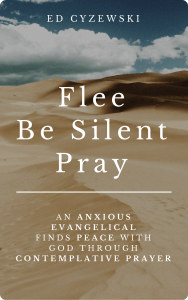
Based on my own resistance to and experiences with contemplative prayer, I’ve written an introduction to this historic Christian practice. The book is titled:

Flee, Be Silent, Pray:
Ancient Prayers for Anxious Christians

On sale for $8.49 (Kindle)

Amazon | Herald Press | CBD

Artboard 1FBP Blog Footer post release

Does Christian Spirituality Boil Down to These Two Questions?


planner-time-for-prayer

Christian spirituality often boils down to two questions: Do I have time? Will this work?

You could say these are chicken and egg questions. If prayer works, you’ll find the time for it. If you don’t find the time for prayer, it won’t work. If prayer doesn’t seem to work, you won’t find the time for it.

Find the time for prayer, and it will work… eventually.

This is why it has helped to compare the ways that the reflection of prayer resembles the reflection that goes into writing. The two use many of the same practices and mindsets. If I struggle at one, there’s a good chance I’m struggling at the other. My failures and breakthroughs in writing have helped me understand my failures and breakthroughs in prayer.

Writing is a lot like prayer since everyone thinks they can write, just as everyone thinks they should be able to pray. However, both require learning some basic disciplines, mindsets, and practices in order to make them more likely and more fruitful. True, anyone can and should pray. Anyone can and should write. However, just sitting down to write can be extremely frustrating. The same goes for just sitting down to pray.

Disciplines, structure, and the wisdom of those who have gone before us provide a framework that helps us stand. We learn within the security of these structures and disciplines. What we learn from others we imitate clumsily at first. Over time we find our own way forward.

In the case of writing, I’ve faced these questions about whether I have the time and whether writing will “work.” I’ve found that I had to spend years making time for writing, prioritizing it, learning from experts, imitating the masters, and failing a lot. The progress was slow and incremental.

We can find time for just about anything if we make it a priority. I have learned that prioritizing things like prayer, exercise, and writing means I have to really plan ahead during the day for things like:

  • When will I do the dishes?
  • When will I fold the laundry and put it away?
  • When will I sleep and when will I wake up?
  • How will I keep myself from wasting time on social media?
  • How will I focus on my work?
  • Some days go better than others with all of these tasks!

If I want to make the most of my writing time, I need to invest in things like:

  • Reading constructive books.
  • Free writing when I have a moment.
  • Jotting down ideas in a notebook or phone.
  • Practicing and stretching myself with new projects.

My growth as a writer is a lot like prayer in that I need to learn the disciplines of prayer, learn from people who have greater experience in prayer, and practice using them. Just trying prayer out a few times won’t give you a clear sense of whether it will work. It’s a long term discipline that you develop over time.

Will prayer work? Only if I make the time for it.

Can I find time for prayer? I can, but I’ll be more likely to do so once I see that it works.

If you’re uncertain, discouraged, or leaning heavily toward doubt right now, I trust that prayer is hard to attempt. Where do you begin if prayer has been a source of frustration?

I’ve learned that I need to begin with making time to practice and learning what I can.

We’re left with faith, believing that God is present already and that the greatest barrier in prayer isn’t coming from God’s end of things but rather training ourselves to become aware of God. We can step forward into prayer believing that those who seek will find. Mind you, we don’t know what exactly we’ll find when we seek. We can’t control the timeline of our seeking.

We can only control our schedules and what we believe about God: that God is present, that God is seeking us, and that the simple desire to pray is enough to begin making time for prayer.


Read more about the basics of contemplative prayer and Christian spirituality in my latest book:

Flee, Be Silent, Pray: An Anxious Evangelical Finds Peace with God through Contemplative Prayer

On sale for $2.99

Amazon Kindle | Amazon print | Kobo | B&N


Jesus Wasn’t a Monk but He Kind of Was


cave-prayer-contemplative-monk

Allow me to reveal just how Protestant I am. I’ve studied the Gospels closely and intensely for the majority of my life, but I rarely made any connections between Jesus and monks, starting with the fourth century desert fathers, right on through the present day. Jesus was out in the public eye preaching sermons and discipling people, right?

When I became more charismatic, I started tacking on “healing people” to Jesus’ list of activities.

What could Jesus possibly have in common with monks who hid in the desert, took vows of silence, and wove baskets or brewed beer (depending on the century) in their free time?

Sure, Jesus went off to pray in the desert for 40 days…

Sure, Jesus spent entire evenings praying…

Sure, Jesus had a vision of God while praying on a quiet mountain side…

Sure, Jesus got baptized in the wilderness and heard God call him his “beloved son”…

Sure, Jesus prayed fervently and personally with God during his most difficult moments…

Sure, Jesus told his followers to pray in the quiet and privacy of their own rooms…

Wait, that’s starting to sound a bit like a monk.

Mind you, there are all sorts of monks. Some are more chatty, some are more handy, some are more interested in preaching, and some are more interested in preserving the quiet, contemplative prayer practices that have been passed down by the historic church. I can’t imagine any Protestants saying that Jesus was particularly “monastic” in his practices or his ministry. I can, nevertheless, see the common threads between Jesus and the monks. They make a lot more sense when I start looking at the ministry of Jesus.

Jesus was kind of like a monk.

The monks also make a lot more sense when I remember that they were a reform movement in the line of a long history of reform movements that took to the desert and wilderness. When the prophets called Israel back to God, they often hung out in the wilderness. When John the Baptist began preaching about repentance… wilderness. When Paul needed to figure out the Messiah in light of Jesus… wilderness.

As Christianity rose in prominence, the monks recognized that the empire’s power and the influence of the clergy could become extremely toxic. They also fled the pleasures of the city, and even if Protestants would like to critique some of their negative associations with the body (Hello there, early church cultural captivity to Platonic philosophy!), we can sort of get it today. They wanted to remove as many distractions from the pursuit of God, and as Christianity grew in power and influence, they also wanted to avoid the temptations of church-based power.

Jesus didn’t go to the extreme of hanging out in a cave 24/7, but the more we look at the way he rejected the power centers of Judaism and any kind of official position within the religious hierarchy of his day, the more he looks like a monk.

The monks became a kind of expression of the Christian faith in a particular time and place, so the continuity and differences shouldn’t surprise us. Just as Jesus heard the voice of God loud and clear alongside a lonely river or atop a deserted mountain, the monks actively sought to hear the voice of God by pursuing solitude rigorously. Just as Jesus battled Satan during his 40 days in the wilderness, we have many reports of visitors to the cells of monks hearing them arguing with demons.

As a Protestant, I have long considered the monks a different class of Christian. Not necessarily a “higher” class (Hey, I AM Protestant after all), just a different class. They did spiritual stuff and experienced God in ways that I’ll simply never touch, right?

As a follower of Jesus, I continue to face the possibility that he was more like the monks than he resembles a lay person like me. He routinely sought quiet moments alone with God and even made great sacrifices in order to make it happen. Jesus modeled the daily pursuit of God within ministry, and he knew deep down to this core that he was God’s beloved Son, a Son that pleased God the Father.

The monks set off to their cloisters in order to uncover this mystery for themselves. How could the God of the universe love them so deeply and fully? They dropped everything in order to find out. They were so committed to this pursuit of God’s love that they didn’t want to risk confusing the praise of church leaders with the acceptance of God.

I’m still a Protestant, but I’m one of the growing number of Protestants who recognize that the spiritual practices of monks are deep, true, effective, and needed. The monks know a great deal about the presence and absence of God, the intimacy of Christ, and the ways that daily attentiveness to the pursuit of God can reorient our lives in ways that we can hardly touch through hours of diligent Bible study and historical-critical exegesis.

I’m not a monk, but I kind of want to pray like one because the monks were kind of like Jesus.


Read More about Contemplative Prayer…

After years of anxious, hard-working spirituality, I found peace with God by practicing contemplative prayer. I’ve written an introduction to this historic Christian practice titled:

Flee, Be Silent, Pray:
Ancient Prayers for Anxious Christians

On sale for $9.99 (Kindle)

Amazon | Herald Press | CBD

FBSP blog footer

Why Jesus Needed to Pray

wilderness-prayer

I’m not 100% certain about all of the reasons why Jesus needed to pray. The thing is, once I start asking why a member of the Trinity would find it necessary to pray for long stretches of time, it makes me wonder if I’m still missing something about prayer.

Why do I pray?

I pray out of fear or a sense of need.

I pray because I feel distant from God.

I pray because I hope to intercede on someone else’s behalf.

I pray to let go of circumstances.

I pray to say thank you—that is, if I’ve managed to loosen my grip on a situation long enough to wait on God.

You could say that my prayer life is very result-focused. I have an outcome or goal in mind. Even my moments of quiet prayer have a goal of sorts in mind. That’s not necessarily wrong. We are told to make our requests known to God and to even be as persistent as a woman who wakes up an unjust judge in the middle of the night in order to plead her case.

There’s an untiring tenacity that the writers of the Bible use to describe prayer over and over again. It’s not wrong to say that prayer can be result-focused. The difference is this: I wonder if sometimes I’ve made the mistake of ONLY being result-focused with prayer.

From the 40 days in the wilderness to the all-night prayer-a-thons that pop up throughout Jesus’ ministry, we can’t possibly think he spent the entire night making requests or saying thank you for things. There’s every reason to believe that he spent significant amounts of time before God in silence, especially since the Psalms, which many Jews had memorized, instructed him to do just that when praying.

I recognize that we’re well into the territory of speculation, but it’s reasonable speculation with a Biblical precedent. It’s not outlandish to presume that Jesus spent long stretches of time simply sitting, kneeling, or standing in stillness before God.

Such prayer leaves the agenda up to God, and nothing at all may happen. Then again, everything could happen. It’s not about what we say, think, or do. There’s no special incantation or procedure that you have to get “just right.” There’s just you and God and a quiet stretch of time that is open to the Spirit.

I suspect that Jesus craved this time with God the Father so much that he was willing to lose an entire night of sleep in order to make it happen. That strikes me on one level as a mind-blowing level of commitment since I’m a sleep deprived parent of young kids. And yet, many people who work out or pursue a serious hobby often sacrifice sleep in order to make it happen in the early or late hours of the day.

The same benefit of writing or running in the still, silence of the morning can be found in a late night prayer time that commits to both speak and listen to God the Father. I suspect that Jesus craved the simple, singular focus of his attention to God the Father. He knew that his days were filled with people making requests, asking hard questions, and traveling throughout territories that were sometimes hostile. Each day presented new challenges and conversations that were no doubt exhausting physically and could leave little time to focus solely on the Father.

There was nothing in the middle of the night that could pull his attention away from the Father. While I don’t know exactly how the Trinity works or how things lined up while Jesus was incarnated on earth, the simple answer is that Jesus craved uninterrupted attentiveness to the Father.

While surrounded with so many people who either misunderstood him and his mission or outright opposed him and even plotted his death, Jesus found his rest in solitude with the Father.

As an American, I’m obsessed with growth, progress, and results. I want things I can measure. I want to work on stuff and excel.

I desperately need to imagine Jesus venturing away from the city in order to find the quiet he needed in order to meet with the Father. I need to imagine him sitting down and letting go of the questions, controversies, and needs that surrounded him nearly every waking minute. In that solitude he is attentive to the Father without distraction, and like a warm breeze drifting from the nearby sea, his Father’s love settles over him.

Read More about Contemplative Prayer…

Based on my own resistance to and experiences with contemplative prayer, I’ve written an introduction to this historic Christian practice. The book is titled:

Flee, Be Silent, Pray:
Ancient Prayers for Anxious Christians

Amazon | Herald Press | CBD

Artboard 1FBP Blog Footer post release