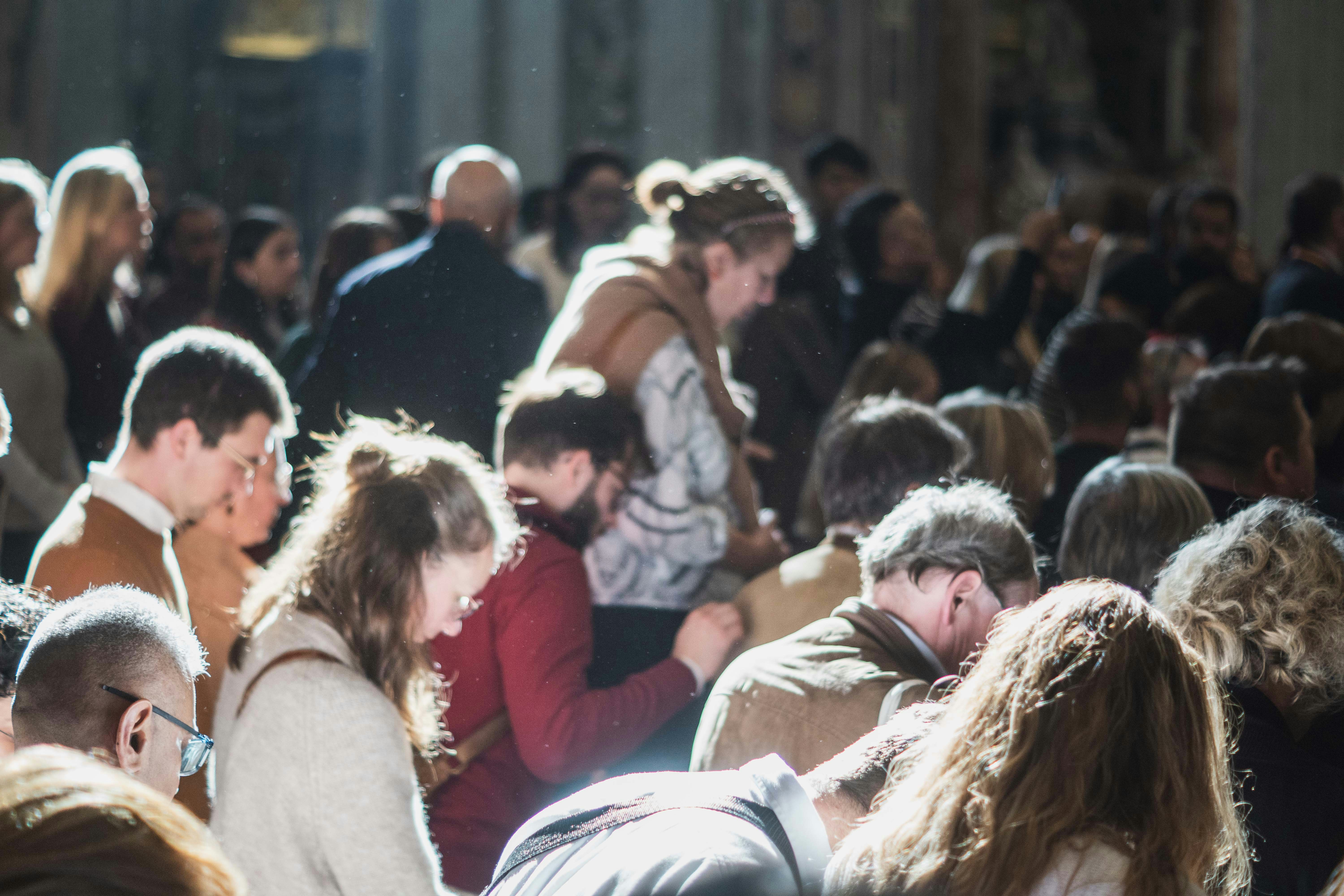
Church Conflict, Trust, and Each Person’s Starting Point

A few years ago, I passed through an extremely difficult season of conflict that involved reporting pastoral misconduct at our church. My own part involved trying to help our priest regain trust after we uncovered several instances of dishonesty. I wasn’t prepared for how quickly everything unraveled as we uncovered additional dishonesty, and things got really bad, really fast.

I have a lot of distance from that season of my life and have the benefits of time and healing to help me look back with a more analytical eye.

The writer in me can’t help thinking that I don’t want to have gone through all of that just to get through it. I hope that I can share a few things that will help others as well.

Some of the lessons are simple, if not a bit blunt. For instance, a dishonest, manipulative person in a position of authority gets ONE chance to come clean. After that one chance, do everything you can within the rules of your church to expose the dishonesty and take immediate action.

Others are a bit harder to explain, and the best I can come up with is this idea of each person having a starting point for handling church conflict.

Let’s begin by hoping for the best that each person has a similar way of processing church conflict and reported misconduct.

Starting Point A is where you learn about the misconduct.

Point B is where you consider all of the reasons why it could be happening.

Point C is where you arrive at a conclusion, whether through witnessing additional misconduct or hearing enough evidence from enough people who all corroborate each other.

Point D is where you are ready to take action based on your conclusion.

Now, here is the wild card in arriving at all of these points. Your personal relationships and trust level for each person involved will determine how fast you move from one point to another.

As a person in leadership at our church, I was one of a handful of people who started off at Point A where I learned about the priest’s dishonesty. I processed explanations, gathered evidence, and witnessed more incidents at Point B, arrived at my own conclusions at Point C, and then took action at Point D where we started having meetings to address the dishonesty.

What I didn’t fully grasp is that each person in leadership and then later in the church had to go through the same process I had just gone through. They had to learn about the dishonesty, process the explanations, accumulate evidence, and then come to conclusions as well.

Those who trusted me and knew me personally still had to go through that process, but their time going through it was much shorter than those who knew the priest well and trusted him. It took a lot longer for them to process the possible explanations and come to conclusions.

When I had been at Point D for a long time, ready to take action, it was hard to see some of my closest friends still at Point B, trying to figure out possible explanations for what had happened. Didn’t they believe me?

They did, but they needed to go through the same process I had just gone through. Mind you, they went through it faster because they knew me and trusted me. Yet, they still needed time to accumulate evidence. And once they witnessed more dishonest behavior, they were immediately ready to take action as well.

Looking back, even the people who didn’t believe me and initially concluded that I was a troublemaker came around to conclusions similar to my own. They just needed more time to witness the dishonest behavior. In retrospect, I have a lot more grace and understanding for them.

Of course, church conflict and pastoral misconduct can be quite complicated and painful, so my little diagram of points A to D won’t always apply perfectly. But it does help to see how we tend to process difficult situations and how personal relationships and trust determine how fast we process a difficult situation.

Even if I understood all of that, it probably would have still hurt a lot to go through it all, but I’m certain it would have hurt a good deal less.


Photo by Debby Hudson on Unsplash

Can Jesus Help Us Sort Out Politics in America?

The too long, didn’t read version of this post is: Maybe.

There is no simple equivalent in America to the political scene at the time of Jesus. We have to make interpretive decisions, and the track record of the American church in politics is… well… really BAD.

Compared to the time of Jesus, we don’t (yet) have an absolute tyrant of a ruler who is worshipped as a god or who is actively exploiting our country as part of a colonial military occupation (although the plight of the American south under white supremacy’s authoritarian violence shouldn’t be overlooked).

In a broad sense, our political situation today is very different from the time of Jesus.

Political opposition to Rome at the time of Jesus was easily lumped together with revolution. Violent forms of execution, like crucifixion, took care of the political opposition.

The Roman occupation government aimed to enrich the Roman Empire and its fake god-king. Government wasn’t by the people, for the people. There were no boot-strapping Jewish shepherd boys who could rise through the Roman political ranks and one day get elected to political office to make life better for the poor farmers and fishermen.

We can try really hard to determine some kind of equivalence between the sayings of Jesus and the politics of our times, but there isn’t a simple one-to-one correspondence between the challenges of his time and our own. Even if we tried, we’d likely never stop debating it.

What were politics like for the Jewish people?

At the time of Jesus, the only options available for the average person were compromise with the pagan Roman occupying army, as a tax collector for instance, or disengagement, either by keeping your head down or relocating to the wilderness like the Essenes.

The Pharisees and Sadducees tried to chart a course of engagement and faithfulness that often led them to compromise of one sort or another.

Of course you could always try out disengagement from Rome and pair that with revolution, but that never ended well.

There wasn’t a fruitful way to have a positive influence in politics without deep compromise to a government that believed its ruler was a deity and that its armies could plunder the world for its glory. We shouldn’t be shocked that we can’t find a simple correlation to modern democracy at the time of Jesus!

What great “What if?” question of Jesus and politics

We are left asking how Jesus may have interacted if he lived in a time of representative democracy. Would he have used the tools of politics to advance his Kingdom agenda? Would he have abstained from all worldly tools altogether?

Perhaps we can at least create some common ground among fellow Christians before we get into the more challenging issues. At least, what should be common ground…

For instance, we should be able to confidently assert that God favors no one nation over another. America is not the new Israel. We may aspire to be “a” city on a hill for democracy (even if “aspire” is doing some heavy lifting), but we are not THE city on a hill.

We should also be able to assert that God does not favor one political party or movement over another. The correction to the corruption of merging Christianity with one political party isn’t to merge Christianity with an opposing political party.

That should be the easy part of discussing Christianity and politics. (NARRATOR: It’s not easy actually.)

Political parties advocate for specific policies and approaches to solving real or perceived problems. I’d say it should be hard for us to imagine Jesus adopting a partisan stance or throwing in his full support of one political party or another. Yet, I also can’t imagine Jesus being completely disengaged from the political process if his vote could count toward meaningful change that would end suffering or advance peace.

This is where we need to be careful with our bias and limitations. It’s likely that we all want Jesus to arrive at the same assessments of our times as our own.

It’s very hard to open ourselves up to the Jesus revealed in the Gospels and to let that Jesus challenge us in our present time.

Which political positions align with the values of Jesus?

We could begin by asking what Jesus cared about. Put simply, he spent a lot of time feeding and healing people while teaching about the coming Kingdom of God. Since we should all, hopefully, want the government to avoid preaching for us, let’s focus on the healing and feeding part of Jesus’ ministry.

These miracles weren’t the equivalent of a parade handing out snacks and candy for fun. Jesus was feeding people who were likely very hungry and food insecure to one degree or another.

If Jesus didn’t heal people, they were stuck with suffering. Can we imagine Jesus wanting it to be harder for someone to see a doctor, to deny life-saving medical care to a child, or to see a mother needlessly die because an insurer ruled she has a pre-existing condition?

Healthcare should be part of the pro-life discussion today, but we are left to fill in the considerable gaps from the time of Jesus. There was no equivalent to a modern healthcare system at the time of Jesus. Can you imagine the Romans investing in a network of hospitals serving the people they had conquered?

If anything, we can find a few more clues in the Old Testament where the rulers of Israel and Judah met with judgment from God because they hoarded wealth, underpaid their workers, and exploited the poor. Rather than using the resources of government for the benefit of their people, they used it for themselves.

Of course, it remains extremely challenging to apply the ideas of an ancient theocracy to a modern democracy, but some patterns emerge. When God could have instructed the kings of Israel and Judah to rule as they pleased, to keep taxes as low as possible, and to let private charities help the poor, we find quite the opposite. A righteous ruler is just, attentive to the needs of the people, and takes action to ensure equity and prosperity.

By the same token, we have to do some interpretative work to arrive at a Christian belief in creation care—not hard work, mind. This shouldn’t be a difficult position for Christians to adopt by connecting a few dots.

Clean drinking water, clean air to breathe, and preventing warming trends that cause severe weather events should be VERY easy positions for anyone to support, regardless of their faith. Political leaders and parties can be challenged to work toward caring for the environment without creating a conflict between “affordable energy” and mitigating climate change or keeping water clean.

We can’t make a one-to-one correspondence with the politics of Jesus and our own times, but we can at least see why this is such a challenging task. At the very least, there is an Old Testament precedent for using government to benefit the people, especially those who have the least, and to ensure justice.

When Jesus didn’t have viable political tools as his disposal, he at least took concrete steps to care for the material needs of others through healing and feeding them. If we have the means to ensure others are healthy and well-fed through the tool of a government created for the people and by the people, I can’t imagine passing up such an opportunity.

We shouldn’t need specific commands to discern in good faith what matters to God. We don’t need God to command us, “Thou shalt make sure everyone has clean drinking water.” If one political party is negligent when it comes to pollution or installing new water pipes, aren’t they in conflict with the most basic part of caring for our neighbors?

Do we have to talk about abortion politics? Uh… Yeah.

Arguments over a consistent pro-life ethic have become a stalemate over the years. I don’t know any Democrats who want “more” abortions to happen. They want women to be free from the government regulating their own medical decisions, and late term abortions are incredibly rare and often only to save the life of the mother.

I am sympathetic with Republicans who oppose abortion because I was once in their shoes. Arguments over when life begins ventures into the realm of science where preachers and theologians are out of their depth. If life begins at conception and 10%-20% of pregnancies end in miscarriage (80% happen within the first 10 weeks), then God has created conditions where a lot of babies are being killed.

This all fails to bring up the real fact that abortions have historically gone UP under Republican presidents and DOWN under Democrats regardless of the laws that are on the books. Is abortion politics about ACTUALLY reducing abortions or just getting certain laws passed.

With the complexity of abortion politics aside, “pro-life” encompasses more issues than abortion, and so it is absurd to call Democrats “pro-death” or baby killers. Neither party is flawless when it comes to pro-life issues. I can see where both sides come from, but I tend to be more critical of the Republican positions that I know so well from within.

Which political actions are antithetical to Jesus?

Here we have a much easier time coming up with standards that can help us judge political causes today. Bearing false witness is clearly prohibited, Satan is called the “father of lies,” so anyone who lies repeatedly, say someone who is fact-checked to have lied thousands of times on the record, does not align with the way of Jesus.

Of course “truth-telling” can be a hotly debated topic when propaganda and half-truths are fact checked. Yet, we can avoid the “all politicians lie” trope by examining who is relying on a false version of reality vs. who has occasionally bent the truth in a speech.

Bending the truth should not be tolerated, but it’s not remotely comparable to a politician who refuses to be fact-checked, lest his torrent of lies is exposed for what it is.

We could argue that honesty and character flaws matter more than anything else because it doesn’t matter what a candidate says if he/she is exposed as self-serving and dishonest. A candidate could say he’s pro-life and favors particular religious groups as long as that serves his political fortunes.

Will that person actually follow through? Could that person shift positions if there is a future advantage? He already tried to back away from the Pro-Life movement, in fact.

Vote for such a man at your own risk.


It’s Always Jesus Plus Something

Jesus plus nothing image

“Jesus plus nothing” is a mathematical impossibility for our beliefs. 

I’ve started watching The Family on Netflix, a dramatized documentary of the Jeff Sharlet book by the same name. I always thought that I wouldn’t need to read Sharlet’s book because I knew enough about the dark underside of American evangelical Christians and politics.

I was extremely wrong.

Sharlet describes something larger than a secretive group seeking to influence politicians on specific policies through their offers of spiritual counsel and support. There is a kind of fraternity of young men who are trained on the surface to be simple devotees of Jesus alone while absorbing an extremely toxic authoritarian theology that believes these men are set apart by God to do great things, placing them on a level above the common person.

I have long wondered why so many evangelicals in politics don’t believe the rules apply to leaders exercising great power. This is because their status as leaders proves their blessing from God and thus overrides the other moral teachings of the Bible in service of the “higher” call to lead.

There is more than enough judgment for a woman who is labeled as a Jezebel or a “loser“ “brother” who leaves the group. Yet, a powerful Christian leader affiliated with the Family who lies, cheats, rapes, swindles, and commits any other sin to satisfy an insatiable pit of greed or envy is above all judgment and rebuke by virtue of his power and position.

This is an extreme form of Calvinistic fatalism that places virtually unlimited power in the hands of those presumed to receive it via divine decree.

The young men described in The Family have a well-meaning but malicious naivety and simplicity about the Bible made all the more menacing because of the rigid authoritarian structure imposed under the guise of brotherhood and fellowship. They claim to have a simple faith that is Jesus plus nothing, but in applying this formula to real life, there is a millstone’s worth of additions to this formula.

No matter how hard we try, something else will always spoil our illusion of clear vision.

If we dare to believe our faith is Jesus plus nothing, there most assuredly will be Jesus plus something.

Since it’s bound to be Jesus plus something, then we need to interrogate what that “something” is that we attach to Jesus. We have roots to our faith. Some roots are deeper than others, but each person who claims to only follow Jesus is living in an illusion of purity and clarity while carrying the obscurity of what has been passed from others.

When I read the story of the Prodigal Son, I don’t read it as a story of immigration and migrant labor. That’s because I read the Bible as a Christian with Jesus plus something, namely American prosperity.

When I read the story of Elisha and his care for widows and mothers in their times of need, I didn’t notice the ways that God was countering the unjust patriarchal systems of the time. That’s because I read the Bible as a Christian with Jesus plus something, namely white male assumptions of power.

When I read the story of the Good Samaritan, I tend to focus on the ways I can be a good neighbor rather than recognizing the ways prejudice and racism in my life prevent me to see how God is working among other races and nationalities. That’s because I read the Bible as a Christian with Jesus plus something, namely the assumptions of white privilege in a culture still influenced by white supremacy.

That isn’t to say that our goal to remove the things that obscure our vision of Jesus is hopeless. And there is still a space for simple practices of spirituality. In fact, I would argue that theology will be more complex than we would hope or believe, while our practice will most likely benefit us most if it’s simpler than we expect.

The people involved in the Family and other conservative branches of the faith tend to insist on keeping the beliefs simple, while imposing complex hierarchies and practices that seem to have a vague biblical grounding. Yet, these leaders insist that they are above scrutiny since there isn’t much to scrutinize. They just believe in Jesus plus nothing–and a long list of practices and rules and hierarchies that allegedly stem from Jesus and dare not be questioned by the rank and file lest they undermine their God-appointed leaders.

Jesus plus nothing gets complicated immediately.

In my book Coffeehouse Theology, I argue that we can have a simple faith and trust in Jesus, but it is necessary to also analyze, if not interrogate all of the other things we add to our faith on our own.

We each add something to our approach to Jesus based on our faith background, experiences, and awareness of other members of the faith. That doesn’t have to be a bad thing.

If anything, that should leave us humble and aware of our deep need for God’s mercy and the guidance of the Holy Spirit.

We should ask more questions, not less, about our beliefs, but in the day to day grind of life, we can practice a simple faith and trust in our Lord who is present and with those who call out for guidance and help.

If we have any hope in holiness and conversion, then we will surely need to rely on Jesus alone–although even our practices require discipline to set aside time and attention for God. If we hope to be present for Jesus without our assumptions and cultural baggage clouding our view so drastically, then we need to figure out what those somethings are and address them with clarity.

It’s never Jesus plus nothing when it comes to theology. It’s always Jesus plus something, and that something will change how we see Jesus until we figure out what it is.


Photo by StellrWeb on Unsplash

Spirituality Is Being Devastated by Technology

You don’t have to compare the quiet contemplation of a rural monastery to the digitized chaos of a major city to conclude that our world saturated in mobile devices and screens may not be the healthiest environment for humans.

Having said that, it doesn’t hurt to consider a few big picture aspects of a rural monastery vs. life in a city surrounded by screens of all sizes.

Consider this, the monk who divides time between prayer and working with his hands is generally focused on one specific task at a time. While working with his hands, he may well be engaged in a simple prayer as well.

The person in the city is surrounded by screens and has hundreds of opportunities for distraction and engagement. There are hundreds, if not thousands of attempts to catch his attention daily, and perhaps he gives in to a few and wastes some time. Then he feels badly about it, gets back to his work, and tries to forge ahead before succumbing again to another distraction.

True, we could be more connected with friends and family and colleagues by technology, but those technology networks are also a thousand points of entry for distractions, products, and who knows what else.

It’s not that we can’t use technology well. It’s that technology isn’t really designed to be used for our health and well-being, to say nothing of the impact of its distractions on spiritual vitality. It’s designed to sell us stuff and to capture our attention at every turn. Sure, you get the fringe benefit of connecting with people you love, but that’s not why the technology is there.

If technology only served to connect you with people you love and to make you healthier, then most of the technology around you would vanish.

I have been immersed in technology because of my work in publishing, and it is for good or ill. At this point in my life, I view technology is a kind of necessary evil that I am trying to manage well. In so many ways the screens in my life have a negative impact, but not entirely negative. Each day I am trying to mitigate the negative aspects and to build on the positive possibilities.

I do know that unchecked and used without awareness, technology today is generally a net negative. I’m hoping that with greater awareness and intention, technology can reach a kind of neutral ground where it is used with limits and restraint so that enough good can result in order to balance out its many possibilities for negativity and addiction.

I’m still in the early stages of this process, but I wanted to put some words down now. I didn’t want to post some findings or conclusions in the future as if they were the result of a brief period of consideration and study.

Rather, I’m hoping to gradually share my journey with technology and its impact on spirituality. I hope you can share in this process when possible so that you can use technology with greater intention and awareness.


Does Christian Spirituality Boil Down to These Two Questions?


planner-time-for-prayer

Christian spirituality often boils down to two questions: Do I have time? Will this work?

You could say these are chicken and egg questions. If prayer works, you’ll find the time for it. If you don’t find the time for prayer, it won’t work. If prayer doesn’t seem to work, you won’t find the time for it.

Find the time for prayer, and it will work… eventually.

This is why it has helped to compare the ways that the reflection of prayer resembles the reflection that goes into writing. The two use many of the same practices and mindsets. If I struggle at one, there’s a good chance I’m struggling at the other. My failures and breakthroughs in writing have helped me understand my failures and breakthroughs in prayer.

Writing is a lot like prayer since everyone thinks they can write, just as everyone thinks they should be able to pray. However, both require learning some basic disciplines, mindsets, and practices in order to make them more likely and more fruitful. True, anyone can and should pray. Anyone can and should write. However, just sitting down to write can be extremely frustrating. The same goes for just sitting down to pray.

Disciplines, structure, and the wisdom of those who have gone before us provide a framework that helps us stand. We learn within the security of these structures and disciplines. What we learn from others we imitate clumsily at first. Over time we find our own way forward.

In the case of writing, I’ve faced these questions about whether I have the time and whether writing will “work.” I’ve found that I had to spend years making time for writing, prioritizing it, learning from experts, imitating the masters, and failing a lot. The progress was slow and incremental.

We can find time for just about anything if we make it a priority. I have learned that prioritizing things like prayer, exercise, and writing means I have to really plan ahead during the day for things like:

  • When will I do the dishes?
  • When will I fold the laundry and put it away?
  • When will I sleep and when will I wake up?
  • How will I keep myself from wasting time on social media?
  • How will I focus on my work?
  • Some days go better than others with all of these tasks!

If I want to make the most of my writing time, I need to invest in things like:

  • Reading constructive books.
  • Free writing when I have a moment.
  • Jotting down ideas in a notebook or phone.
  • Practicing and stretching myself with new projects.

My growth as a writer is a lot like prayer in that I need to learn the disciplines of prayer, learn from people who have greater experience in prayer, and practice using them. Just trying prayer out a few times won’t give you a clear sense of whether it will work. It’s a long term discipline that you develop over time.

Will prayer work? Only if I make the time for it.

Can I find time for prayer? I can, but I’ll be more likely to do so once I see that it works.

If you’re uncertain, discouraged, or leaning heavily toward doubt right now, I trust that prayer is hard to attempt. Where do you begin if prayer has been a source of frustration?

I’ve learned that I need to begin with making time to practice and learning what I can.

We’re left with faith, believing that God is present already and that the greatest barrier in prayer isn’t coming from God’s end of things but rather training ourselves to become aware of God. We can step forward into prayer believing that those who seek will find. Mind you, we don’t know what exactly we’ll find when we seek. We can’t control the timeline of our seeking.

We can only control our schedules and what we believe about God: that God is present, that God is seeking us, and that the simple desire to pray is enough to begin making time for prayer.


Read more about the basics of contemplative prayer and Christian spirituality in my latest book:

Flee, Be Silent, Pray: An Anxious Evangelical Finds Peace with God through Contemplative Prayer

On sale for $2.99

Amazon Kindle | Amazon print | Kobo | B&N