Do You Want to be Made Well? Probably Not

20160318-barnimages-igor-trepeshchenok-03-768x514

“Do you want to be made well?”
 – John 5:6

That’s the question Jesus asked a blind and paralyzed man. The man was so focused on his own plans and solutions to his hopeless problems that he never even answered Jesus’ question. Perhaps that non-answer was answer enough.

It’s a good thing that Jesus wasn’t picky about his answer. I can relate to this man. Who hasn’t been so fixated on the solutions that work for everyone else? Who hasn’t looked at his own faltering plans and doubled down, trying to make them work?

There’s an even deeper issue at play, at least for me:

Honestly, I don’t want to be made well. Too often I choose to limp along or to stick with my comfortable half measures that make life tolerable. Actually moving into a place where I could thrive and experience renewal takes sacrifices, discipline, and, most importantly, hope.

Do I believe that God can make me well?

Do I believe that God offers something better than what I already have?

Do I believe that reaching out to God will change anything?

Who wants to make time for God if there isn’t a guarantee that prayer will “work” or that God can offer something better than what I already have?

Here is what I’m learning: I settle for far too little, far too quickly, far too often.

The first step you take is often the hardest because you don’t have hope or experience to fall back on. Beginning with prayer is the great unknown. Where is this going? Who knows?

I have learned that Jesus promises “Seek and you shall find,” but he doesn’t offer a lot of details about what exactly we’ll find. We’re seeking the treasure of the Kingdom, but we only have this guarantee: “You’ll know it when you find it.”

Who knows when you’ll find it.

Do you want to be made well?

Yes and no.

I want to be made well, but only if it’s easy and doesn’t cost much. I want to be made well if I can understand and, ideally, control the process. I want to be made well only if I’ve seen the solution work for other people so that I can imitate them.

The hardest thing about spirituality for me, and I suspect many Protestants, is grasping the amount of effort and will power it takes to daily surrender to the love and power of God. The life-change and healing we seek is 100% from God, but it takes everything we’ve got just to surrender and to trust completely. It takes so much effort to bring ourselves to the place where only God can work to heal us.

Healing will never come from our own plans, methods, and “medications.” We can choose to limp along with sleeping pills, wine, recreational drugs, consumerism, or sexual indulgences. We can choose to run from the pain of the past, the anxiety of the present, and the terror of the future. There’s no escape that we can engineer on our own. There’s no way to medicate this pain long enough. There’s no healing that we can engineer on our own that replaces the healing power of God’s loving presence.

As a new struggle, source of pain, or wound emerges in my life, I ask God yet again, “This too, Lord? Must I bring this to you, completely out in the open with a blind faith that you can heal this?”

Surrender is a life-long and daily struggle.

There’s no guarantee about what follows after the surrender, what the healing will be, or how long it will take. There’s no guarantee for anything other than the hope I can gather from past experiences and the experiences of others (including the stories of scripture).

Each time I bring my wounds and limps to the Lord, I find that it’s only through this bracing vulnerability and faith that I can find healing. It’s only through doggedly fighting to make space in my mind and in my day for God that I can expect to be made well.

Do I want to be made well?

Do I want to make time to be made well?

Do I want to make time to hear the voice of God?

Do I want to make space in my life for God’s presence?

Or do I want to keep limping along, hiding my pain and medicating it with the imperfect medications on hand?

You can be made well. I can be made well. I suspect that we can’t even imagine what God has in store for us. That may be the greatest challenge we face when it comes to answering Jesus’ question. Only Jesus himself knows how badly we need to be healed, and that’s why he isn’t picky about how we answer his question.

Whether we struggle with vulnerability or surrender, God’s mercy is more than enough to meet our great needs and weaknesses, even when we can’t manage to say one simple word: “Help.”


Read More about Contemplative Prayer…

After years of anxious, hard-working spirituality, I found peace with God by practicing contemplative prayer. I’ve written an introduction to this historic Christian practice titled:

Flee, Be Silent, Pray:
Ancient Prayers for Anxious Christians

On sale for $9.99 (Kindle)

Amazon | Herald Press | CBD

FBSP blog footer

I Resisted Winter and Missed the Renewal of Spring

The Contemplative Writer Twitter header.jpg

The kale we planted in the garden last spring grew into thick stalks all summer and kept our table supplied with greens. By fall the kale stalks were curling and falling all over themselves. Their leaves, which had been full, crisp, and green throughout summer started wilting, turned shades of brown and yellow, and finally succumbed to the constant attacks of tiny pests. By the time the cold winds of November swept the final leaves off the trees, our kale plants were little more than battered stalks with tiny bits of green poking out here and there. Yes, they were just barely alive, but they were far from healthy.

I don’t know why I waited so long to pull out the old kale. Maybe I was hoping that it would survive the winter and sprout new life in the Spring. I left it hanging limp and lifeless all winter. By the time the snow melted, the kale had all but rotted away.

As soon as the weather grew warm, I finally gave in and yanked the old kale stalks out of the garden. I poured new compost into the beds and raked it smooth. A few weeks later I scattered a new crop of kale and lettuce seeds into the orderly garden beds.

The new kale is going to take some time before it’s ready to eat, but I couldn’t hold onto last year’s planting. It had to go in order to make room for what’s next.

How long have I tried clinging to last year’s planting and held up the new things that must take their place?

I have been longing for the new thing, but have continued to cling to what is old.

I have become withered and overgrown, bitter and stagnant, but then I wonder why the new life hasn’t taken root and grown yet.

This week I had a chance to finally pull some old roots up as I make space for a new venture. The “Revert to Author” notice arrived for my first book that I wrote about theology. At the time I was one of many writers trying to sort out Christian theology and whether my faith could survive without the promise of certainty. Some are still wrestling with that question, some have moved on with their faith, and some needed to leave their faith behind. I have moved on with my faith, realizing that I didn’t need an airtight theology in order to have a relationship with a God whose top concern is love.

As I set aside my identity as a writer about theology and culture, I felt both a relief and a fear of what’s next. The fear of “what’s next” is why we often cling to what’s old and dying. We can’t imagine that something better is possible.

I made the mistake of thinking: Better to stick with the broken thing we understand than the new blessing we can’t fathom.

The same day that I signed my agreement to revert the rights of my theology book back to myself, I also continued to work on plans to launch a new website: www.thecontemplativewriter.com. This is a project that has been in the works for a long time, but I just didn’t see how to move forward with it. I kept plodding along with what I knew about theology, uncertain about what would grow if I pulled everything up and started all over.

I finally started planting new things a few years ago when I took a break from blogging about theology and then released Pray, Write, Grow: Cultivating Prayer and Writing Together. Since then, each step toward prayer and writing, or writing about prayer, has been affirming and life-giving.

It was a long winter, but I now see that I needed the winter. I needed a winter to kill what was no longer productive or life-giving. I needed winter to force me to uproot the past and to make room for what’s next.

Shifting to writing about prayer feels like the beginning of Spring. There is new life to this direction, and I’m finally realizing how I’ve held myself back by failing to uproot what I planted last season.

How many of us go into winter kicking and screaming, lamenting the loss of summer’s warmth and the brilliant colors of the fall because we lack hope for the future?

Perhaps fighting winter is a good sign at times. Perhaps we rightly see the good that we’ve had. I’m grateful for all that I’ve accomplished and learned from that last season. In fact, the things I’m planting today are benefitting from what I planted before.

For this new season, I need to keep writing on this website with longer form posts about prayer, writing, and Christianity, but I’m also making a new space for brief, daily posts about contemplative prayer. The site officially launches April 2nd and begins with regular daily posts (not Sundays) on Monday, April 4th.

My new site, The Contemplative Writer, will offer daily posts that provide guidance for daily prayer, Christian spiritual practices, and sources for meditation and contemplation. You can sign up to receive posts via email, the weekly email with highlights and a custom Examen, or follow through the RSS feed. In the coming month I hope to add more spiritual direction topics and a podcast version of the newsletter.

This website is what I’ve needed in my own life. It’s my hope that my own imperfect journey toward prayer and the wisdom of others will prove beneficial for you as well.

Visit The Contemplative Writer today.


When the Truth Doesn’t Help and God Is Hard to Find

unsplash_524000a90aaad_1

My pastor once asked during a sermon: “Who would you turn to when your life hits rock bottom, the theological know-it-all or the person who embodies the love and compassion of Jesus?”

Some may say that one need not choose between the two, suggesting that an unrelenting, uncompromising dedication to the truth is the most loving thing you can do. My pastor was aiming at something entirely different.

If you get the truth that Jesus and his contemporaries were communicating, you’ll start to embody his love and compassion. In fact, transformation becomes far more important than indoctrination.

I won’t say I’ve hit rock bottom, but our family is in a challenging, isolating season. It has felt like ALL HANDS ON DECK for months now, and we have no guarantee that it’s going to end soon. In the midst of it, someone said to me, “Remember, we have a great God.”

I’m not sure that “remembering” theological statements in this season has been that helpful. I have been far more in need of God’s presence and empathy rather than intellectual guarantees. It’s a similar principle to the story of Job: when difficulty strikes, theologizing should never come before empathy and presence.

I’m not shutting down the “thinking” part of my faith, tossing out my theology books, or leaving my Bible unread. The big picture of my life doesn’t boil matters down to an either/or proposition between theology and love/empathy. Perhaps I’m reacting against a proposition-based, theologically-driven form of the Christian faith that mightily feared not having an answer for a particular situation.

When life becomes difficult, this fragile form of the faith grasps for answers and throws around truth as if the people in a difficult situation could pose a threat to the stability of Christianity. What if someone’s trouble demands an answer that a proposition-based faith can’t deliver?

More than propositions, Jesus came to give us God’s presence. The assumption is that seeking first his Kingdom and his righteousness will ensure that things work out in the end. If anything, Jesus disrupted the answers of theological systems without necessarily tossing out theology all-together.

Jesus pointed us to the place where we can find God’s presence and experience union with God. I have grown suspicious of anyone who wants to debate that point or inserts caveats.

As life feels uncertain, and challenges pile up, I have longed for God’s presence more than ever. The people I’ve turned to for prayer aren’t the ones with all of the answers. I’m taking my weakness and fear to the people who will pray with compassion and love. These are the people who know the Father’s heart and can intercede on my behalf as fellow beloved children of God. These are the people who happen to have a sound theology, so far as I can tell, but that is only  because they have drawn near to the loving presence of God.


Read more about the basics of contemplative prayer and Christian spirituality in my latest book: 

Flee, Be Silent, Pray: Ancient Prayers for Anxious Christians

On sale for $8.49 (Kindle)

Amazon | Herald Press | CBD

Artboard 1FBP Blog Footer post release


Jesus Wasn’t a Monk but He Kind of Was


cave-prayer-contemplative-monk

Allow me to reveal just how Protestant I am. I’ve studied the Gospels closely and intensely for the majority of my life, but I rarely made any connections between Jesus and monks, starting with the fourth century desert fathers, right on through the present day. Jesus was out in the public eye preaching sermons and discipling people, right?

When I became more charismatic, I started tacking on “healing people” to Jesus’ list of activities.

What could Jesus possibly have in common with monks who hid in the desert, took vows of silence, and wove baskets or brewed beer (depending on the century) in their free time?

Sure, Jesus went off to pray in the desert for 40 days…

Sure, Jesus spent entire evenings praying…

Sure, Jesus had a vision of God while praying on a quiet mountain side…

Sure, Jesus got baptized in the wilderness and heard God call him his “beloved son”…

Sure, Jesus prayed fervently and personally with God during his most difficult moments…

Sure, Jesus told his followers to pray in the quiet and privacy of their own rooms…

Wait, that’s starting to sound a bit like a monk.

Mind you, there are all sorts of monks. Some are more chatty, some are more handy, some are more interested in preaching, and some are more interested in preserving the quiet, contemplative prayer practices that have been passed down by the historic church. I can’t imagine any Protestants saying that Jesus was particularly “monastic” in his practices or his ministry. I can, nevertheless, see the common threads between Jesus and the monks. They make a lot more sense when I start looking at the ministry of Jesus.

Jesus was kind of like a monk.

The monks also make a lot more sense when I remember that they were a reform movement in the line of a long history of reform movements that took to the desert and wilderness. When the prophets called Israel back to God, they often hung out in the wilderness. When John the Baptist began preaching about repentance… wilderness. When Paul needed to figure out the Messiah in light of Jesus… wilderness.

As Christianity rose in prominence, the monks recognized that the empire’s power and the influence of the clergy could become extremely toxic. They also fled the pleasures of the city, and even if Protestants would like to critique some of their negative associations with the body (Hello there, early church cultural captivity to Platonic philosophy!), we can sort of get it today. They wanted to remove as many distractions from the pursuit of God, and as Christianity grew in power and influence, they also wanted to avoid the temptations of church-based power.

Jesus didn’t go to the extreme of hanging out in a cave 24/7, but the more we look at the way he rejected the power centers of Judaism and any kind of official position within the religious hierarchy of his day, the more he looks like a monk.

The monks became a kind of expression of the Christian faith in a particular time and place, so the continuity and differences shouldn’t surprise us. Just as Jesus heard the voice of God loud and clear alongside a lonely river or atop a deserted mountain, the monks actively sought to hear the voice of God by pursuing solitude rigorously. Just as Jesus battled Satan during his 40 days in the wilderness, we have many reports of visitors to the cells of monks hearing them arguing with demons.

As a Protestant, I have long considered the monks a different class of Christian. Not necessarily a “higher” class (Hey, I AM Protestant after all), just a different class. They did spiritual stuff and experienced God in ways that I’ll simply never touch, right?

As a follower of Jesus, I continue to face the possibility that he was more like the monks than he resembles a lay person like me. He routinely sought quiet moments alone with God and even made great sacrifices in order to make it happen. Jesus modeled the daily pursuit of God within ministry, and he knew deep down to this core that he was God’s beloved Son, a Son that pleased God the Father.

The monks set off to their cloisters in order to uncover this mystery for themselves. How could the God of the universe love them so deeply and fully? They dropped everything in order to find out. They were so committed to this pursuit of God’s love that they didn’t want to risk confusing the praise of church leaders with the acceptance of God.

I’m still a Protestant, but I’m one of the growing number of Protestants who recognize that the spiritual practices of monks are deep, true, effective, and needed. The monks know a great deal about the presence and absence of God, the intimacy of Christ, and the ways that daily attentiveness to the pursuit of God can reorient our lives in ways that we can hardly touch through hours of diligent Bible study and historical-critical exegesis.

I’m not a monk, but I kind of want to pray like one because the monks were kind of like Jesus.


Read More about Contemplative Prayer…

After years of anxious, hard-working spirituality, I found peace with God by practicing contemplative prayer. I’ve written an introduction to this historic Christian practice titled:

Flee, Be Silent, Pray:
Ancient Prayers for Anxious Christians

On sale for $9.99 (Kindle)

Amazon | Herald Press | CBD

FBSP blog footer

The Hidden Cost of Free Stuff for Your Calling

office-professional-writer

I used to work with a youth pastor who had an “Aww shucks” way about him that hid a shrewdness that I’d associate with an oil tycoon or high stakes finance big wig. His office was littered with broken computers, sports equipment, and the literally “important” pile of stuff was always on the floor in front of his door. He looked like a classic youth pastor.

Those who thought they could boss him around quickly learned otherwise. He always had the right policy in place to keep the kids safe, each event had been carefully considered with the big picture in mind, and he always knew how to handle money.

Perhaps that last one about money impressed me the most because handling money has always been a mystery—at least, once you get past the part where I spend it on hockey tickets or a cheeseburger. Earning it and saving it have largely eluded me.

Whenever the youth pastor collected registration forms for any event or trip, he always asked for a modest deposit, typically between $10 and $20.

“The kids won’t flake out and the parents won’t forget if there’s a little money on the line,” he shared with me.

This, of course, is a pretty standard trick to prompt people to make a commitment. It was just the first time I saw how things worked behind the scenes at a church and an important lesson in the ways money changes behavior.

As I’ve taken one step after another toward my calling/vocation/career as a writer, I’m starting to see how the wealth of free writing and promotion tools has been a major set back in terms of my mindset and commitment level. In the past year I’ve started paying for more tools, and there’s an advantage in paying for tools, services, books, and even training.

While I love the democratic, accessible, free to join nature of so many internet tools, it does come with the very real risk of creating a culture of dabbling where creators fail to take themselves and their work seriously. Do we sign up for a bunch of free tools, play at writing, and then condemn ourselves to an eternal purgatory as a wannabe writer, photographer, or creator because we fear losing money or making a commitment?

Free stuff is great. Trying stuff for free is great. Freemiums are a super way to test out something without any financial risk. Free eBooks are really nice when you want the content in them. Free blogging tools, free social media services, and free management and marketing software are all wonderful for writers trying to get started on a tight budget. However, the inherent risk of setting up a free website, sending email newsletters for free, contacting fans for free through social media, and being able to set up eBooks for free by simply loading a Word file means that the point of entry is so low and accessible that we may never actually set worthy goals or take leaps of faith that actually require… faith.


In 2016 I wanted to finally take myself a little more seriously as a professional author, and one of the steps I needed to take was finally paying up for professional social media tools like Buffer, purchasing and learning Scrivener for writing and compiling eBooks, managing my invoices and expenses with Freshbooks (seriously, give it a spin and integrate PayPal for Business, it’s great!), and paying for the next level up in MailChimp (while giving ConvertKit a long look). It was time to graduate from all of the freemiums and to start using professional tools at a higher level just like any professional business venture.

Once I started paying a bit more each month for all of my tools, I started to think differently of myself and my work.

Were there ways I could improve my writing?

Could I write more books?

Are there ways to make myself more efficient?

Can I do a better job of planning my schedule each week?

I never thought of myself as puttering around or acting like an amateur, but the truth is that I hadn’t taken myself as seriously as I should have. I’d paid to attend writing conferences, but that didn’t translate into professional changes in my day to day operation. When I stopped trying to squeeze by with free, cheap stuff, I clicked into a mindset where I’d better make the most of the tools I’m paying to use.

The truth is that I run the risk of turning into a dabbler every day. I can switch from a person with a vision and calling into a person who just plays around with all of the free, cheap stuff and tries to just get by.

When I practice my Examen each evening, I try to look at whether I’ve stretched myself at some point throughout the day. The questions look something like this:

Did I step out in faith in some way?

Did I reach out to others vulnerably and honestly?

Did I need God or fall back on God in the course of my day?

Before you answer any of these questions or head off to guilt trip central with me, I want to suggest something very important. God is merciful and loving. God wants to restore us and when we are faithless, God is faithful. For every time that I’ve lost sight of the fact that God keeps calling me back to my writing work and the calling to write seriously, there is ample mercy and forgiveness that carry me back so that I can get my act together.

Dabbling isn’t an act of faith. I don’t need God’s help in order to play around in the fringes.

It’s not that spending money automatically means you’re living by faith. It’s not a magic trick. It doesn’t guarantee that you’ll end up where you need to be any more than a $20 deposit guaranteed that the high school students will show up for the youth group event. Life happens. Distractions come up. Nothing is certain.

But perhaps you’ve been on the fence, aimless, or discouraged. Maybe you’re terrified of failure. Maybe you want to just play it safe. I know that feeling well. Man, I love playing it safe. There’s nothing better than home base. Who wants to try something new, risk failure, and then have to learn from a bunch of mistakes?

NOT ME.

But I have some money on the line now. I’m taking little steps of faith. I’ve paid my deposit to keep pursuing my calling. I’m trying to avoid being an aimless dabbler. I’m trying to live by faith and to try things that require faith in God and, more importantly, God’s provision.

If I end up playing it safe today, I can fall back on God’s mercy and kindness. There’s always tomorrow. As my friend Ray Hollenbach says, “New morning, new mercies.”

Perhaps you can end your day by asking, “Where can I move toward living by faith tomorrow?” This isn’t about RESULTS or charts with gold stars or earned favor.

We’re learning to hear and then respond to a gentle whisper from God that sometimes calls us to take some big risks. We’re learning to put something real and tangible and risky on the line, trusting that God will go with us as we step out into the unknown, hoping that paying that deposit for the trip was worth it.


Why We Need the Wilderness

wildnerness-pray

Why did Jesus spend so much time hiding in the wilderness?

That strikes me as a terrible strategy for influencing the largest number of people. He was completely cut off from the existing networks and leaders who could help amplify his message.

His talent pool of potential apostles was also frightfully low in the wilderness backwaters around Galilee. How in the world would he find speakers, managers, and teachers educated and sophisticated enough to carry his message to enough people? Wouldn’t they just wreck what he started?

All of that time in the wilderness also made Jesus really inefficient with his time. He was always withdrawing to pray for long stretches of time. Didn’t his life feel a bit out of balance, always praying alone or teaching a few disciples instead of communicating to larger crowds on a regular basis?

Every time Jesus returned to the centers of power and influence, the religious leaders met him with strong opposition and applied one test after another to determine whether he was an insider or an outsider. If he refused to play their games, he most assuredly had to be an outsider.

Why did Jesus choose the wilderness?

He prioritized prayer.

He preemptively identified himself as an outsider so that his message did not depend on the religious establishment to prop up his ministry. He let the message grow on its own.

Notice that Paul did something very similar. He withdrew to the wilderness for a period of time and then let his message rise and fall more on its own merit and inspiration from God rather than depending on the leaders of the early church.

The wilderness is where we begin and build the right kind of foundation so that we actually have something worthwhile to say.

I confess that I didn’t start out loving the wilderness. I still have my gripes about it today.

I’m finally appreciating the value of moving forward at my own pace (God’s pace?) as the Spirit leads. I don’t kick and scream quite as loudly when I need to go into the wilderness. I can see how a seeming step backwards into the wilderness is the only way I can move forward.

Most of us don’t need one more thing to do. We need more wilderness, more space, and more withdrawal.

I remember reading piles of Christian books throughout college and seminary, and I started to hate a particular phrase: “We must…”

We must engage this, we must consider another concept, we must remember, we must do another thing, and we must keep adding one… more… thing… to do. The more a book said “We must,” the more I resisted the impracticality of its message. It seemed like every Christian book I read was an unintentional recipe for spiritual burn out.

Americans are a people deeply invested in doing. We’re optimistic work-a-holics who have a reputation for taking a fraction of the vacation time that the rest of the world deems essential. As a culture, Americans aren’t very good at withdrawing from much of anything. When we burn out, we immediately blame ourselves for not being strong enough, not being resilient, not being organized, or not hiring someone to help us do more.

If we try to fix a problem, we tend to fix it by adding “something” else to the mix rather than subtracting. If you want to fix your diet, you focus on eating MORE of something else, such as meat (hello, Dr. Atkins). If you want to fix your crowded schedule, you get a cool new app or five cool new apps that all sync together. If you want to fix clutter, you buy better storage containers.

As a culture, we don’t have much of a grid for disconnecting. We don’t naturally value the wisdom of those who speak from a place of simplicity and less unless that simplicity comes with a product attached to it.

Venturing into the wilderness doesn’t look like STRONG LEADERSHIP(TM).  We fear that the vision, strategy, and key results are all going right down the toilet when we step away. Perhaps they will. Then again, if we keep pushing, keep adding, keep trying to bear it all, we will break down, wear out, and burn out. We need the strength to admit our weakness.

It’s an act of faith to withdraw. I’m trusting God to provide for us and to guide us when I step back and make the nearly impossible admission that I can’t do it all, that I don’t know where all of this heading, and perhaps exerting more control is the worst thing for me.

Most importantly, when I look around and wish I had more influence or could expand my work to new, greater heights, that’s most likely the exact moment I need the wilderness. Growth that’s lasting and meaningful comes from the wilderness.

The lure of “I want it now!” success doesn’t mix well with the wilderness.

The wilderness will kill our drive for quick success. That’s why we need the wilderness.

Read More about Contemplative Prayer…

After years of anxious, hard-working spirituality, I found peace with God by practicing contemplative prayer. I’ve written an introduction to this historic Christian practice titled:

Flee, Be Silent, Pray:
Ancient Prayers for Anxious Christians

Amazon | Herald Press | CBD

Artboard 1FBP Blog Footer post release

What If We Defined Success as Freedom?

on-track-freedom

How many times have I made myself miserable by focusing on my unfulfilled hopes and desires?

How often have I stayed put for fear of appearing like a failure?

When haven’t I said that I’m not enough or not doing enough in order to meet a certain measure for success?

Sometimes life feels like an endless race where I just keep moving the finish line for myself. All it takes is a bit of unchecked envy or comparison to make me realize I’m doing everything wrong, am in danger of appearing as a failure, and at risk of being a lonely isolated failure forever. So I squint my eyes hard to look at that finish line and commit to work harder than anyone else in order to reach it before people learn THE TRUTH about me.

A New Standard for Success

Let’s forget that finish line for a second. Let’s forget what everyone else is doing.

What if that finish line for success and the fear of being found out as a fraud is actually holding you in bondage? What if the allure of freedom through success, money, influence, etc. is just a fleeting mirage of our consumer society? What if the people who appear to be on top are actually MORE TRAPPED than we are because they have all of the same fears as us and they need to maintain the appearance of having it all together?

I’m done with defining success as a particular accomplishment that we can measure with material possessions or online analytics.

Let’s define success as freedom.

Do you know that God loves you deeply and has sent you to love others?

Are you creating space in each day to rest in that love and in the presence of God?

Are you sharing that love and freedom in some way? Are you free to love your family and friends?

I’ve lived under the weight of anxiety, fear, and performing for others for far too long. Sure, there are many things that I can legitimately fear, but fear and scarcity become lifestyles that rob us of the gifts we should enjoy.

If you’re looking to define yourself or your day as a success, let’s ask this question: Am I living in freedom?

God Offers What We Need

The Gospel message that I have given my life to is about freedom, freedom in Christ and freedom through the Spirit. Our lives are hidden away in Christ and Christ lives in us. We have been set free for the purpose of freedom. This is the anthem of the Gospels and Epistles where Jesus and Paul repeatedly argued with people who wanted to add behavior requirements and mandatory rituals for followers of Jesus. Paul clearly stated that we don’t live in the freedom of Christ by subjecting ourselves to yet another written code.

The love of God frees us to love and serve others. There is a cost of following Christ, but there is also tremendous freedom as we drop the crushing weight of pursuing success and trying to identify ourselves by what we can earn or the influence we can gain.

It is extremely problematic to define ourselves by the flimsy judgments of others and the forces of the market.

I can’t do anything to make God love me more.

I can’t do anything to improve upon the freedom that God gives.

I can only choose to accept God’s freedom by faith and lean into it each day. That is where the real struggle of spirituality comes in for me.

Are You Thirsty for God? Then You Are In!

Each day I can either seek the presence of God and move toward freedom or I can seek outward measures of my worth and success. I can start to look at everything I haven’t achieved or I can rest in all that God has given me.

The good news is that even if we face this struggle daily, we can turn things around. We can stop the fear, anxiety, and longing for something, anything other than what we have.

Instead of working harder, getting more efficient, or adopting new ways to schedule productive days, we can opt out of the crazy, soul-crushing system. We can take the ultimate leap of faith into a moment of silence where we believe that God calls out to us: All who are thirsty, come!


What’s Your Next Step?

Keep in touch via my newsletter where I’ll share more “off the record” thoughts on prayer, writing, and caring for your soul. Sign up and receive two FREE bestselling eBooks.

Does this describe at least part of your writing career? Check out my book: Write without Crushing Your Soul. The eBook is usually between $1.99 and $3.99 on Kindle.

Dig deeper with some helpful books: Richard Rohr’s Immortal Diamond and Brene Brown’s Daring Greatly are among the most helpful books I’ve read.


The Gifts of a Cold Sandwich and a Book Released in Tragedy

roots-and-sky

During the first day of the 2012 Festival of Faith and Writing, I picked up my disappointing boxed lunch in a mostly deserted lobby at the arts building of Calvin College and regretted my decision. While everyone else I knew was going out for lunch, I was going to sit on a step and eat a cold sandwich by myself.

Way to network, champ!

Just as I was about to give up, I noticed an empty seat in a sitting area where five women were eating their equally cold and disappointing boxed lunches. I fought through my social anxiety and struggles with small talk, took the empty seat, and immediately introduced myself to the woman next to me.

Things started to look up immediately.

“Are you the Ed Cyzewski who runs the Women in Ministry series?” a woman across from me asked.

“That’s me,” I replied, relieved that the ice had been broken so fast.

It turned out that this woman, Angie Mabry-Nauta, is a pastor and had really appreciated the series on my blog where I hosted stories of women serving in ministry—a way that I hoped to outflank the tiring “women in ministry” debate. The woman sitting next to her was Christie Purifoy, a blogger and, at that time, aspiring author who had a freaky number of things in common with me.

  • Christie has a PhD in English Literature, the very degree that my wife has been working on.
  • Christie was pregnant and had a nearly identical due date as my own wife, who was pregnant with our first son at the time.
  • Christie also had plans to buy a house in the Philadelphia area, which happens to be my home town.

I exchanged business cards with Angie and Christie, found them on social media, and have since stayed in touch. Christie and I further connected as fellow writers on the Deeper Story website, which is no longer active.

Around two years ago Christie contacted me with some big news. She was finally sending out a book proposal to a literary agent. I enthusiastically read through her proposal and was completely riveted with her prose and story telling.

I’m terrible at endorsements and reviews, especially when I enjoy the book. Do I say it’s a TOUR DE FORCE!? A majestic triumph for the ages!!!!?? I can’t quite figure out the right tone and word choice for these things. It’s MUCH eaiser to be critical, right?

Truth be told, I’m picky, oh so terribly picky, about memoir. 80% of the memoirs that I pick up, I put down before the half way point. I don’t need simple, every day events imbued with embellished life-altering meaning. You ate a piece of bread and you thought some deep thoughts. Get over it and tell me something worth reading.

I’m the ultimate “get off my lawn” memoir reader.

Having said that, when I love a memoir, I really love it. For just a small sample:

When We Were on Fire? Amazing.

Any Day a Beautiful Change? Perfect.

Girl Meets God? Beautiful.

Tables in the Wilderness? I hate you, Preston.

Coming Clean? Breaks my brain.

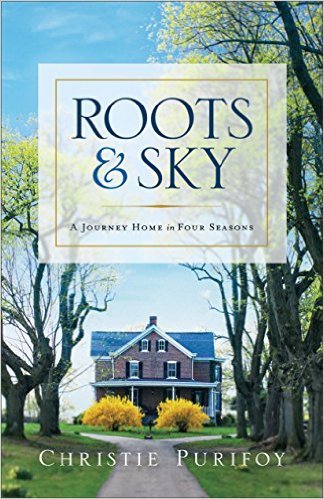
So when I picked up Christie’s sample chapters for her new book, Roots & Sky, I found artful prose and engaging description of the everyday without unnecessary embellishment. She opens up about the simple longings and desires we all experience and invites us to sit with her over tea or to take a stroll in her garden to talk it over. It’s perhaps cliché these days to say that a book “helps you find God in the everyday events of life,” but this book takes a very unique, artful spin on that concept that I found engaging and enjoyable.

I could not be more enthusiastic about this book, but just as Christie should be celebrating this beautiful book, tragedy struck her family. Christie’s brother-in-law, the husband of her sister, was one of the 12 Marines who appears to have perished in a helicopter crash off the coast of Hawaii. Christie has set off to Hawaii in order to comfort her sister and her four nieces and nephews.

I can’t imagine what Christie, her sister, and the rest of the family are going through during this time of tremendous loss. Perhaps as you read this post, which is being posted on Friday, January 22, 2016, the families will be attending a memorial service for the Marines.

Would you like to help Christie and her family at this time?

First of all, I know that they would all deeply covet your prayers—prayers for God to be near those who are grieving so deeply, prayers for God’s provision for this family, prayers for these children who have lost their father at so young an age, and prayers that God will sustain Christie at this time as she comforts and grieves.

Secondly, as Christie has stepped back to serve her family, a group of authors, bloggers, and friends have stepped up to help get the word out about this book. While there is undeniable tragedy and pain in this world, authors and artists like Christie are creating beauty, and we don’t want to lose sight of that. Here are some ways you can help:

Order your own copy of Roots and Sky: A Journey Home in Four Seasons. (pre-orders are especially helpful)

Post a brief review on Amazon, Goodreads, etc. Reviews are critical since so many people buy books online.

Share this book with your network: Check out this new memoir: Roots and Sky: A Journey Home in Four Seasons by @ChristiePurifoy http://buff.ly/1Ta6PLz.

I’m trusting that God is going to bless a lot of folks through this book, and I can’t wait for you to read it for yourself!

The Worst Has Already Happened and It’s Going to Be OK

danger-1166553-640x480

Failure, rejection, isolation: these are just a few of the things I fear on a day to day basis. Perhaps I don’t even take the time to reflect on what I fear the most. Fear can simmer in the back of my mind.

In our work, in our relationships, and in our spirituality, we often fear the worst happening.

I fear that no one will care about my next book.

I fear that the people I respect will reject me or, worse, ignore me.

I fear not having close friendships while everyone else has tight-knit communities who rally around them and cheer them on.

Writing has pushed me to face these limits in so many ways on a regular basis. On many occasions the worst has happened. I’ve faced all of these fears, and without a doubt they have left me devastated, sad, and despairing about the future.

Then something unexpected happened: the sun rose on another day, and another after that.

I didn’t really have any choice in the matter. I had to figure out what to do next.

I may have endured some of these struggles quietly, but don’t mistake that for handling them gracefully.

Facing failure, seeing my worst fears come to life again and again, and staring into the vast expanse of loneliness for long seasons pushed me to also see all of the unhealthy ways I’d relied on flimsy crutches to keep myself standing. Things such as the validation of the crowd or of specific authors and editors were given far too much weight in determining the value of my work and my progress in my calling.

Rejection today does not mean it’s inevitable for next year or five years from now if I keep working and try something different.

Most striking, the perspective I’ve gained after facing my worst fears revealed to me that so many of my worst fears were already realized long before I thought I was facing them. In many cases I lived in either delusion or ignorance, and it took falling on my face dramatically to finally remove my own blinders.

I saw the hard truth: while I feared that readers would be apathetic about my work, I could finally see in hindsight that very few people cared about my writing when I started out, and rightfully so. I needed a lot of time to work on it and to build deeper connections.

I don’t know how to avoid starting off so fragile. I know that the number one fear of bloggers is that no one will read their posts. So many don’t start because of this fear. I worked at my blog for several years without seeing much traction. It was the worst.

Then the sun came up again and again and again. I tried something different, and things finally started moving forward. I could point to several different factors, but perhaps I most needed to fail before I could figure out the right way forward.

With so many things in life we have to ditch the narrative of steady progress. Writing has showed me that it’s more like a series of wrong turns, crashes, and stretches of progress. I’ve been all over the map, and I don’t think I could truly move forward until I finally felt stuck, lost, or banged up beyond usefulness.

I had to be jarred from my daydream. It took failure to make me realize just how tough things were at the outset. And yet, once I saw how bad things were, I finally saw that things could may be OK if I kept moving forward.

I have no doubt now that the bad days will come again and again. I also know that there will be good days and even days of slow, incremental progress. I know that I have a calling to write, but that doesn’t guarantee a smooth trip forward.

Writing has served as a kind of lab for living. It has given me a much higher tolerance for pain and failure in other areas of my life. I am learning that I may fail others at times in relationships, but I can make progress in being more considerate or less controlling. I may really hate the first three months of running, but at a certain point I’ll start to crave my weekday runs. I may really struggle to focus for five minutes during prayer, but if I keep failing and trying month after month, I can build myself up to 20 minutes of quiet meditation that feel far more natural—and needed.

I still fear plenty of things. Worry is a lifestyle or habit that I’m learning to break. Some days I fail dramatically at trusting God with my worries and cares. I’m grateful that I’ve failed enough to know that tomorrow promises another day to take a step forward.

Can Parents Ruthlessly Eliminate Hurry from Their Lives?

clock-1529321-638x478

I read once that in the early days of his ministry at Willow Creek Community Church, pastor John Ortberg contacted a spiritual leader for advice (I think it was Dallas Willard).

“What do I need to do to be spiritually healthy?” Ortberg asked.

Long pause.

“You must ruthlessly eliminate hurry from your life,” he said at last.

That’s it. Willard refused to add anything else to his advice—not even a footnote.

That concept sounded challenging when I only had to manage myself and my anxiety-ridden mind. Now we have kids, and hurry just feels like the baseline for every day.

Before the birth of our first son, I asked a mother of three (now four) about the ways that having a kid changes your day-to-day life.

Her eyes grew big. “The nap,” she said. “Everything revolves around the nap.”

I only have two kids, but her advice has proven true thus far. Most days I can only make the nap happen if I hurry.

If you’ve ever seen a young kid completely losing it in a store, red-faced bawling and throwing everything while shrieking, “NOOOOO!!!!”, you have most likely seen evidence of either a late nap or no nap. Not every time, mind you, but this is a typical outcome for nap-less child.

I consider myself a spiritual or contemplative writer. I also spend about half of each day with our kids. Hurry feels essential to the latter even if it’s toxic for the former.

Most days it’s on me to get the kids home in time for their naps, preparing lunch, finding what they need for nap time, and setting things up for a smooth transition for when my wife comes home to put the oldest down for a nap.

If I’m late, there’s no wiggle room. Lunch is a long, slow, messy disaster where the older child spills milk frequently, food is chewed up and then thrown by the younger child, and both require constant prodding to take the next bite.

You could say that each day is like a stack of dominos where falling off course at an early point in the day makes it that much harder to knock out the next thing.

If the kids are late for lunch, then I can expect that they’re late for their naps, I’m late to my work, the chance of at least one kid having a melt down increases, the chance of short or skipped naps increases, and then an afternoon of over-tired and cranky kids increases.

There’s no single moment that is a make or break scene. A late nap isn’t a guarantee that the wheels will fall off. It’s more like you’ve loosened up the lug nuts on the wheels and taken a high-speed drive on a bumpy road.

In order to make the nap happen I have to manage the prodding of my children throughout the morning. If we’re going to the children’s science museum and still have time for lunch, the ideal is to leave the house by 9:30 am, and the prodding always includes negotiating, cleaning up spills, and multiple threats. The journey from the parking lot to the ticket desk to the play area requires SIGNIFICANT prodding to stay on track. Then the play time is followed by more prodding to get a snack and more prodding to get all the way back to the car and then, hopefully, a little prodding to get into the house.

I know that my tendency is to be a hurried, up-tight, no-nonsense parent. While we can’t stop and look at every single display in the science museum hallway, I began to wonder this fall if I needed to work on cutting back on the hurry in my life. I started to notice that plenty of parents bring their kids 5-10 minutes late for pre-school. Yes, our son prefers to be there early, but that has yet to translate into cooperation when leaving the house without a long list of conditions and needs.

There are times when we genuinely need to move faster in order to get the kids home in time to eat and then sleep. However, hurry has also become a default setting of sorts for myself.

Hurry becomes a lifestyle rather than an occasional tactic for moving kids in the right direction when time is of the essence.

I’m working on my awareness of hurry through my daily Examen practice. I want to know when I’m making too much of a small thing. I also want to extend grace to myself when I’m doing my best to handle a difficult situation.

I can feel the pull of hurry when I’m praying, meditating on scripture, reflecting on my day, or reading at the end of the day. There’s a pull to get this done and move on to the next thing.

With hurry, life becomes a production line where tasks need to be completed efficiently and production capacity is the only goal.

Hurry hates stillness and quiet.

Hurry hates “being” because it’s all about doing. Spirituality needs being in order to translate into doing.

Parents who want to cultivate a healthy spiritual life regularly face this gap between what spiritual leaders tell us we need and the meager scraps left in our days. This spiritual struggle while parenting small children is well documented in Micha Boyett’s book Found.

Must parents watch their spirituality whither away under the burden of hurry?

I’m very much in process here. I don’t have the answers. I do have an observation:

The spirit or mindset of hurry strikes me as a far greater threat rather than beating myself up over each time I have to hurry in order to keep our kids happy and sane.

I don’t want to let hurry become my default. I don’t want hurry to be a part of nearly every interaction with my kids.

And here’s the real kicker and perhaps the greatest trap of all: We can be in a hurry to get rid of… hurry.

I’ve been moving into a season of awareness and discernment about hurry. I don’t want to rush this. After all, I most likely became a hurried, worried parent gradually. What makes me think the solution will happen overnight?

I’m not in a hurry to address my struggles with hurry, and that feels like enough for today.