An Invitation to Spy on My Bookshelves

I have the honor of contributing to the guest series “Other People’s Bookshelves” over at Anne Bogel’s blog, Modern Mrs. Darcy. Anne is a talented writer who manages to read a ton of books, which she shares in her epic Summer Reading Guides each year, and who wrote one of the must-read books on time management, productivity and creativity.

In this post I share the books that are most important to me, what we read for fun, and why I used to hide my theology books.

Check out my bookshelves at Anne’s blog.

ed-bookshelves-for-bogel

When Prayer Is a Still Small Voice for Big Loud Problems: A Post for Preston Yancey

beuchnerquote1

A few weeks ago the upcoming memoir Tables in the Wilderness by Preston Yancey arrived on my doorstep. I started to casually read it. He’s a twenty-something writer who likes to cook and hang out with icons. I didn’t quite know what to expect. While I haven’t finished it yet, I’ve been completely delighted by his story and his masterful writing, and I highly recommend preordering it today.

Preston is also a passionate blogger who has kindly shared his blog, hosting me for a guest post adapting A Christian Survival Guide’s chapter about prayer.


Did you know that Jesus spent significant amounts of time praying? He regularly took trips into the wilderness and up mountains to pray for extended periods of time. It’s not exactly a hidden aspect of his ministry. It’s just one that I didn’t think about too much until recently.

Have you ever wondered why Jesus prayed so often?

Wasn’t Jesus already pretty tight with God since he was a member of the Trinity? The fact that he took time to pray is a Trinitarian brain bender. Wasn’t he still God?

If Jesus made prayer an integral part of his life, what makes us think we can do any better without it? If anything, Jesus sent us a very important message about the practice and importance of prayer. Our survival as followers of Jesus depends on it. If our Lord modeled prayer for us, then we’d better figure out a place for it in our lives.

Many Christians I know today, myself included, struggle with a condition I call “prayer guilt.” We all like to pray. We all see the value of prayer. We even pray most days. However, we always feel like we never pray enough. If we have prayed, we didn’t pray long enough or failed to stay focused while praying. I’ll even tell myself, “Sure I prayed, but the prayers weren’t very good.” It would be nice to at least have a vision or speak in a tongue or two before checking prayer off my “to do” list.

I’ve spent far too many days living with an underlying sense that I should be praying more or doing more for God. I can always think of someone who must be meditating longer, reciting prayers that are more ancient, or lighting taller, brighter candles. Whether or not I’m correct, that guilt leaves me feeling inadequate and unable to approach God with the kind of confidence that Jesus talks about.

Read the rest at Preston’s blog.

When I Was Ashamed of the Gospel: A Guest Post for Micah J. Murray

A Christian Survival Guide

Micah J. Murray is one of the most talented young writers I know. His blog Redemption Pictures is a must read each week. However, he does a lot more than blogging. He produces videos, designs websites, and, in his latest venture, designs t-shirts based on his most popular posts. I’m especially fond of this one:

LOVETHESINNER1


Micah was kind enough to share his blog with me so that I can post an adapted version of the Survival Guide’s chapter on sharing the Gospel: “Death of a Sales Pitch?” Maybe you can relate to feeling like you’re ashamed of the gospel if you aren’t out there sharing it all of the time…


When I realized I was ashamed of the gospel, I feared losing my salvation.

I’ve been told that REAL Christians share their faith and aren’t ashamed of the gospel. In fact, I’ve been told that if I didn’t share my faith at EVERY opportunity, I’m actually ashamed of the Gospel and Jesus would deny me (Matthew 10:33).

Talking to strangers is pretty much the last thing an introvert like me wants to do, but when an evangelism class in seminary required that I share my faith ten times every week, I finally had a crisis of faith and sanity.

I had constant anxiety attacks about evangelism . . . even while shopping . . . at Wal-Mart.

We could make ourselves insane with evangelism.

If every person is an eternal soul who could end up in hell suffering for the rest of eternity, shouldn’t we walk from person to person every minute of every day asking them if they know Jesus?


Read the Rest at Micah’s blog: Redemption Pictures.

A Guest Post for Rachel Held Evans: How God Handles Our Doubts

A Christian Survival Guide

I’m guest posting today for Rachel Held Evans today, which is both an honor and quite intimidating. Rachel wrote one of the best books about facing our doubts when she shared her personal faith journey in Faith Unraveled. It’s one of the books I recommend in A Christian Survival Guide because of its bracing honesty and commitment to exploring the scriptures. It’s also really well written–which is why it’s intimidating to guest post for Rachel. Thankfully, Rachel has been one of the most generous authors I know, sharing her place with anyone who may have something helpful to share with her readers.

In today’s guest post is adapted from A Christian Survival Guide and addresses the way God deals with Christians who doubt… which is the exact opposite of what I expected for most of my Christian life…


A few years ago I felt like prayer had stopped working. In fact, I began to doubt whether it had ever worked at all.

I was just talking to myself in an empty room. Quieting myself to “hear” God really didn’t work either. In fact, that just made things worse. The longer I waited with nothing happening, the more my anxiety kicked into gear, worrying that God really wasn’t going to respond.

I know that some Christians go through a season of doubt like this and can’t survive. They can’t find God and have to give up. In my own case, I held on. I can’t make it sound like I did something better. I just ended up in a different place after seeking prayer and counsel from trusted friends and family who walked with me through that season.

However, I know that many Christians and former Christians haven’t found the same resolution for their doubts. In fact, admitting your doubt feels like admitting failure, if not giving fellow Christians a reason to condemn and judge us for unbelief.

I’ve been on both sides of doubt, playing the part of judge at one point and doubter at another.

It’s easy to be dismissive toward those who have doubts because we really, really don’t want to have the same problems. It’s disturbing to hear that someone who grew up in the same church as you and attended all of the same Bible studies and prayed all of the same prayers is either doubting God or thinking of leaving the faith altogether. Let’s be honest about the problem here: If this person is about to leave the faith or has already left the faith, why can’t the same thing happen to you as well?

What should we do about doubts?

We don’t want doubts to linger, but we need to address them patiently and honestly. Where do we begin?

Read the rest of today’s post at Rachel’s blog.

What Is God’s Role in a Violent World? My Guest Post for Nate Pyle

I’ve known Nate Pyle through social media and blogging for about a year now I suppose, but we finally met in person at the Festival of Faith and Writing last Spring. We had a great chat during a writers happy hour, and I got to learn a bit more about his upcoming book and some of his writing projects, which are all fantastic. I’m really honored to contribute a guest post to his blog during the release of A Christian Survival Guide (which is $2.99 this week!), sharing an excerpt from the book about God and violence: “Deliver Us from God?”. When you’re done reading my post, make sure you subscribe to Nate’s blog and follow him on Twitter.


lewisquote


“The Lord is a warrior; the Lord is his name.”

Exodus 15:3


We don’t have to look further than the rubble-filled streets of Gaza to recognize our world’s problem with violence. From military conflict to mass shootings, violence is a common tool for solving “problems.”

A quick breeze through the pages of the Bible reminds us that nothing much has changed. In fact, it appears that even God resorted to acts of violence in order to solve “problems.”

There’s no getting around the words of scripture. God is described as a warrior in the book of Exodus. So, is it accurate to say that God is violent? Do we misrepresent God? And if God is violent, would we want to worship such a God?

Read the rest at Nate’s blog.

Buy A Christian Survival Guide and 3 Other Books for the Price of One

1404162367_thumb.png

Starting Monday, August 18th and ending Friday, August 22nd, three of my most recent books will be $2.99, and one will be $4.99. Best yet, my latest book A Christian Survival Guide is available as a free eBook on Monday the 18th only. Here are all of the details:


A Christian Survival Guide is also being offered at a steep discount this week.

On Monday, August 18th, it will be offered as a free eBook at select sites:

Amazon and B&N

Tuesday-Friday, August 19-22, it will be offered for $2.99. (See also the Publisher)

Print Copies: Get $3 off on Amazon this week.

Survival Guide Order Button


DISCOUNTED EBOOKS: The Good News of Revelation and Hazardous (a book about making the risky decisions that result from following Jesus), are both $2.99 at Amazon. Unfollowers is $4.99 at my publisher’s website. Scroll down for the links. All offers end August 22nd!


Publisher’s Weekly shared about A Christian Survival Guide:

“Cyzewski approaches each topic with candor, sharing stories that make it easy to relate to the topic at hand. While many of the topics are complex, he provides a point of entry into each and raises thoughtful questions about how much importance Christians can assign to aspects of the discussion.”

After you’re done reading A Christian Survival Guide, I’d love for you to share what you think in a brief review.

Thanks so much for reading!

CASCADE_Template
The Good News of Revelation
$2.99 on Amazon

Purchase from the publisher.

HazardousAngled-160_thumb
Hazardous: Committing to the Cost of Following Jesus
$2.99 on Amazon

Purchase from the publisher.

Unfollowers1-page-0
Unfollowers: Unlikely Lessons on Faith from the Doubters of Jesus

Purchase from the publisher for $4.99.


A Christian Survival Guide
FREE (Monday) or $2.99 (T-F)
Learn More Here…

Purchase from the publisher.

Note: All Amazon links are affiliate links. 

Thanks so much for reading my books. If you have a moment today to share this post using the social media links below, I’d be grateful.

Happy reading!

What Saved My Faith: A Synchroblog about Christian Survival and a Big Book Discount


synchroblog

I wrote last week about my doubts that arose when I didn’t receive any obvious manifestations of the Holy Spirit and God felt distant whenever I tried to pray. Much to my dismay, there wasn’t a quick fix to my faltering faith. I’m writing a follow up post as part of a synchroblog this week: What Saved My Faith? Synchroblog details are at the end of today’s post: 


When God felt distant throughout my early 20’s, I felt like my faith was completely breaking down. The only way to save my faith was to ask the question that I thought would mean losing it:

“Why has God abandoned me?”

What did my lack of charismatic experiences mean about my faith or about God?


I couldn’t figure out a way to make prayer work until I acknowledged that I’d hit a dead end. I had to admit that I was struggling to connect with God. In fact, one word sums my experience up:

SILENCE.


While I wouldn’t describe myself as particularly charismatic at the time,  I was used to spiritual experiences. I’d had many moments where the words of scripture seemed to jump off the page, and I sensed either an intense joy or sorrow. I’d felt conviction to make major life changes. I’d felt God’s presence while praying int he past.

However, one day it all just fell apart. I can’t say what exactly happened. It’s not like you plan for prayer to stop working or for insecurity to become the norm. Prayer, which had just flowed before, was riddled with uncertainty, doubt, and fear.

The Bible describes a present God who is able to meet people when they pray. That was not my experience.

I quickly became an anxious Christian. I wanted my spirituality to work, and if it didn’t work the way I expected it to work, then I feared that I’d been abandoned by God.

It’s not that I didn’t believe in God. I’d experienced too much. Rather, I just feared abandonment. All of the promises of scripture couldn’t squelch the burning anxiety that God had abandoned me.

“Where are you God? Why won’t you come near?” I asked each day.

I knew so many people who heard God speak, who experienced God, and who sensed God’s direction in their lives.

Why not me?


I had to start believing something without personal proof: What if God was near even if I couldn’t sense God’s presence? What if I had to remain faithful without any assurance that God saw me?

I had to learn how to wait on God.

I’ve been surrounded by Christians who talked about victory and breakthroughs, but I didn’t have any concept of a dark night of the soul. One thing pulled me out of my downward spiral into darkness: I relied on the prayers of others. 

First, I asked for prayer.

I asked for a lot of prayer, in fact. Each time I received assurances. I gave God every opportunity to tell me what I was doing wrong through the people praying for me. It turned out that I wasn’t living in sin or on the brink of being cast into the flames of hell or anything else.

In fact, my father-in-law sensed that God had imparted the Holy Spirit to me. If God wasn’t angry with me, I decided to take a different approach to prayer.

I prayed the prayers of others.

When you can’t find your own words to pray, the words of the Psalms and the historic church can serve as a real life saver. In fact, as I struggled with doubts and uncertainty during my dark night of the soul (or whatever one calls these things, I’m a Protestant, remember), I relied heavily on the daily prayers from the Divine Hours (buy the books or pray online).

The Divine Hours exposed me to all kinds of prayers: petitions, laments, praise, etc. I saw that doubt, dark nights of the soul, fear, and uncertainty came up quite a bit while praying. The majority of the readings were short passages of scripture, and I saw that waiting on the Lord comes up quite a bit in the Bible and especially in collected prayers in the Hours.

Psalm 5:3
In the morning, Lord, you hear my voice; in the morning I lay my requests before you and wait expectantly.

Psalm 27:14
Wait for the Lord; be strong and take heart and wait for the Lord.

Psalm 130:5-6
I wait for the Lord, my whole being waits, and in his word I put my hope.
I wait for the Lord more than watchmen wait for the morning, more than watchmen wait for the morning.

The Psalms are full of waiting, in fact.

So I started to wait. I started to rely on the prayers of others. Slowly, gradually, I learned to wait and trust God on my own.

The more I relied on the prayers of others, the more I say that my prayers were full of pushy petitions and demanding deadlines. I was asking God to show up in the time, place, and manner I specified. Perhaps my season of silence was God’s way of shutting down the ways I’d been trying to exert my control over prayer. Who knows.

I started waiting and praying the prayers of others, and I eventually began to sense God’s presence and voice again. In silence and in the recitation of scripture, I found a new path to God that didn’t rely on crafting clever prayers. In fact, prayer became peaceful and restful, inviting God to come and simply paying attention to however the Spirit would move.

I don’t think I could have figured out how to pray on my own. I had to experience the prayers of others and copy the prayers of scripture and fellow Christians. That felt like cheating. It made me feel like a failure, as if I wasn’t smart enough to sort this out on my own.

Rather than failing, I was actually learning what faith looks like. I was learning to stop relying on my won wisdom and to seek the wisdom that can only come from God alone.  By relying on the prayers of others, I finally learned what it means to pray in faith, waiting and trusting in the presence and direction of God.

The things that feel like threats to our faith are often just the necessary failure of flawed faith that must break down and shatter before real faith can take their place. 


This post is part of a synchroblog for the release of A Christian Survival Guide: A Lifeline to Faith and Growth  that’s answering the following question:

What saved your faith? 

Write a post this week answering that question and then scroll down to learn how to join the synchroblog.


A Christian Survival Guide is also being offered at a steep discount this week.

On Monday, August 18th, it will be offered as a free eBook at select sites:

Amazon and B&N

Tuesday-Friday, August 19-22, it will be offered for $2.99. (See also the Publisher)

Print Copies: Get $3 off on Amazon this week.

Survival Guide Order Button


How to Join the Synchroblog:

1. Write a post for your blog during the week of August 18-23.

2. Begin or end your post with something like, “I’m joining the synchroblog for the release of A Christian Survival Guide: A Lifeline to Faith and Growth by answering the prompt: ‘What saved my faith?'”

3. End with a link to today’s post.  (This is the short link: “http://wp.me/p36rtR-k5”). Add the link up information to your post, the synchroblog image, and end your post with a prompt like this: “What saved your faith? Write your own post answering that question and then visit www.edcyzewski.com to learn how you can join the synchroblog or to read additional posts to celebrate the release of Ed’s book A Christian Survival Guide, which is discounted on Amazon this week. “

4. Link to your post in the comment section on Ed’s blog post and tweet with the hashtag “#SavedMyFaith”. 

5. Read other posts by checking the comments or the #SavedMyFaith hashtag on Twitter. Then comment, tweet, or share the best posts you find!

3 Reasons Why You’ll Hate My New Book

lewisquote

I try to avoid reading reviews of my books.

OK, I admit, if it’s 5 stars or a glowing review in Publisher’s Weekly, I’ll probably read the review. Possibly even 10-15-80 times.

But the other day I saw the first one star review show up for A Christian Survival Guide. I didn’t read it. I was just passing along the link to the book’s page and didn’t scroll down to see anything else. However, I can pretty easily imagine why quite a few Christians will really hate this book.


1. Our Christian culture has confused certainty with stability.

There’s nothing wrong with being certain about what you believe. However, there’s a big problem when we expect everyone to follow our own templates for faith. We all pass through seasons of doubt, uncertainty, or personal struggle, and the results of those seasons will differ from person to person.

There’s no single template for followers of Jesus. And actually, if there was, the template for following Jesus would be doubt and confusion. Jesus’ followers had three years to get things straight about Jesus and what kind of Messiah he was, and they still weren’t fully clear about Jesus until the very end of his ministry.

My pastor has a saying that goes like this, “In Christianity, you either become a mystic or you become an atheist.” That’s an intentional overstatement, but he gets to the heart of things: Bible study and theological systems can’t handle everything life throws at us. We all have to sort through things in our own way, and oftentimes that means prioritizing the presence of God over theological certainty.


2. This Book Is Too Liberal and Too Conservative

When someone asks if I’m conservative or liberal in my theology, I usually say, “It depends who you ask.” I’m probably too conservative for the liberals and  too liberal for the conservatives. It’s not that I’m trying to land in the theological middle on every issue. Rather, I try to keep various perspectives in conversation with each other without always taking a side in each instance.

That will probably drive some people crazy. Remember, this is a book for people who are processing their faith and trying to sort out answers. If there’s a majority position that causes a lot of problems for Christians, I take some pretty major swings at it. If you love the idea of an end times rapture and hell being a place of eternal conscious torment, you’re going to really hate this book, because I present the biblical arguments against both of these positions.

That isn’t to say that one can’t believe in the rapture or hell as ECT in order to survive as a Christian. Rather, I’m helping people ask hard questions about these kinds of issues.


3. I Will Tip Some Sacred Cows

While I can’t cover every topic that may cause someone’s faith to falter, I’m also pretty frank in pointing out the kinds of issues that have become distractions from the core issues of Christian living. I write in the Introduction to the Survival Guide:

“When I speak of Christian survival, I’m talking about the real problems and doubts that can hinder your relationship with Jesus and your fellowship with others. In America we are bombarded with all kinds of campaigns, organizations, and agendas that are supposed to be important to us as Christians.

We’re told by politicians on both sides that we need to support legislation that will preserve the “moral character” of America. We learn that our country is either in danger of being taken over by maniacal socialists/fascists (which is an impossible mix by the way) who will turn America into Canada or that fundamentalists will turn our open-minded republic into the Holy Land Experience. Others warn us that men need to watch ultimate fighting or they’ll start baking cupcakes and give up their careers to stay home with the kids, and that women need to raise kids and bake cupcakes lest they spend their free time watching ultimate fighting.

We are bombarded by campaigns to build museums that tout certain agendas or prove certain views of the Bible. Some lament that America is on the brink of becoming a land crawling with atheists and therefore we need to buy a certain book, attend another conference, or believe some checklist of absolutes. Others fear that America is on the brink of being overrun with religious zealots who want to take control of the minute details of our lives.

I trust that the people behind such campaigns mean well and that they love Jesus, but these “important” issues are not essential for our faith as Christians. I’m far more concerned about getting the basics of Christianity right: learning how to pray regularly, how to commune with the Holy Spirit, how to love our neighbors, and how to read the Bible so that we can live in relationship with Christ and do God’s will on earth. If the basics are following Jesus, loving God, and loving others, shouldn’t we make our top priority the removal all of potential obstacles that could keep us from God?”


So you may hate this book. It’s a distinct possibility. Some people have already confirmed how much they disliked this book. However, I suspect that as annoying as this book will be for one group, it will be a lifeline for others. In fact, I’ve heard just that thing from many early readers who felt like I’d been spying on them and addressing the very questions that have been troubling them. It’s really impossible to answer everyone’s questions in one book.

That’s how faith works: it’s always shifting and moving. At least, that’s how it works for me. I’ve passed through different seasons. I’ve watched my faith change and grow and struggle and then shift. This is a book for a season of questions, seeking, and exploring. It’s my hope and prayer that you’ll find my book a helpful guide if you’re in that kind of season right now.


Check out A Christian Survival Guide today! You’ll… um… love it? 

A Christian Survival Guide


Get 5 FREE eBooks with A Christian Survival Guide

1404162367_thumb.png

I’ll level with you. I’m a writer, not a book promoter. However, over the next two weeks, I’m going to be promoting my new book A Christian Survival Guide: A Lifeline to Faith and Growth.

I loved writing this book. I’m working on loving the promotion of it. Every author tries to talk up their books without overwhelming friends and family with updates. So here’s the plan, my publisher and I have put together some different offers that will appeal to different groups.

Each offer is about giving readers a chance to get the best deal possible on my writing, whether that’s just A Christian Survival Guide or it’s a bunch of books I’ve written. For instance, if you’re relatively new to my writing, this week you can pick up six eBooks for the price of one.


Starting today, August 11th: Buy A Christian Survival Guide from my publisher, and you will receive a link to FIVE free eBooks at the end of the day that includes: the TWO full length Coffeehouse Theology Study Guides, Divided We Unite, Creating Space, and Why We Run from God’s Love. The offer ends Friday, August 15th.

Not convinced? You can also read a two-chapter sample of the Survival Guide for free over at NoiseTrade books.

Can you help spread the word? 

Get 5 FREE eBooks when you purchase A Christian Survival Guide by @edcyzewski at Kregel: http://ow.ly/zR9b1.


And just a heads up, I have no idea about the precise time this offer expires on Friday the 15th (I assume by midnight EST). So don’t delay, but if you do hit any glitches, please drop a comment to let me know!


What Saved Your Faith?

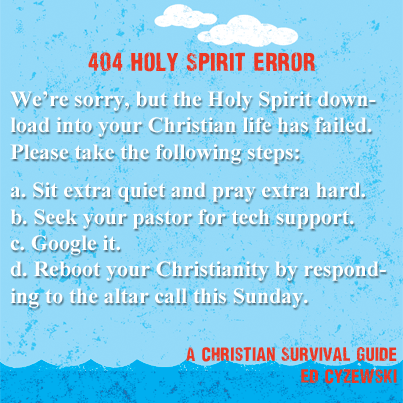
Holy Spirit Download Error

“Why does God bless some people and not others?”

That was one of the questions that almost ended my faith.

When I learned that miracles can happen today and that many had actually been healed, I had a brand new crisis of faith to consider. I met Christians who spoke in tongues, shared words of knowledge that were eerily accurate, and even healed people from various ailments. I saw a friend receive deep spiritual healing during a revival. I saw another receive a life-giving blessing.

Throughout all of this Holy Ghosting, I stood by, flat-footed and uninvolved. God hadn’t “poured out” his Spirit on me. I was just a regular old Christian with a Bible, notebook, and highlighter, learning more truth but not experiencing the kind of life the New Testament described.

Why not me?

Although there are many hucksters and abusers of spiritual gifts such as tongues and healing, I’d witnessed and learned about enough genuine encounters to know there was something to it. I wanted in. And when things didn’t start happening when I prayed for them, my faith took a nosedive.

What did my lack of charismatic experiences mean about my faith or about God?

I feared that I wasn’t a true Christian or that God had somehow found me unworthy. It wasn’t so much that I doubted God’s existence. Rather, I feared the end of my faith if I stepped out in faith, asked God for something, and then nothing happened. If I stepped out in faith and found only silence, I didn’t know what to do next. Should I just keep praying and waiting?

American Christianity has done a terrible job preparing me for patiently waiting on God or preparing me to deal with a spiritual “dark night” of the soul. We have language for quick fixes, processes, how-to manuals, and words like victory and break-through.

We hear a lot about break-throughs, but we don’t talk so much about breakdowns.

We hear about God delivering someone in the nick of time, but we don’t hear much about God being “late.”

I feared that the problem was inside of me and that God couldn’t or wouldn’t fix it. I feared that God was playing games with me, waiting for me to say the right words or to make the right sacrifice. If couldn’t figure out the code words, I couldn’t have the blessing.

In a sense, the hardest thing was simply letting myself ask that question. It seemed like the wrong kind of question for a good little Christian to ask. I feared the question and avoided it for years. I lived in fear and uncertainty.

The only thing that relieved the tension in my life was the moment I finally leveled up with a trusted mentor: “I don’t understand why God won’t bless me with the Holy Spirit?”

The day I asked that question, putting into words the seemingly irreverent if not downright heretical questions in my mind, I could finally do the one thing I wouldn’t let myself do: Search for answers.

We run from all kinds of questions, issues, and doubts. That running undermines our faith and alienates us from God far more than simply asking the questions we fear the most. In fact, there is freedom in simply asking what you’re not supposed to ask.

Starting Monday, August 18th, I’m going to blog about this question and some others that I wasn’t supposed to ask. These were some of the questions that guided my journey while writing my new book A Christian Survival Guide.

I’m inviting you to join me by writing your own post for a synchroblog. Here’s the prompt:

What saved your faith?


We face so many reasons to stop believing, so much discouragement, and face palm ourselves daily with the antics of certain Christians.

Why do you keep believing? What made the difference for you?

I’m inviting you to write about it and to link up for the week of August 18th. I’ll include some basic synchroblog information to include at the end of your post so readers can join in or read additional posts.

If you’re wondering how I resolved my question about the Holy Spirit and healing, I’ll write about that on Monday the 18th of August to kick off the synchroblog.


synchroblog


How to Join the Synchroblog:

1. Write a post for your blog during the week of August 18-23 about what saved your faith.

2. Begin your post with something like: “I’m joining the synchroblog for the release of A Christian Survival Guide: A Lifeline to Faith and Growth by answering this prompt: ‘What saved your faith?'”

3. End with a link to my post for Monday, August 18th (This is the link that is NOT live yet: http://wp.me/p36rtR-k5). Add the link up information to your post, the synchroblog image, and end your post with a prompt like this: “What saved your faith? Write a blog post answering that question and then visit www.edcyzewski.com to learn how you can join the synchroblog or to read additional posts to celebrate the release of Ed’s book A Christian Survival Guide, which is discounted on Amazon. ”

4. Link to your post in the comment section on Ed’s post and share it on Twitter with the hashtag “#SavedMyFaith”. 

5. Read other posts by checking the comments or the #SavedMyFaith hashtag on Twitter. Then comment, tweet, or share the best posts you find! I’ll make a round up on Monday, August 25th.