If a leader is too combative and controlling, there’s a reason for that.
If a spiritual teacher keeps giving you tasks and obligations, you’re not learning spirituality or how to abide in Christ.
If a theology system makes God sound like a monster, then you’re not learning about the God who is love.
If you are fearful of God, then your teachers and guides are in error.
You aren’t crazy. Trust your instincts.
Christianity shouldn’t be a series of inconsistencies and shocking incongruities to be accepted at face value.
There should be mystery and uncertainty when encountering the divine, but if you’re repeatedly running into one red flag after another, you can stop explaining away the obvious problems or treating them as inevitable.
You can stop listening to the leaders who demand the acceptance of inconsistencies.
If a system of theology appears to be controlling, oppressive, and harmful, then trust your instincts.
Ask questions, seek the wisdom of trustworthy women and men with more experience, and explore other traditions and perspectives within the faith. What you find may surprise you.
There’s a good chance that other people have already asked the same questions and raised the same concerns.
My faith has evolved from assenting to a doctrinal checklist to consenting to the loving presence of God without any expectations or demands.
My hands are no longer clutching lists of things to do or inconsistent doctrinal statements that require defending.
When all is well, my hands are open, ready to receive from God.
I’m still angry some days at the Christian machine with its demands, obligations, and hoops to jump through. I forget that God is present, views me as a beloved child, and desires that I share this love with others.
At the very least, I can approach each day with the relief that I’m not crazy, that so many of my instincts about Christianity have led me toward a more loving and generous spiritual practice.
I don’t have to run from questions, doubts, uncertainties, and incongruities. There is a lot that I’m still sorting out and recovering from, but the survival of my faith no longer rests in defending insufficient answers to eternally complex questions.
I can rest in the mysterious presence of God with open hands and a mind that is no longer trying to fit square pegs into round holes.
Growing up as an evangelical Christian, I frequently heard about the dangers of compromise. Oftentimes this type of compromise related to sexual immorality or false doctrine.
There was one type of compromise we never talked about in my circles: Racism.
The election of Donald Trump has made the gravity of this compromise particularly apparent, even if some evangelicals remain determined to deny it. If our tolerance, if not outright embrace, of racism isn’t the most serious compromise of the American evangelical movement, it most certainly is the easiest to spot, provided you’re willing to objectively look for it.
The reality of the evangelical movement today is that many white evangelicals have tolerated racism provided that politicians and leaders can deliver on other priorities, such as tax protections for churches, “freedom of religion” concerns, and anti-abortion policies. Abortion, of course, is the main issue that is used to justify the neglect of racial justice, conveniently forgetting that activists could advocate for the rights of the unborn AND racial minorities at the same time.
Instead, evangelicals have overlooked racist elements in our society, including housing, policing, incarceration, execution, and education policies. In the case of immigration policies, outright racism is cloaked by cries for law and order and national security, forgetting that immigrant crime tends to be negligible and that many come to America to flee the security threats in their own nations.
For many white evangelicals, racism and white supremacy have become an ingrained part of our identity and heritage. Admitting the depths of racism in our own lives, in our ancestors, and in the society where we enjoy many benefits and advantages isn’t just disruptive—it casts many of our assumptions about the past into doubt. The future becomes uncertain without our narrative in place.
It has been much easier for white evangelicals to ignore racism or to pick up the “what-about” tactics that are readily provided by the racist, white supremacist elements in the Trump administration. For those subjected to conservative media every day, it is preferable to throw out barbs about Hillary and Obama or black on black crime rather than confront the demons of racism in our churches and society.
We need a season of retreat and surrender so that we can allow God’s Spirit to probe our hearts, to confess our failures, and to stop serving the illusions of white supremacy that have been integral to our false selves. We need to be prepared to listen to those who are suffering under our current system, surrendering the lie that racism can be tolerated, provided that other issues are addressed by politicians.
The roots of racism and white supremacy run deep in America, and I confess that I have failed more often than I like to confront it, to learn about it, and to take steps to make things right. When I have spoken to activists about what I should do next, they have overwhelmingly told me to get educated about the nature of white supremacy and issues such as racism in the church, housing policies, incarceration policies, etc.
Evangelicals can talk about so many forms of compromise with ease, but once we bring up the compromise of racism, far too many folks become defensive. That strikes me as quite telling.
Along the way, contemplative prayer has helped me to let go of my illusions and defensiveness. By God’s grace I’ve become slower to speak and more willing to listen, but contemplation remains an essential, daily practice.
We have hard work to do. If my own ongoing process has told me anything, it’s that we won’t like what we find.
The good news is that the evangelical movement has a growing core of diverse leaders. They love the church, and they aren’t afraid to speak the truth we so badly need at this moment. Here are a few leaders you can begin to follow and then add the people they recommend:
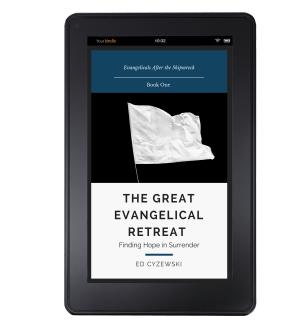
By the way… One of my aims in my new eBook series, Evangelicals After the Shipwreck, is to help evangelicals turn over the hardened soil of our movement by learning from the contemplative tradition of the church as we seek justice and restoration.
If there was ever a people who needed to step back and to take stock of their current situation, it’s us. If there is one reform group in the church we can learn from, it’s the desert fathers and mothers and the nuns and monks who responded to a corrupted church from the firm footing of solitude (You can download the first book for free here and the second book, Why Evangelicals Need the Wilderness, is $.99).
Growing up as an evangelical, I learned a simple question that determined what I should believe and how I should put my faith into practice:
WHAT DID PAUL DO?
If Paul did it, believed it, or even suggested it as maybe a good idea, then it was good enough for me. To my shame, I remember telling one of my Bible professors in college that it was more important in my eyes to study the epistles than the Gospels.
He gently suggested that I should reconsider that… and I certainly have.
Prioritizing of Paul aside, it is the great fortune of American evangelicals today that Paul offers us unequivocally excellent advice for our current situation where evangelical Christianity appears to be fragmenting, if not altogether collapsing due to political and cultural compromise.
Far too many evangelicals have aligned the Kingdom of God with a single political party and a patriarchal, white supremacist culture that idolizes power and wealth.
Christians throughout America are dropping the “evangelical” label because it has either become meaningless or has taken on far too many negative associations.
Evangelicals are mocked and disparaged because of the ever-shifting values and moral “standards” of a few talking head leaders who continue to work the political system for their own gain and a sizeable evangelical group that fails to see serious issues such as overt racism and xenophobia as deal breakers in their leaders.
Thoughtful hashtags are emerging around questions of evangelical identity and an evangelical future: #stillevangelical #exevangelical. Back in the early 2000’s we used terms like “younger evangelicals” (via Robert Weber) and “post-evangelical” to describe this fragmenting. Should we drop the label “evangelical”? Abandon the movement? Fight for it?
Significant portions of the evangelical movement are corrupt, but there are many positive members and hopeful signs emerging. Regardless, I am not personally interested in preserving a movement or a label. It may be more helpful to understand where we are, what God is saying, and to sort out what to do next with a clear head.
I’d like to suggest that there is a very simple and productive next step every evangelical can take in response to the failures and chaos of our current evangelical situation, and it conveniently meshes with what Paul did. You can even call it a “biblical response” for bonus points. Here is the plan, ready?
Retreat.
Not forever, but for a while. You could say that many of us evangelicals need to take a retreat of sorts from whatever we’ve been doing. We need to surrender for a season instead of constantly forging ahead, trying to make an overhaul on the fly.
I suggest this because many evangelicals are discouraged, confused, and uncertain about the future. We could stay in the chaos of our movement and try to sort out a next step, or we could retreat, wait on the Lord, and then move forward when we gain a bit of clarity.
Throughout the Bible and the history of the church, there is a pattern of reform emerging from prophets and communities in the wilderness or in solitude. From Elijah to John the Baptist to the desert fathers and mothers, to the many nuns and monks who reformed the church from the solitude of their cloisters, reform and prophetic direction has come from those who retreated in order to seek God before spreading their ideas more widely.
There’s a principle for prayer taught by Henrí Nouwen that we first need to let go of what we’re holding before we can receive something from God. A time of surrender and retreat before God can help us let go of the negative influences on our lives.
I suspect that we’ll look to different leaders and teachers as well as shift some of our priorities on the other side of this retreat.
Here is what Paul reported about his own retreat following his Damascus road experience when his entire world came crashing down:
“You have heard, no doubt, of my earlier life in Judaism. I was violently persecuting the church of God and was trying to destroy it.I advanced in Judaism beyond many among my people of the same age, for I was far more zealous for the traditions of my ancestors.But when God, who had set me apart before I was born and called me through his grace, was pleasedto reveal his Son to me, so that I might proclaim him among the Gentiles, I did not confer with any human being,nor did I go up to Jerusalem to those who were already apostles before me, but I went away at once into Arabia, and afterwards I returned to Damascus.” (Galatians 1:13-17 NRSV)
We don’t exactly know what Paul did in Arabia, but whatever God revealed to him brought him in unity with the rest of the church (Galatians 2:1-2).
At a time when evangelicals are distracted, divided, and uncertain about what to do about a movement that appears destined for the rocks, there aren’t simple answers or clear next steps. Perhaps we can relate to Paul, finding out that the cause we’ve given our lives to is, at least in part, misguided, corrupt, and even, at times, opposed to the very people Jesus dearly loves.
It’s safe to say that our own wisdom got us into this mess, so it surely won’t get us out of it. If anything, it’s going to just lead us into another mess.
I believe that God has not abandoned us, but if we have any hope of hearing God’s voice, we need to create space for God to speak. It’s not a mistake that John the Baptist proclaimed his message of repentance and restoration in the wilderness—preparing the way for the Lord. Jesus spent the majority of his ministry in relatively isolated spaces as well.
If you’re a discouraged or uncertain evangelical who is dispirited by our movement, then perhaps it’s time to step back. You may even hear the whisper of God to guide you forward, but first you need to venture up to the mountain to hear it.



 Ed Cyzewski: Author // Contemplative