What Saved My Faith: A Synchroblog about Christian Survival and a Big Book Discount


synchroblog

I wrote last week about my doubts that arose when I didn’t receive any obvious manifestations of the Holy Spirit and God felt distant whenever I tried to pray. Much to my dismay, there wasn’t a quick fix to my faltering faith. I’m writing a follow up post as part of a synchroblog this week: What Saved My Faith? Synchroblog details are at the end of today’s post: 


When God felt distant throughout my early 20’s, I felt like my faith was completely breaking down. The only way to save my faith was to ask the question that I thought would mean losing it:

“Why has God abandoned me?”

What did my lack of charismatic experiences mean about my faith or about God?


I couldn’t figure out a way to make prayer work until I acknowledged that I’d hit a dead end. I had to admit that I was struggling to connect with God. In fact, one word sums my experience up:

SILENCE.


While I wouldn’t describe myself as particularly charismatic at the time,  I was used to spiritual experiences. I’d had many moments where the words of scripture seemed to jump off the page, and I sensed either an intense joy or sorrow. I’d felt conviction to make major life changes. I’d felt God’s presence while praying int he past.

However, one day it all just fell apart. I can’t say what exactly happened. It’s not like you plan for prayer to stop working or for insecurity to become the norm. Prayer, which had just flowed before, was riddled with uncertainty, doubt, and fear.

The Bible describes a present God who is able to meet people when they pray. That was not my experience.

I quickly became an anxious Christian. I wanted my spirituality to work, and if it didn’t work the way I expected it to work, then I feared that I’d been abandoned by God.

It’s not that I didn’t believe in God. I’d experienced too much. Rather, I just feared abandonment. All of the promises of scripture couldn’t squelch the burning anxiety that God had abandoned me.

“Where are you God? Why won’t you come near?” I asked each day.

I knew so many people who heard God speak, who experienced God, and who sensed God’s direction in their lives.

Why not me?


I had to start believing something without personal proof: What if God was near even if I couldn’t sense God’s presence? What if I had to remain faithful without any assurance that God saw me?

I had to learn how to wait on God.

I’ve been surrounded by Christians who talked about victory and breakthroughs, but I didn’t have any concept of a dark night of the soul. One thing pulled me out of my downward spiral into darkness: I relied on the prayers of others. 

First, I asked for prayer.

I asked for a lot of prayer, in fact. Each time I received assurances. I gave God every opportunity to tell me what I was doing wrong through the people praying for me. It turned out that I wasn’t living in sin or on the brink of being cast into the flames of hell or anything else.

In fact, my father-in-law sensed that God had imparted the Holy Spirit to me. If God wasn’t angry with me, I decided to take a different approach to prayer.

I prayed the prayers of others.

When you can’t find your own words to pray, the words of the Psalms and the historic church can serve as a real life saver. In fact, as I struggled with doubts and uncertainty during my dark night of the soul (or whatever one calls these things, I’m a Protestant, remember), I relied heavily on the daily prayers from the Divine Hours (buy the books or pray online).

The Divine Hours exposed me to all kinds of prayers: petitions, laments, praise, etc. I saw that doubt, dark nights of the soul, fear, and uncertainty came up quite a bit while praying. The majority of the readings were short passages of scripture, and I saw that waiting on the Lord comes up quite a bit in the Bible and especially in collected prayers in the Hours.

Psalm 5:3
In the morning, Lord, you hear my voice; in the morning I lay my requests before you and wait expectantly.

Psalm 27:14
Wait for the Lord; be strong and take heart and wait for the Lord.

Psalm 130:5-6
I wait for the Lord, my whole being waits, and in his word I put my hope.
I wait for the Lord more than watchmen wait for the morning, more than watchmen wait for the morning.

The Psalms are full of waiting, in fact.

So I started to wait. I started to rely on the prayers of others. Slowly, gradually, I learned to wait and trust God on my own.

The more I relied on the prayers of others, the more I say that my prayers were full of pushy petitions and demanding deadlines. I was asking God to show up in the time, place, and manner I specified. Perhaps my season of silence was God’s way of shutting down the ways I’d been trying to exert my control over prayer. Who knows.

I started waiting and praying the prayers of others, and I eventually began to sense God’s presence and voice again. In silence and in the recitation of scripture, I found a new path to God that didn’t rely on crafting clever prayers. In fact, prayer became peaceful and restful, inviting God to come and simply paying attention to however the Spirit would move.

I don’t think I could have figured out how to pray on my own. I had to experience the prayers of others and copy the prayers of scripture and fellow Christians. That felt like cheating. It made me feel like a failure, as if I wasn’t smart enough to sort this out on my own.

Rather than failing, I was actually learning what faith looks like. I was learning to stop relying on my won wisdom and to seek the wisdom that can only come from God alone.  By relying on the prayers of others, I finally learned what it means to pray in faith, waiting and trusting in the presence and direction of God.

The things that feel like threats to our faith are often just the necessary failure of flawed faith that must break down and shatter before real faith can take their place. 


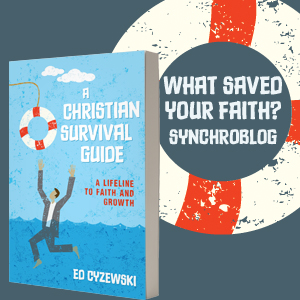
This post is part of a synchroblog for the release of A Christian Survival Guide: A Lifeline to Faith and Growth  that’s answering the following question:

What saved your faith? 

Write a post this week answering that question and then scroll down to learn how to join the synchroblog.


A Christian Survival Guide is also being offered at a steep discount this week.

On Monday, August 18th, it will be offered as a free eBook at select sites:

Amazon and B&N

Tuesday-Friday, August 19-22, it will be offered for $2.99. (See also the Publisher)

Print Copies: Get $3 off on Amazon this week.

Survival Guide Order Button


How to Join the Synchroblog:

1. Write a post for your blog during the week of August 18-23.

2. Begin or end your post with something like, “I’m joining the synchroblog for the release of A Christian Survival Guide: A Lifeline to Faith and Growth by answering the prompt: ‘What saved my faith?'”

3. End with a link to today’s post.  (This is the short link: “http://wp.me/p36rtR-k5”). Add the link up information to your post, the synchroblog image, and end your post with a prompt like this: “What saved your faith? Write your own post answering that question and then visit www.edcyzewski.com to learn how you can join the synchroblog or to read additional posts to celebrate the release of Ed’s book A Christian Survival Guide, which is discounted on Amazon this week. “

4. Link to your post in the comment section on Ed’s blog post and tweet with the hashtag “#SavedMyFaith”. 

5. Read other posts by checking the comments or the #SavedMyFaith hashtag on Twitter. Then comment, tweet, or share the best posts you find!

When Debating the Bible Isn’t Fair for Anyone

Bible debate fight

I’m no longer in the reformed theology camp. That isn’t a shock to anyone who knows me. I left it after being immersed in reformed theology in seminary.

Nevertheless, I would lose every debate to a reformed theologian.

But then every reformed theologian would lose a debate with me.

Here’s the thing: We’re both playing by different rules, and until we can admit that, we’re going to keep talking past each other.

We most certainly begin with different experiences. There’s no escaping the stories that send us speeding off in different directions. Sometimes we crash into each other, able to only see the present, and fighting tooth and nail against what is before us instead of all that has preceded it.

However, the main difference is that I play by different rules when I read and interpret the Bible compared to five or ten years ago. I could handle ambiguity and mystery, but now I’ve realized that comfort with uncertainty isn’t enough.

I needed to understand the role of creatively listening to the ways God speaks through scripture without necessarily looking for scripture to spell everything out.

That is not a very evangelical sentence. It most certainly doesn’t fit with many of the conservative reformed traditions I know.

I use the metaphors of blueprints and paintings in A Christian Survival Guide to describe these two ways of reading the Bible.  Here’s the full explanation:

“Sometimes I’ve used the Bible as if it was a blueprint that spelled out the precise way to live as a Christian. I expected everyone to believe and practice everything just like me. I’m sure you’ve attended churches where you feel tremendous pressure to conform in all areas. I once met a pastor whose church was considering firing him because he didn’t believe in the rapture. Other churches put pressure on families to conform to their specific biblical guidelines. I’ve had my own narrow theological guidelines that I’ve used to neatly divide my friends into insiders and outsiders.

Is the Bible supposed to do that? Does it give us specific guidelines to follow in any and every situation?

I have since found that the Bible functions more like a work of art.

We all know that paintings, poems, or stories have a range of meaning and can be interpreted in several ways within that range. As new generations view a painting or read a book, they can appreciate what it meant to the original author, what it meant to previous generations, and what it means to them in the present.

A painting can accurately portray an actual event. A poem can communicate a truth. Then again, there is a significant difference between a portrait that aims to capture a precise image of a person and an impressionist painting of a wheat field on a warm summer day where the wind gently courses through the heads of grain. In art and poetry, truths aren’t always dropped on us in plain, bold letters. We have to talk about them with others and think about them, returning to them over time to ponder the meaning further.”

There’s no doubt that sometimes a plain, word for word, literal reading of the Bible leads to a direct, unavoidable conclusion. I think we all try to read the Bible like this sometimes.

A conservative may argue that Jesus is fully divine and human because he stated, “I and the father are one,” adding that he was born of a virgin by the power of the Holy Spirit.

A liberal/progressive may say, “Christians should not support war because Jesus commanded us to love our enemies.”

Both adopt simple, literal reading of passages. Neither strikes me as a stretch, and both represent New Testament teachings that are worth affirming.

However, there are ways some conservatives explain away Christian opposition to war. There are ways some liberals explain away the divinity of Christ.

You would think that a clear, easily applied blueprint would lead all honest inquirers to the truth. It’s no surprise that followers of Jesus are fragmented and divided over how to read and interpret the Bible, but if we want understand why we are fragmented so much, we need to look at our starting assumptions about the Bible.

We all believe that the Bible is telling us how to do something, but we aren’t agreed on what that something is. If we view the Bible as more of a painting than a blueprint, then we have a place to begin:

The first and really only “how to” the Bible offers is this: “How to meet with God.” Scripture is a series of paintings that show how people have met with God and points us toward ways we can interact with God—through the mediation of the risen Christ and the Holy Spirit. However, we aren’t necessarily supposed to duplicate the details of these paintings precisely.

Just as a Picasso would feel out of place with medieval iconography, so too would a series of realist landscapes raise eyebrows in a museum filled with Jackson Pollock paintings and other modern works that defy a predetermined form.

The interpretive work of the Bible is a creative process where the Holy Spirit meets us in the pages of scripture and guides us closer to the presence and, consequently, will of God.

My more reformed friends begin at a different place, arguing that the Bible is God’s revelation for us that tells us how to live—that’s at least what I was told while immersed in conservative reformed theology. If you want to know how to conduct yourself, structure your church, or set up your family, look no further than the words of scripture for your inspired guide.

We’re both starting with different questions and assumptions about what the Bible is and how it guides us. When we discuss these differences, we could sell each other short if we make the mistake of assuming we’re both starting with the same assumptions and expectations about the Bible.

There are pejorative statements like, “Progressives have a ‘low’ view of scripture.” But then it’s really just a different view of scripture.

As my view of scripture has shifted from a blueprint to a painting, I’ve found that I take the Bible far more seriously now than ever before.  I believe that the Bible is a tool of the Spirit for ushering God’s people into his presence. I believe that the Bible is a guide for living, but it’s not necessarily a word for word blueprint for all people at all times.

There are times when we may interpret the Bible in a more straightforward, blueprint sort of way, but that doesn’t negate the fact that oftentimes we can’t simply drop the stories of another people at another time in history directly into today’s context.

If anything, the Bible shows us a God who is always reaching out to all kinds of people, using actions, symbols, and customs that are familiar to them.

Need a temple with sacrifices?  You got it.

Need to switch things up for the exile? No worries.

Want to obey the Law perfectly? Stop worrying about obeying the Law perfectly and just love people, showing mercy and compassion—even if that requires breaking the Law.

Ready for me to welcome all nations? Let’s drop mandatory circumcision and those rules about animals sacrificed to idols.

The Bible does not reveal a God of blueprints.

If there’s any blueprint for how God acts, it’s that God rips up blueprints, sets a table before us, and says, “Hey, let’s talk.”

Pick up A Christian Survival Guide to read more about how and why we read the Bible (see the chapter “The Bible: A Source of Crisis and Hope”) as well as how we interpret the Bible today (see the chapter “The Bible and Culture: Less Lobster, More Bonnets”).