Deliver Us from the Idolatry of Big Things

public-domain-images-free-stock-photos-high-quality-resolution-downloads-public-domain-archive-17-1000x750

If it wasn’t for the television ministry of a relatively affluent pastor of a long standing megachurch, there’s a good chance I wouldn’t have become a Christian.

My dad got saved because he happened upon Charles Stanley preaching about the prodigal son on television one night. My dad prayed to receive Christ that very evening and things haven’t been the same for us ever since.

I won’t paint catastrophic, apocalyptic pictures of two paths for my life. As if my life without Christ ends with me in a prison cell doing arm curls with a massive dumbbell, just living for the moment I can get a smoke in the yard. No, it’s a bit more mundane, but still sobering. I know that I would be largely at the mercy of my desires, anger, and anxiety because I battled them for years on my own and only found deliverance through God’s presence and intervention. That’s enough to make me eternally grateful for Charles Stanley’s massive church (we visited it, and the size of it is bananas) and their television ministry.

The younger Stanley, Andy, recently let his guard down a bit during a sermon and said that people who go to small churches are selfish and aren’t looking out for the best things for their kids. He said that big churches provide big pools of kids in their youth groups so that they’ll have lots of friends.

The lesson? Go to a big church if you don’t want to be a selfish person.

I watched the video with my jaw down. Did he just say that? Oh, he did. Andy later apologized on Twitter. But I think he let his cards show a bit during the sermon, don’t you think? More to the point, I think Andy’s little rant about big churches goes beyond an overreaction against people who criticize the size of his church. Sure, he has every right to be annoyed at the haters who can’t appreciate the value of his church, and we most certainly need churches of every size—we really do. Remember, Paul praised God for the simple fact that the Gospel is going out regardless of the preacher’s motives.

Let’s give Andy some grace for a moment and remember that we’re all tempted to treat big things as the best or ideal. Like Andy, we all have our own anecdotes about big things working and we imagine that’s really the only way to go. Most importantly, we face the temptation of measuring our faithfulness with numbers, and bigger is always better.

How many Christian ministers, writers, nonprofit leaders, and creators in all manner of professions automatically assume they’ve failed if they can’t build a large enough audience or reach a certain goal? In addition, how many spend time longing to imitate the size and success of those with larger audiences? How many of us have gone to conferences in order to guarantee audacious goals are crushed for the all things?

The temptation to compare is constant. I share about the danger of envy for Christian writers in Write without Crushing Your Soul, and the truth is that low sales numbers may mean it’s time to try something different, but they don’t necessarily validate or invalidate God’s calling on your life or the value of your work.

Bigger numbers don’t always indicate God’s blessing or calling.

Where do we turn if bigger isn’t always better?

This is where I show my charismatic Christian cards.

The times that I have sensed God’s presence and peace have been the times when I knew I was on the right track. Letting go of something that wasn’t right eventually brought a sense of relief and peace—if not immediately, then at least in retrospect.

Growing a big ministry or audience or anything isn’t always a blessing. For many pastors and creators, a big audience can lead to suffering or a downfall. Pastors burn out from the pressure and writers struggle to produce content to keep their readers happy. Some eventually break down and leave it all behind. I’ve seen it happen over and over again.

I don’t pray for big things. I pray for faithfulness. I pray that I can remove the clutter from my day long enough to hear God’s still small voice and that I’ll have the courage to obey it.

The results may be small. I may need to make some changes. That’s fine with me. I’ve seen big things and small things work.

After my dad got saved while listening to Charles Stanley, we started attending a small church of about 150 people in rural New Jersey. I made some great friends. Yes, our middle school group was small, but our church was a family. People genuinely loved each other and loved to share the Bible with others. While the particulars of fundamentalist Christianity introduced some negative elements at times, I never doubted that I was loved and accepted in our tiny church.

I never felt like I was missing out from the big church stuff. We had something precious and valuable in our little country church, and I wish folks like Andy Stanley could take a Sunday off to visit a church like that to see what I mean about that.

Our culture’s obsession with big stuff is an American-Made idol that we can all make the mistake of worshipping. Perhaps we can only find salvation if we sometimes intentionally seek God in the small things and quiet moments.


Carolyn Custis James Shares Why Our Notions of Manhood Matter

Presentation1 (1)

What does the Bible have to say about gender roles and masculinity in particular? Most importantly, does the Bible’s message on these issues have any relevance to both local and global events? You’ll find plenty of weighty Biblical reflection on these questions in the new book from Carolyn Custis James: Malestrom: Manhood Swept into the Currents of a Changing World.

I had a chance to preview the book and shared the following endorsement:

“Carolyn Custis James writes with urgency, clarity, and meticulous research about issues that don’t just concern every man, but relate to the health and stability of the entire church and our wider world. This is a call for men and women to live in the health and freedom of God’s calling for both genders”

Carolyn was gracious to respond to a series of questions about her new book:


What prompted you to write this book? 

My motivation for writing underwent a transformation in utero as it were. Initially, I wanted to tell the powerful stories of men in the Bible who have gone missing because they’ve been eclipsed by larger figures or downsized because we’ve viewed them through American eyes or a gendered lens. Men like Judah, Barak, Boaz, Joseph of Nazareth, and Matthew.

I thought it was time to take another look at these men.

As I began to research, my eyes were opened to a global male crisis of epic proportions—a powerful force that bears down on every man and boy as they battle to achieve and maintain their right to call themselves “a man.” Manhood, so it seems, is not a birthright. It must be earned by conforming to the prevailing definition of manhood in one’s particular culture. Definitions of manhood vary from culture to culture and tend to be a moving target in cultures like our own, where the definition changes from one generation to another and is never a one-size fits all definition. Inevitably some men and boys never make the grade.

The malestrom is the particular ways in which the fall impacts the male of the human species—causing a man to lose himself, his identity and purpose as a man, and above all to lose sight of God’s original vision for his sons.”

Patriarchy (“father rule”) lies at the heart of the malestrom. Trace any of the malestrom’s currents. Inevitably you’ll end up looking at patriarchy—a fallen human system that bestows power, authority, privilege, and leadership on men over women and children and also over other men. It’s destructive impact plays out in devastating ways in the lives of both women and men.

Christians tend to avoid the subject except to promote certain aspects of patriarchy (a “kinder-gentler” version) deemed “biblical.” From what I was seeing, I couldn’t in good conscience sidestep putting patriarchy—an issue so deeply problematic (to put it mildly)—on the table. It isn’t overstating things to say every man and boy is a victim of the malestrom.
Presentation1

Linking this male crisis to the maelstrom—those powerful whirlpools in the open sea known to drag hapless ships, crew, and cargo to the bottom of the sea—underscores the deadly seriousness of this crisis. When God’s sons forget who he created them to be and operate off-mission the effects are both devastating personally and catastrophic globally.

Here are just a few examples of the malestrom’s currents that cause men and boys to lose themselves.

  • Men and boys represent a staggering 30% of the millions of humans enslaved today. That’s roughly the population of New York City proper—men and boys trafficked for sex, forced labor, and soldiering.
  • A man’s sense of who he is as a man can be undermined by something as commonplace as a job loss, a demotion, a diagnosis, a foreclosure, a divorce, or simply the inevitable realities of old age.
  • Every Sunday in our churches, men are marginalized if they don’t show up with the right portfolio or pedigree. They are shamed in tongue-lashing sermons if they don’t happen to “man-up” to whatever definition of manhood a pastor embraces.
  • Even men who seem to “have it all” are just a coup or a phone call away from being dragged under by the malestrom. A man can hold the reigns of power in his country, only to be ousted or defeated by voters the next election. Then, who is he?

As I probed deeper, I discovered even more disturbing indications of just how serious a crisis this. Here is what the experts are saying:

  • Anthropologist David Gilmore linked “masculine pride” to violent conflicts in the world. He asserts that “such violence is ‘as much a product of a manhood image . . . as political and economic demands.”
  • Sociologists agree. They identify an “insidious link between masculinity and violence that fuels many of the wars that rage across our world.”

As I wrote in Malestrom,

“The need to establish and maintain one’s manhood drives men into violent action and exerts constant pressure for men to prove themselves. It fuels aggression, competition, and self-interest, and creates countless casualties at the giving and receiving ends of violence and injustice. It feeds the illusion that behind every change in the culture, every alteration in circumstances, lurks a threat to one’s right to call himself a man.”

The most bone-chilling discovery came when I read Middle Eastern experts, like Georgetown University Professor John L. Espiosito, who now are saying that young men are being drawn into the ranks of ISIS in “a search of a new identity, and for a sense of meaning, purpose and a sense of belonging.”

As one young ISIS recruit put it, “You go overnight from being an unemployed nobody to being a headache to the most powerful man in the world.”

Just this week, Rachid Ghannouchi, leader of the Tunisian Islamist party, made a comment with reference to politics and government that has profound relevance to a challenge the church needs to engage regarding masculinity and manhood: “The only way to truly defeat ISIS is to offer a better product to the millions of young Muslims in the world.”

This is the pressing challenge facing the church and the one I take up in Malestrom. What message does the Bible have that speaks into this crisis to give every man and boy an indestructible identity, meaning, purpose and belonging that will cause them to thrive as human beings? Will that message trump (apologies for using that word) other voices speaking false, inadequate, and ultimately destructive messages into the lives of men and boys?

I’m convinced that the insular debates in the church over rules and roles, who leads and who follows, and the “kinder-gentler patriarchy” currently embraced in much of evangelicalism ultimately miss the mark. But the powerful, counter-cultural stories of those missing men in the Bible help us to gain insight into the brand of manhood Jesus’ gospel brings.

I believe the church has a prophetic responsibility to address this crisis.

Malestrom is an effort to begin that discussion.


I love how this book has a very personal and global focus at the same time. Share a little bit about that. 

Considering the issues and the realities at stake, it’s hard to treat this crisis in a detached academic way. I’ve lost sleep (still do) over the crises, injustices, and atrocities against women and girls in today world. This project raised my level of concern for men and boys to full equality with my concern for women and girls. It’s hard to fathom the loss to the church and to the mission of God when my brothers set their sights too low and miss what God has in mind for them. As a woman and as a Christian, I have responsibility to do something about it. So yes, Malestrom is profoundly personal for me.

The global perspective is one of the distinctives of Malestrom and other books that I have written. The Bible is not an American book. It is a global book, and so is its message. Maintaining a global perspective changes the questions we ask. They get bigger and the stakes go up. Conclusions we draw from scripture must be applicable anywhere in the world.

Patriarchy is not the Bible’s message, as many of us have been taught. In fact, the Bible actually dismantles it. Patriarchy is the cultural backdrop that sets of in the boldest relief the radical, not-of-this-world kingdom message of the Bible. As Americans and westerners, we are as foreign to the patriarchal world of the Bible as anyone can possible get in today’s world. That ought to give us a massive dose of humility when we open the Bible and a willingness to seek help from people who know that world and can enlighten us.

Years ago I had the first of many aha moments in a conversation with a Tanzanian seminary student. When I asked him about his culture and what it meant for him to be the firstborn son in his family, his answer changed forever how I read the word “son” in the Bible. Understanding the world of patriarchy restores the power of the gospel message in extraordinary ways.


How would you address women who may say, “This is a book for guys”?

I would agree with them. I hope every woman who reads Malestrom will say that. In fact, Malestrom will make the perfect Christmas gift for the men we love. Sarah Bessey’s endorsement says it all:

“This is the book I’ve been waiting for—as a wife, as a mother of a son, as a woman committed to the blessed alliance God intended between men and women. This book will be healing and restorative for so many. It’s a beautiful invitation to manhood in the Kingdom of God.”

Frankly, I hope women say that about all of my books. Men need to read them too. As one man commented after reading my first book, “I know you wrote this book for women. I didn’t read it for women. I read it for myself.”

At the same time, Malestrom is absolutely also a book for women. We need to understand the issues facing men and boys and join in calling the church to engage this crisis.


What would you say to guys who don’t think this book applies to them because they’re egalitarian or progressive? 

I’m glad you raised this question.

It is a sad fact that, when it comes to gender issues, evangelicals tend to think in binary terms. We classify people, books, and ourselves into one of two camps—Complementarian or Egalitarian, traditional or progressive, as though this is the crux of gender issues.

Malestrom rejects that binary mindset by raising different questions. If you read my books through that binary lens, you’ll miss the whole point. A self-defined complementarian did. In his review of Malestrom, he wrote, “I have no dog in this fight” and proceeded to disavow patriarchy as having anything to do with his complementarianism. Instead of seeing the very damaging and dangerous global crisis that actually threatens him too, he shrugged and walked away without noticing real human lives are at stake. The issue I’m raising is deeper and far more serious that the issue he was trying to dodge.

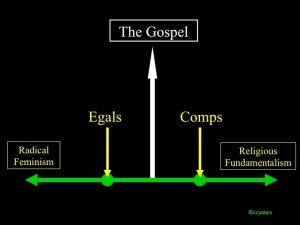
To be more explicit, this complementarian/egalitarian debate places the church on a continuum that, if taken to its extremes, ends up with religious fundamentalism at one end and radical feminism at the other. I’m convinced that Jesus’ gospel takes us off that continuum to a radically different counter-culture way of living and working together as male and female.

It is a frightening reality, but the egalitarian message is actually dangerous if preached in a full-fledged patriarchal culture. If a woman embraces an egalitarian manifesto in Saudi Arabia or Afghanistan, she could lose her head—literally. Complementarianism and egalitarianism can’t be lived out everywhere. But the Gospel can be lived anywhere. Even under burkas.

As Christians, we have important work to do that goes beyond deciding which camp we’ll join. There are deeper, global questions that need asking. How does Jesus’ gospel speak into the lives of every man and boy with indestructible identity, meaning, purpose, and belonging that is bestowed on him at birth by his Creator? How does Jesus’ gospel radically transform what it means to be male or female? And how are we supposed to be joining forces to advance his kingdom?

The issues at stake are global and alarming—no matter which camp you embrace. We have ISIS to consider.


Learn more about Malestrom here or visit Carolyn’s blog

image001

We Can’t Call America a Christian Nation if We Hate the Beatitudes


holding-the-bible-1498772-639x356

Last night the state of Georgia executed Kelly Gissendaner by lethal injection. For those who advocate that America is a Christian nation, we have once again demonstrated that many of these same Americans finds the beatitudes that Jesus taught reprehensible.

Jesus said:

Blessed are the merciful,
for they will be shown mercy.
Blessed are the pure in heart,
for they will see God.
Blessed are the peacemakers,
for they will be called children of God.
Matthew 5:7-9, NIV

Replacing the lethal injection with a life sentence would have shown mercy.

Allowing a woman to live rather than killing her would have made peace for the children who pleaded for their mother to be spared.

There’s no doubt that Kelly Gissendaner was guilty of her crime, and there’s also no doubt that she was killed needlessly and mercilessly by the department of corrections.

Kelly Gissendaner was guilty of convincing her lover to murder her husband Doug. The lover who actually committed the murder was sentenced to life in prison. Gissendaner was handed the death penalty. While in prison, Gissendaner became a sought-after mentor, a model prisoner, and a theology student committed to her faith.

Even with the death penalty looming, she repented of her sins and sought a new direction for her life. I believe that God, who has a habit of forgiving even murderers, offered Gissendaner the forgiveness she sought.

While the family of Gissendaner’s husband continued to advocate for her death until the end, her two children forgave her and fought to see her granted clemency.

Even Pope Francis advocated for an end to the death penalty in America and personally appealed for Gissendaner.

There are a lot of people in Georgia today who continue to argue that we’re a Christian nation.

There are a lot of people who believe that our department of corrections provides an opportunity to “correct” mistakes.

If we’re going to talk about Christianity, let’s talk about the beatitudes that Jesus taught: mercy, forgiveness, and peace.

If we’re going to talk about Christianity, let’s talk about Jesus hanging on the cross and forgiving the criminal who repented even in his last hours.

I could argue that the death penalty is wasteful, unjust, and illogical (killing people to prove that killing people is wrong), but my greater concern is that we actively live with a dissonance between the teachings of Jesus and the way our nation treats prison inmates.

Either we believe that the Gospel has the power to actually change a person like Dissendaner, or we admit that we’d rather have nothing to do with Jesus.

Either we believe that our department of corrections is blatantly failing inmates when they kill someone who had made corrections and posed no legitimate threat to anyone, or we have to accept that we’d rather kill or lock up those who broke the law without offering them any hope of working toward righting their wrongs and choosing a new direction for their lives.

Kelly Gissendaner committed a terrible crime that demanded justice.

She also made significant life changes since committing that crime.

The fact that our department of corrections recognizes the former without the weighing the significance of the latter highlights how some in our nation are so deeply opposed to the teachings of Jesus about mercy and peacemaking that they would rather kill needlessly than appear weak or soft on crime.

A reporter who witnessed the execution shared that Dissendaner was visibly emotional, apologized, prayed, and then sang Amazing Grace as the lethal injection drugs were administered.

“Amazing grace, how sweet the sound, that saved a wretch like me…”

If we don’t believe that someone like Gissendaner could be saved by God’s amazing grace and was worthy of mercy by our legal system, then perhaps we don’t fully grasp the depths of God’s grace and forgiveness.

Why We Need to Stop Talking about Spiritual Growth

ruler-1479782-638x480

I’m a competitive person. I love tracking my results against other people or even against myself.

In college I used to drive the 11 hours from my home to my dorm with minimal stops to try to beat my time each trip.

When I run in the morning, I want to go just a little bit further with each run, even if it cuts into my writing time.

When I set a word count goal, I’ll leave a wreckage of butchered words as my fingers fly across the keyboard.

I want to grow and improve. Why wouldn’t I want to get better at things I care about?

Now, if there’s one thing I care about, it’s Christianity. Heck, I plunked down thousands of dollars and untold hundreds of hours into seminary for four years.

I wanted to get better at studying the Bible, praying, and doing Christian-ish things. I was always measuring my progress. I wanted to grow spiritually. I wanted to know I was doing better from one year to another.

And good heavens, I burned out. I burned out over a lot of things, but in retrospect, I can see how the concept of “spiritual growth” tapped into the worst parts of my competitive drive.

Am I sinning less this year compared to last year?

Am I praying “better” than last year? (You know you’ve thought something similar at least once.)

Do I know the Bible better than last year?

My constant need to measure fits in well with our Christian subculture that recognizes the blessings of God and the gifts of individuals based on the dollars they raise and the numbers they lead in salvation prayers or baptize. The larger your church, the more influence you’re afforded.

Measure, measure, measure. We measure everything, all of the time. It’s no wonder we fall into this trap when it comes to judging whether we are spiritually healthy or not.

As I’ve confronted my own measuring mania, I’ve tried to move away from the language of spiritual growth. I don’t want to know if I’m getting better or improving or providing some metric of my spiritual awesomeness.

The truth is that I could pray a lot or improve my Bible knowledge and still be a wandering, self-centered mess without direction.

Speaking of direction, spiritual direction is just the sort of thing we need to talk about instead of growth.

Let’s talk about where I am and where you are right now and which direction you’re moving in.

We could also speak in terms of temperature, being hot or cold.

Jesus spoke in terms of abiding on the vine. If we abide in him and he in us, the life of God will be evident. Our direction or proximity tap into this idea of abiding.

What if we ditched the language of spiritual growth in favor of spiritual proximity (close or far, hot or cold) or spiritual direction?

Are we living close to Jesus? Are moving in step with Jesus? Are you close enough to Jesus to know whether or not you’re moving in step with him?

These have been helpful concepts for a performer like myself who will endlessly beat myself up for failing to attain certain spiritual growth goals. I can lose my connection with God as I focus on my weaknesses and supposed distance from God.

The past two weeks have been really full with tired kids and lots of additional work. Sleep deprivation from kids is nothing new. I’ll also never complain about having a lot of work to do.

However, as I took stock of my direction and considered my spiritual “temperature,” I honestly had no idea where I was pointed. I felt like I was just running from one thing to another. As I considered my temperature, I felt the chill of being far from God’s presence.

I hadn’t cleared very much space for God over the past week, and I felt the lack in my soul. As I consider that we could “lose our souls” in the midst of busy schedules, I took more intentional steps to create space over the past few days for abiding, prayer, and meditating on scripture. I wasn’t measuring anything. I just tried to be present for God.

I skipped the part where I beat myself up for being a spiritual slacker. I didn’t lament that I’d lost ground in my race to grow spiritually.

I reoriented my life. I shifted my priorities. I changed how I spent my time.

As I stepped into greater awareness of the state of my soul and the presence of God, I felt the crazy of the past few weeks buzzing through my body. The residual anxiety that had followed me throughout each day finally emerged.

This morning I was driving my oldest son over to a friend’s house. He had asked me to play music because he loves anything with loud drums. We chatted about the way the music gets quiet and louder “on its own” during different parts of the songs. He noticed the “jingle bells” that the drummer played during the bridge and celebrated the booming bass drum by shouting, “BIG DRUM!”

As I turned off the highway, I realized that, for the first time in several weeks, I was completely at rest. I wasn’t buzzing with anxiety. I wasn’t worried about anything known or unknown. Mind you, I can flip that anxiety switch on in a second. It doesn’t take a lot.

However, it was a relief to know that a few days of attending to my soul and more actively creating space for prayer and devotion could actually result in God changing the direction of my soul.

Before I realized what I was doing, I naturally resolved to make myself feel even more relaxed and at peace with God tomorrow.


Read more about the basics of contemplative prayer
and Christian spirituality in my latest book:

Flee, Be Silent, Pray: Ancient Prayers for Anxious Christians

On sale for $9.99 (Kindle)

Amazon | Herald Press | CBD

FBSP blog footer

If There’s a Slippery Slope, Then Jesus May Be Leading Us Down It

slipper-slope-Christian

The fear of the unknown has been a powerful force for Christians over the years. If you let go of a particular doctrine, welcome a particular person, or adopt a particular belief, THERE’S NO TELLING WHERE IT COULD LEAD!

It’s amazingly effective for several reasons:

  1. There is no way to effectively dispute the future. It hasn’t happened yet.
  2. It doesn’t actually engage an idea or its implications for the present.
  3. It aims to keep listeners reliant on authority figures and gatekeepers for protection.

I’ve used the slippery slope argument myself in the past.

One day in seminary we were discussing Christian unity, and I mentioned my horror over a theoretical “liberal” Christian teaching my child’s Sunday school class. “THINK ABOUT THE CHILDREN!!!” There’s no telling where a liberal teacher could lead my children…

My professor, who had a good bit of conservative Baptist in him, pushed me to rethink my fear-based logic.

A good ten years of living with the Gospels has helped me see how unhelpful it is to live by fear in the first place, to say nothing of asking who or what we’re supposed to put our faith in to begin with. Didn’t Jesus say he was leaving his followers with peace after all?

If we are interacting with anything, be it theology, a social issue, or a political cause, from the position of fear and uncertainty about sliding down a slippery slope into the great and potentially terrible unknown, let’s at least ask if we’re using fear to excuse ourselves from engaging with ideas we’d rather not face. There may be times when a bit of caution is warranted—for instance, my personal alarm bells go off if someone starts treating the Trinity as optional or suspect.

All of that to say, if there’s a pattern to the Gospel stories, it’s Jesus leading his followers down one slippery slope after another.

You can’t glean wheat on the Sabbath… who knows where that will lead!

You can’t forgive a cripple’s sins… who knows where that will lead!

You can’t heal on the Sabbath… who knows where that will lead!

You can’t forgive a woman with an adulterous past… who knows where that will lead!

You can’t heal a Gentile woman… who knows where that will lead!


Things continue along similar lines with the early church.

You can’t preach to the Roman soldiers… who knows where that will lead!

You can’t convert Gentiles without making them Jews first… who knows where that will lead!


It’s one slippery slope after another in the New Testament. So the issue isn’t how to avoid all of the slippery slopes.

We need to figure out which slippery slope Jesus is leading us down.

Jesus gave us a few clues about these slippery slopes:

“I give you a new commandment, that you love one another. Just as I have loved you, you also should love one another. By this everyone will know that you are my disciples, if you have love for one another.”

John 13:34-35, NRSV


“No good tree bears bad fruit, nor again does a bad tree bear good fruit; 44 for each tree is known by its own fruit. Figs are not gathered from thorns, nor are grapes picked from a bramble bush.”

Luke 6:43-44, NRSV


How do we produce good fruit and become loving people, then? I can think of no better metaphor than Jesus’ teaching: “I am the vine, you are the branches” (John 15).

The logic of slippery slopes is this: Stay close to certain beliefs and practices, avoid certain beliefs and practices, and then you will stay close to Jesus.

The vine and branches logic is this: Stay close to Jesus and then you’ll know which beliefs and practices to hold onto to and which to avoid.

I remember several women from my days in a fundamentalist church who were the most sincere and loving prayer warriors I’ve ever met. If we tried talking about Bible translations, atonement theory, politics, and who knows what else, I’m sure we’d all go a little crazy these days. However, there was unmistakable fruit in their lives. You felt loved when you met them. They were connected to the vine.

You could say there’s a family resemblance among those who understand they are the children of God. They’ve been transformed by the common love that flows from the Father, Son, and Spirit.

We all hope and pray that we’re on the same page as Jesus, and I’m sure that we’ve all got something quite wrong about him. If there’s one thing I hope I am closer to getting right than not, it’s this idea of slippery slopes.

If Jesus was all about keeping people from sliding down slippery slopes, then he did a terrible job of it. If anything, he blatantly broke the Law or at least rejected how his contemporaries interpreted the Law.

Jesus led his followers down a slippery slope where the law of love and the law of the Spirit trumped the particulars of the written Law.

There aren’t letters bold and all-caps enough for me on this. People had chapter and verse support for opposing the ministry of Jesus. The literalists of his day found his ministry deeply troubling and obviously opposed to the purposes of God.

It was a slippery slope toward love and Spirit.

It was a slippery slope away from boundaries and external rules.

It was a slippery slope away from written laws to the law being written on our hearts.

Jesus slipped down to the center of God’s love that has the power to transform us, to lead us toward holiness, and to fill us with more than enough love to pass on to others.

Perfect love drives out fear, by the way…

So whatever is going on around us, love provides a steady foundation. When we are rooted and grounded in love, we can gladly slide down any slippery slope. Perhaps those things are actually what’s sliding away after all, while we remain fixed in the love of Christ.

This is why Paul writes:

“I pray that, according to the riches of his glory, he may grant that you may be strengthened in your inner being with power through his Spirit,17 and that Christ may dwell in your hearts through faith, as you are being rooted and grounded in love. 18 I pray that you may have the power to comprehend, with all the saints, what is the breadth and length and height and depth, 19 and to know the love of Christ that surpasses knowledge, so that you may be filled with all the fullness of God.”

Ephesians 3:16-19, NRSV

When you are rooted in the love of Christ, you’re (ideally, at least) less reliant on authority figures and laws that tell you what to believe, what to do, or how to stay safe. The unknown will always be unsettling. That is why our best bet is to rest in the one who has already overcome the world.


Are Independent Authors Just Control Freaks with Issues?

control-authors-indie-publishing


I’ve been reading magazines, blogs, and books on publishing since 2005, and over the years I used to think the self-published or independent authors had some control issues. It wasn’t hard to arrive at that solution.

Almost every author or publishing expert who wrote about independent publishing or self-publishing listed CONTROL as either the main reason for choosing that path or at least one of the most attractive reasons to choose that path.

I imagined these controlling folks as the sorts of people who didn’t want someone to tell them to stop working on terrible books like The Wrath of Moragina the Sexy Sword Sorceress or The Jerusalem End Times Code Prophecy. And even if the books they wrote looked somewhat professional and the authors appeared somewhat competent, I still imagined that they were just outliers who refused to play by the accepted rules of publishing.

I used to think to myself, “Come on, get over yourself. You don’t need to control everything in publishing.”

Don’t you trust the people working at the publisher?

Don’t you want to work as part of a team at a publisher?

Aren’t you missing out on all of the good things publishers offer?

Now that I’ve worked in commercial and independent publishing for a good stretch of time, I can see why control is actually far more important for authors than I would have ever guessed. [Note: for the sake of clarity, I’m assuming Joanna Penn’s terminology here where self-publishing describes book publishing on your own as a hobby and independent (or Indie) publishing as book publishing on your own as a professional endeavor.]

While I’ve had lots of good experiences with my colleagues involved in traditional publishing and I’m deeply proud of the books I’ve produced, I also know first hand how independent authors miss out on the downsides of working with a traditional, commercial publisher. In fact, independent authors who play their cards right can essentially find work-arounds that help them reap most of the benefits of traditional publishing while gaining all of the benefits of publishing independently.

Did I mention that the control is great?

Sorry. Moving on…

While I didn’t enjoy independent publishing when I first tried it out in 2010, the changes in the tools available and distribution opportunities have made it far more feasible. In fact, I’m now prepared to defend the independent book publishing control freaks. I’m now one of them. Control is great. Have I mentioned that yet? In fact, once you gain control over your publishing career, you may never let go of it.


When control is good for independent book publishing:

  • I can jump on opportunities with price promotions or giveaways.
  • I can work with fellow authors easily and share my content with them immediately.
  • I can get immediate results on promotions and find out what works and keep doing it. [I have to wait until next January to learn how many sales the BookBub promotion for one of my traditionally published books got from this past January. Also? I split the cost of the promotion with the publisher.]
  • I can change mistakes in my books easily and even change titles and book covers if they haven’t performed well.
  • I can update previous books to include new links to my new books.
  • I can direct readers right to my own website and mailing list at the beginning and end of my books.


That isn’t to say that independent publishing is for everyone. There are some popular authors who are doing quite well and have no need to read this post.

On the other hand, there are many talented writers and bloggers who are languishing over book proposals and waiting for months to hear back from editors and agents who have inboxes flooded with projects they hardly have time to review. I can identify with the desire to publish commercially. I also wouldn’t give up that experience for anything.

However, if you want to write books, just start writing books today. Work with professional editors and designers, build your email list, and find fulfilling ways to connect with readers. Just resolve to write books no matter what if that’s what you really want to do.

Stop waiting for someone to give you the green light.

There are so many simple ways to create professional eBooks and print on demand books. There are plenty of editors (**raises hand**) who can help improve your books. There are more than enough competent designers.

Take risks. Make mistakes. Learn lessons. Ask for advice. Read reliable blogs. Keep working no matter what. No one can stop you from opening your computer or notebook in order to write—unless that person has stolen them from you and is running down the street with them.

Best yet? If you manage to publish independently, you’ll have complete control…


Rohr for Writers: Ending the Cycle of Offense and Hope for Redemption

Rohr forWriters

“Ken Keyes so wisely said, ‘More suffering comes into the world by people taking offense than by people intending to give offense.’ The offended ones feel the need to offend back those who they think have offended them, creating defensiveness on the part of the presumed offenders, which often becomes a new offensive—ad infinitum.”

– Richard Rohr, Falling Upward


My early days as a writer were often fueled by responding to people I considered worthy of criticism. In fact, a website can thrive simply by serving as the critic of certain groups or individuals. In cases where there is no accountability for abusive leaders, they can serve an important purpose.

Speaking for myself and my own situation, I didn’t have a single original or constructive thought for quite some time. I only had reactionary thoughts. I didn’t invest in the personally costly work of creating something else. I only called people to fight or oppose something—or someone. Make no mistake, it’s always easier to be a critic, not a creator.

I didn’t see that I was becoming just like or worse than the flawed people I opposed. The more I leveled criticism at those who criticized or judged me, the more I perpetuated a self-defeating cycle that only pulled me further down rather than lifting anyone up. I would have been better off saying nothing.

I routinely ran the risk of dehumanizing the objects of my critiques into mere containers for their ideologies. I painted them with broad brushstrokes, covering up any of their virtues so I could focus on what I wanted to attack. It’s much easier to pick someone apart who appears to be, on the surface at least, irredeemable and completely worthy of scorn. In taking offense and responding out of that anger, I applied a label and reduced that person to an idea that must be defeated.

To make matters worse, the moment I hit back, the original offender could claim the status of “victim,” whether rightly or wrongly. Once the cycle of mutual offense begins to spin, it’s extremely hard to end it in any matter that would come close to being redemptive or constructive for either side. In fact, both may be pulled downward, obsessing over the need to strike back after absorbing an insult or accusation.

By bringing all of this up, I can understand that some may say I’m undermining accountability and potentially propping up those in power. That’s the last thing I want. Rather, I want to talk about how we can overcome what is truly offensive by modeling something better and hopefully even more potentially transforming than what is offensive. The times I have struck against what is ugly and offensive, I have found my own soul adopting the tactics and mindset of the other side.

It has been hopelessly counterproductive to strike back against an offense in kind.

I don’t know where we draw all of the lines here, especially since each situation is unique, but I do know that I personally need to figure out a way to respond to an offense by modeling and even offering something better. The correction needs to have some sort of invitation that aims to break down walls and provide a path to redemption—the very opposite of an attack that may build up another wall and apply labels that could prove counter-productive.

This is an attempt to tread on the high road, and it is by far the most demanding way to go. I certainly don’t like it. I fear that I could get it wrong and still make a mess of things.

However, I have this one thing going for me: every time I’ve struck back at someone I find particularly wrong and offensive, I regret the outcome immediately. More often than not, the other party just retreats further into a defensive posture and sends yet another offending jab my way.

If the goal is to fester ongoing conflict, that’s easy enough to do. If the goal is loving my enemies, forgiving those who wound me, and offering the hope of transformation through the indwelling Spirit of God, there’s no denying that I must work twice as hard to offer an alternative.


Learn more about the connections between prayer and writing in my book:

Pray, Write, Grow: Cultivating Prayer and Writing Together

Denomination Derby: Why You Should Join the Wesleyan Denomination

Denomination Church Logo

I found Timothy Hawk, or did Timothy Hawk find me—actually, I’m not sure. That’s a common problem Arminians have. We have a hard time sorting out who made the first step. Regardless, I met Timothy Hawk one way or another through his son who happened to be at the same university while my wife worked on her Master’s degree in English. Perhaps much to Tim’s surprise, I’ve heard nothing but good things from his son about him, and found common cause with his work in prison ministry since my in-laws got me hooked on prison ministry for a season of my life. I’m honored to have Tim share what he loves about the Wesleyan denomination in today’s denomination derby post.


In the beginning…

I am a third generation Wesleyan (former Pilgrim Holiness), following my parents and grandparents on both sides of my family. I was raised in the Wesleyan Church, with mandatory attendance at every offered worship service, Sunday School, summer VBS, and every revival series or special services. My Dad was almost always a trustee, so I would even go to the church with him some evenings and Saturdays to work. There were times that I think we were at the church more than at home. I am not complaining, because I loved church, and I loved the people at our church.

I was called to pastoral ministry when I was twelve. There was never a question as to what my course of preparation would be for this journey. I attended United Wesleyan College, a small Bible college in Allentown, PA, and began my ministry as a youth pastor in 1985. Right on schedule, I was ordained in 1987 in the Northwest District of the Wesleyan Church. I pastored my first congregation alone beginning in 1987, as well. I continued pastoring, leading three churches over 14 years until in 2001 I accepted a position as prison chaplain in New York, where I continue to serve. In 1999 I obtained a Master of Arts from Indiana Wesleyan University.


Who are the Wesleyans and why do I love them?

The Wesleyan Church is an evangelical denomination with just under 500,000 members worldwide, with a little less than half of those in North America. The denomination is the result of a merger between the Wesleyan Methodist and Pilgrim Holiness Churches in 1968. Both of these former denominations were formed during the turbulent mid-1800 years of the Methodist Church, when people left over social issues.

I love the Wesleyan Church because of their history regarding social issues. Many ancestors to the current Wesleyan Church were Abolitionists, involved in speaking, writing, and even the Underground Railroad. This action spanned the movement from the highest leadership to the grass root attendees.

Women’s rights are another issue the Wesleyans fought for, blazing a trail leading to some of the first ordained women into the pastoral ministry. An early women’s rights convention was held in Seneca Falls, NY at the Wesleyan Chapel in that town. The Wesleyan Church today maintains a strong support of the ordination of women, and is led by General Superintendent Dr. Joanne Lyon. I am proud to be part of a denomination that supports women.


I love Wesleyan theology!

Dr. Melvin Dieter stated in one of my graduate classes that John Wesley was an eclectic theologian whose theology was a lot like grandma’s cookies, a pinch of this and a dash of that, leading to the difficulty of really grasping his thinking completely. This eclecticism is quite attractive to me, as well as the many liberties allowed by the Wesleyan Church on many topics. The denomination reflects Wesley’s emphasis on holiness with the mission statement, “To spread scriptural holiness throughout every land.” This is the foundation for the Wesleyan-Arminian position of emphasizing the free will of man and an acceptance of the possibility of apostasy. While the denomination has a comprehensive statement of belief, there is a lot of flexibility within it for varying theological positions. I believe that this is a strength of the denomination, embracing diversity while maintaining unity among the essential core beliefs of the Christian faith.


I love the flexibility in worship.

If you traveled around the world visiting Wesleyan Churches, you would experience about every style of worship that you can imagine. Some follow a strict liturgy with much leader and congregational interaction while others practice a very enthusiastic and free worship. Observance of the Eucharist is mandated by the denomination once per month, but some churches partake in the sacrament weekly. Some churches sing only from a hymnal, others only sing contemporary choruses, while many present a mix of the two. The creeds of the church, the doxology, the Gloria Patri, and the Lord’s Prayer are used in some churches, while others might question your reference to them. Cultural influence is as prominent an influence on worship as is theology. All this variety is due to the Wesleyan denomination not prescribing a set style of worship. I love that about the Wesleyans.


Is the Wesleyan Church too good to be true?

Throughout my journey there have been times that I have questioned my loyalty to the Wesleyan Church. While there are some theological statements that I might challenge, the underpinnings of the denomination, rooted in the tradition of John Wesley, resonate with me more than others that I have explored. My greatest disagreements surround social issues and the membership guidelines of the church.

Since the Wesleyan Church has a history of standing for social justice, I hope and pray that they may change course on these issues, and that I might be a part of such a change. Being a small denomination and having spent my entire life within it, I find my roots deep and my connections broad within this body of believers. I married a girl who was also raised in the Wesleyan Church, her father being a Wesleyan pastor, broadening our connections to people around the world. Every time I contemplate pursuing transfer to another denomination I feel like a child preparing to run away from home. I wonder if I would simply find myself circling around the block, knocking on the door, and asking to come back home.


About Today’s Guest Blogger

Timothy_4x6Timothy Hawk is an ordained minister in the Wesleyan Church. He is currently a chaplain at Elmira Correctional Facility in Elmira, NY. He has been married to his wife, Susan, for almost 31 years, has three children, and three grandchildren. He has often said that everything he learned about God he learned from his children! You can follow him on Twitter @tim_hawk and visit his website at www.timothyhawk.com to find his blogs.


About Denomination Derby

This series invites ministers or ministry volunteers with seminary training to share what they love about their denominations so that readers will have a greater awareness of and appreciation for the good things happening throughout the church. Search for more posts in the series by clicking on the “church” category.

We have several writers lined up to write about their respective denominations, but nominations for guest bloggers or requests for a particular denomination are welcome.

Subscribe to my RSS email list to make sure you get the posts each Friday as they go live.

email-rss-subscribe


My Post for A Deeper Story: When Toddlers and Spiritual Practices Meet


I’m writing over at A Deeper Story’s Family Channel today about the disconnect I’ve experienced between the advice of spirituality experts and the reality I face as a parent of small children:

“For every act of spiritual renewal I’ve attempted, it feels like there’s an equal and opposite reaction from my children.

That’s not a solid law. It may not even be true.

It just feels like that when you’ve gone to a spiritual direction event for two hours, and you take your kids home, and all hell breaks loose. They’re off their schedule from the car rides and misplaced naps and meals. They struggle to settle down and get overtired and hungry at all of the wrong times.

And so the baby is screaming on your shoulder because he needs a bottle and a nap, but you can’t do a thing until the toddler goes down for the nap he desperately needs. However, the toddler is pitching a fit because he wants to read two books rather than the customary one before his nap.

So you beg and plead with the toddler who will not be reasoned with. He refuses to be denied another book. So you bounce the baby a bit more and read through the book as fast as you can. But he keeps flipping back to the page where the ducklings dive into the water to point and say, “Waa!!!”

That means “water.”

I beg him to stop flipping back. I ask him to help daddy. Daddy really needs his help. His brother needs his bottle. But of course my words are wasted because he’s a toddler who wants his way and cannot see any reason why it should not be so.

So I’ve grown angry and frustrated by a situation that is simply out of my control. Part of me wishes that going limp on the floor and screaming is an option for me too. In fact, I read a story once about a mother who got her toddler to stop pitching such fits in public by imitating her in a few department stores. I’m tempted.”

What If a Newspaper Reviewed the Book of Revelation?

ephesus-expose

Oh, hey, did you hear that another Left Behind movie is coming out in October? It’s sure to make the book of Revelation extra, super scary. Check out this official description:

“The most important event in the history of mankind is happening right now. In the blink of an eye, the biblical Rapture strikes the world. Millions of people disappear without a trace. All that remains are their clothes and belongings, and in an instant, terror and chaos spread around the world. The vanishings cause unmanned vehicles to crash and burn. Planes fall from the sky. Emergency forces everywhere are devastated. Gridlock, riots and looting overrun the cities. There is no one to help or provide answers. In a moment, the entire planet is plunged into darkness.”

Death! Destruction! Chaos! Terror! End Times Judgment!

AWESOME!

Man, Revelation sounds terrifying… that is, if such events linked to an actual rapture were actually going to happen.

I’ve already shared quite a bit about the book of Revelation in my book The Good News of Revelation. That book digs into the background of Revelation, particularly its audience.

The short version is that John wrote a book in a series of symbols in order to answer a very important question: Why are God’s people killed and oppressed by the Romans if Jesus is Lord?

As evidenced from the movie promotion, the Left Behind version of Revelation can turn God into a violent and angry monster hell bent on destroying the world—or at least the people who weren’t raptured. When I worked on A Christian Survival Guide I found that such violent depictions of God can become a huge barrier to faith.

How do we reconcile Jesus, who said, “My peace I leave with you” and a God who is about to send fire pouring down on the earth?

Well, there are lots of ways we could go about this. We could even look at the Bible, but sometimes a little bit of humor can help cut the tension.

Why not write up a fake book review of Revelation to snap us out of Left Behind terror?


Book Review from the Ephesus Exposé

“Sophomore Effort from Fisherman Casts Wide Net in Revelation by John of Patmos”


Dragons, beasts rising from the sea, and angel guides add elements of danger and mystery to the latest release from John of Patmos, even if they sometimes fall flat as familiar, pedantic tropes from Jewish “apocalypticisms” and the wildly speculative book of Daniel. John is clearly reacting to the stinging critiques of his previous eponymous release that used painfully simple Koine Greek and dragged over-wrought symbols and signs through each scene. If his microcosm of a “gospel” was too reductive, obvious, and heavy handed, his apocalypse veers toward the obscure and obstreperous with its grandiose literary aspirations and pantheon of religious symbols.

For all that is familiar and overused in Revelation, it’s a coruscating and provocative read that offers a new-age twist from John’s break-off Jewish sect of Nazarenes that reenacts a series of familiar, though sometimes tiring, biblical clichés such as the serpent vs. the woman and the plagues that precede the exodus. His opening epistolary warnings to a series of churches lends an air of urgency that drives home the many symbols of heavenly and earthly warfare that follow. No doubt his readers may puzzle over the identity of the Antichrist, but once again, John’s failure to develop this character only serves to expose his limitations as an author. For all of his faux sophistication, John of Patmos remains hooked on his humble origins and has yet to produce a work of literature that will endure beyond its two-week release period. Fascinating though John’s innovations may be, this humble laborer’s work still smells fishy.

– Flavius Josephus

Read more ridiculous parodies in A Christian Survival Guide—because everyone struggling to save their faith needs a good laugh, right?